
Reviewed · MUSEUMS
British Motor Museum Entry Ticket in Gaydon
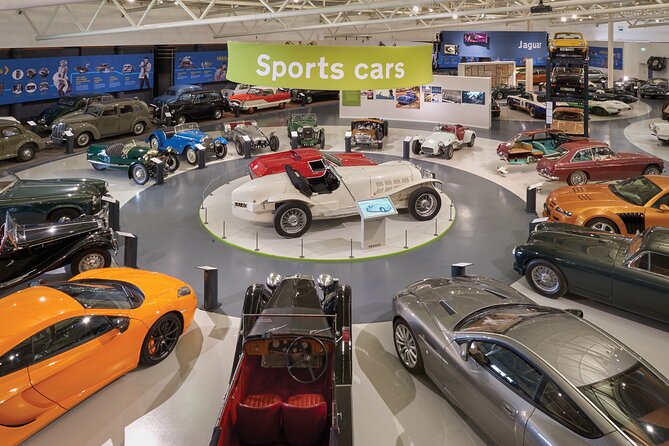
The British Motor Museum in Gaydon packs an astonishing sweep of British motoring into two spacious buildings. You can move from early production cars to famous Jaguars, experimental prototypes, film vehicles, and familiar family cars in a single visit. I like the clear displays and the chance to connect national industry with cars people actually drove. I also like that the staff and volunteers are keen to explain what you are seeing.
You should allow at least two hours, and more if you read every panel or stop for lunch. The one drawback is its focus: if cars do not interest you, the museum may feel like a long walk past a very large number of vehicles.
Key things to know before you go
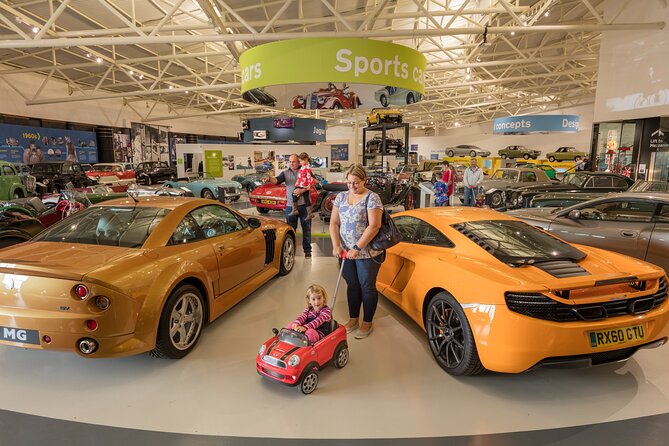
- See Britain’s largest historic car collection: The museum traces British car making across decades, from prototypes and production models to specialist vehicles.
- Look for the Jaguar displays: The Jaguar collection is one of the strongest parts of the visit, with cars that appeal to both serious enthusiasts and casual admirers.
- Expect more than standard road cars: Film vehicles, concept cars, unusual prototypes, older Land Rovers, Minis, Fords, and other memorable models add variety.
- Plan for two buildings: The spacious layout makes it easy to walk around, but the scale means a quick visit can become an unexpectedly long one.
- Use the café as part of your plan: Hot and cold meals, snacks, and well-liked cakes make it practical to stay through lunchtime.
- Book ahead for a simpler arrival: The mobile ticket costs $24.95 per person, and the experience is commonly booked about 12 days before the visit.
Why Gaydon’s museum works so well
Many transport museums show a few prized vehicles and leave you wanting more context. This one takes a broader approach. You see how British cars changed across the decades, but you also see how they fitted into daily life, design, industry, film, and national identity.
That mix gives the museum its appeal. A serious collector can study rare models and prototypes, while someone who simply remembers an old Mini, Ford, Morris Minor, or Land Rover can enjoy a personal trip down memory lane. The collection does not depend only on luxury or racing cars. Familiar vehicles matter here too.
I especially like the way the displays move between the practical and the glamorous. A family car can sit within the story of mass production, while a striking Jaguar or concept car shows what designers hoped the future might bring. You are not just looking at polished metal. You are following the choices that shaped British roads and workplaces.
The museum is also spacious, clean, and modern in feel. That matters more than it sounds. Car museums can become tiring when vehicles are squeezed together in dim rooms. Here, the layout gives you room to stop, read, and take in the shape of each car without constantly being in someone else’s way.
More museums and galleries in England:
- Tower of London and Crown Jewels Exhibition Ticket
★ 4.5 · 6,677 reviews - Chelsea FC Stadium Tours and Museum
★ 5.0 · 1,908 reviews - Official tickets: Moco Modern & Contemporary Art Museum
★ 4.5 · 1,157 reviews
What you see in the two museum buildings
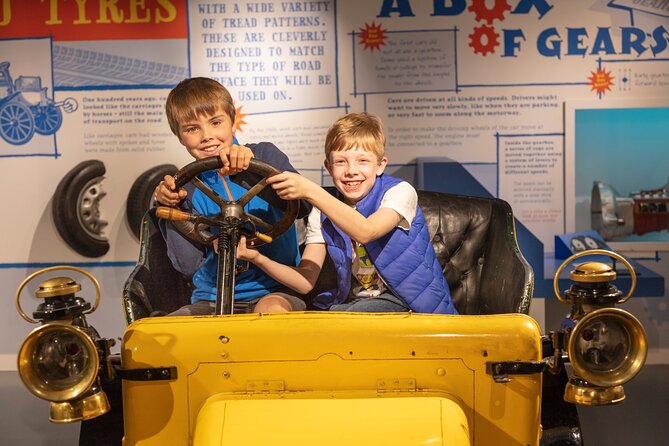
The visit is self-guided, so you can set your own pace. Most people will need around two hours for a solid look, while car enthusiasts can easily stretch the visit toward four hours.
Start by getting your bearings and checking the layout. The collection is arranged so you can work through the story rather than wander without direction. Displays cover prototypes, production cars, and vehicles from different periods of British motoring.
The prototypes are a good early stop because they show the gap between an idea and the car that reaches a showroom. Some designs are elegant, some strange, and some reveal how uncertain the future of motoring once seemed. You can then compare those ideas with the production models that actually made it onto British roads.
The familiar cars often create the strongest connection. You might find yourself pausing over a model owned by a parent, driven during your first job, or remembered from childhood. Several cars have that effect, including older Minis, Fords, Morris Minors, and Land Rovers. These are not just objects for specialists. They are pieces of everyday life.
The displays include explanatory panels for each model, with information on its background and place in British motoring. I recommend reading more than just the name and date. The value of this museum comes from understanding why the cars look and work as they do, and how they fit into wider changes in society.
The Jaguar collection deserves extra time
The Jaguar displays are one of the museum’s biggest draws. Even if you arrive mainly to see ordinary British cars, set aside time for this section.
Jaguar gives the collection a touch of glamour and performance, but the display is still useful for showing design development. You can compare shapes, interiors, and engineering ideas across different periods. For a Jaguar enthusiast, this may be the main event. For everyone else, it adds contrast to the practical family cars elsewhere.
The staff presence can make this area particularly rewarding. One visitor praised the person working around the Jaguar collection for being able to explain the cars in detail. If someone is available when you visit, ask questions. A short conversation can turn a quick look at a beautiful car into a better understanding of what makes it important.
The collection also includes vehicles linked to film and popular culture. These cars change the mood of the visit. You are not only studying factory production and design. You are also seeing how particular vehicles became part of public memory through cinema and television.
Film cars and prototypes keep the displays varied
A museum built only around standard production models could become repetitive. The film cars and prototypes prevent that.
Film vehicles provide an instant point of recognition, even for people who are not deeply interested in engineering. They also show how a car can take on a new role once it appears on screen. A vehicle that was ordinary in a showroom may become memorable because of the story attached to it.
The prototypes offer the opposite kind of interest. They are less familiar, but they reveal the risks and experiments behind the cars you eventually see on the road. Some ideas remain concepts, while others influence later production models. This part of the collection rewards curiosity more than prior expertise.
The variety is one reason family groups often work well here. One person can focus on classic cars, another on Jaguars, another on film vehicles, and a younger visitor can simply pick out the strangest shape in the room. A 13-year-old or 16-year-old with a growing interest in cars should have plenty to hold attention, especially if an adult helps connect the models to everyday life.
A few more things to do in England worth a look
- Thorpe Park Admission Ticket
★ 4.0 · 5,915 reviews - Alton Towers Resort 1 Day Admission Ticket
★ 3.5 · 5,501 reviews - The London Eye Entry Ticket
★ 4.0 · 3,498 reviews - London Eye Fast-Track Ticket
★ 4.5 · 3,456 reviews
Staff, volunteers, and guided help
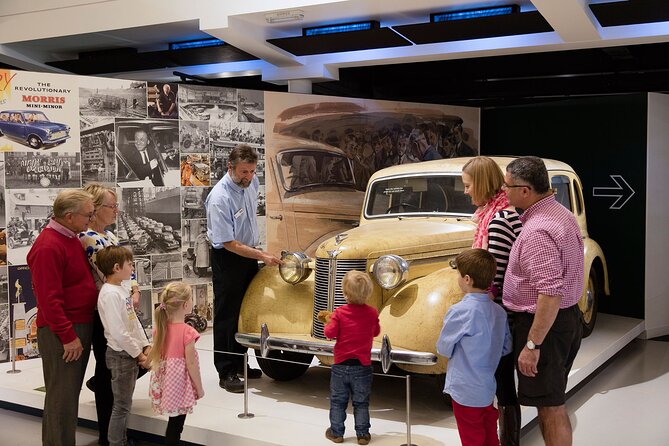
You explore independently, but you are not left on your own. Staff and volunteers are available to answer questions and explain the vehicles. Their enthusiasm is one of the museum’s strongest features.
You may also find a guided tour taking place. One particularly praised guide, Jim, was described as bringing cars to life with stories, technical knowledge, and amusing details. A guided visit with him even allowed some people to sit in or on selected vehicles under supervision. That should not be treated as guaranteed, but it is worth asking at the entrance what tours or talks are running that day.
Another guided explanation was praised for making the collection easier to understand, especially for anyone who prefers a spoken introduction before exploring alone. If you are visiting with a partner or relative who is not a car expert, a tour could help give the day more shape.
The museum is still easy to enjoy without a guide. The written information is plentiful, and you can pause at the cars that matter most to you instead of following a fixed route. That freedom is useful if your group has different interests or energy levels.
How much time should you allow?
For a quick but worthwhile visit, plan on two hours. That gives you time to see the main halls, stop at the Jaguar collection, and read selected displays.
Three hours is a better target for most people. It allows room for the prototypes, film cars, familiar models, and a café break without rushing. If you are restoring vehicles, collecting memorabilia, or simply enjoy comparing models, four hours would not be excessive.
The museum is larger than it first appears. The broad selection can make a short morning disappear quickly. I would avoid scheduling another fixed attraction immediately afterward, especially if you are visiting with a car enthusiast who wants to examine details.
A morning arrival around the stated 10:00 am start gives you the best chance of setting your own pace before the day feels compressed. The ticket is mobile, so you can keep admission details on your phone rather than managing paper.
Is the $24.95 ticket good value?
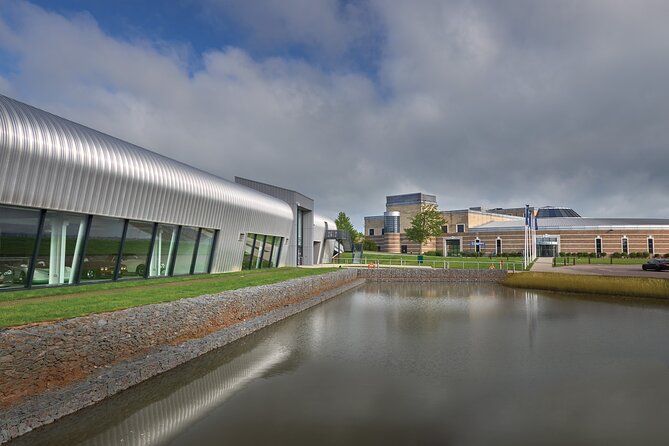
At $24.95 per person, this is not a bargain-basement museum stop, but the price looks fair if you use the visit properly. You are paying for a large collection, two buildings, detailed displays, staff support, and the option to spend several hours on site.
The value improves if you have a genuine interest in British cars, design, or industrial history. A casual visitor who only wants to glance at a few classic cars may feel the admission is less compelling. If you plan to stay for three or four hours, take in the Jaguar displays, and stop for food, the cost becomes easier to justify.
Free parking is another practical advantage. The site is a little off the main tourist path, but it is easy to find and has plentiful parking. That makes the museum more convenient by car than many central-city attractions.
The on-site café also helps. It serves hot and cold meals and snacks, and the food has been praised as good quality, with cakes and even mince pies earning special affection. You do not need to leave the museum to find lunch, which makes a longer visit much easier.
A practical visit for families and older relatives
This is a strong choice for a family day out, especially when different generations can recognise different cars. A grandparent may point out a model they once owned, while a teenager focuses on a Jaguar, prototype, or film vehicle.
The museum is spacious, warm, and clean, with places to take a break. That matters if someone in your group cannot walk continuously for several hours. You can slow down, use the café, and return to the displays rather than trying to force the whole collection into one fast circuit.
Most people can take part, and service animals are allowed. The supplied details do not give a full accessibility guide, so anyone with specific mobility needs should confirm arrangements directly before travelling.
The museum also works well as a birthday gift for a car enthusiast. It offers enough variety to feel like a full outing rather than a short display, and a knowledgeable companion can add plenty through conversation.
Booking, timing, and cancellation
Admission is offered in English, and confirmation is provided when you book. The mobile ticket supports a straightforward arrival, while booking around 12 days ahead is a sensible pattern if you want to secure your plans.
Free cancellation is available up to 24 hours before the experience start time for a full refund. Cancellations or changes made inside that 24-hour window are not accepted for a refund, and the cut-off follows local time.
Because the visit is self-guided, you are not committing to a tight tour schedule. Still, check the start details on your confirmation and arrive ready for a visit that may take longer than expected.
Who should book the British Motor Museum?
Book this if you like classic cars, British design, Jaguars, prototypes, film vehicles, or the story of how cars shaped ordinary life. It is also a smart choice for families with a young car enthusiast, grandparents showing children the cars they once drove, and anyone restoring an older vehicle.
I would be more cautious if your group has little interest in cars. The café and attractive buildings cannot carry the whole experience on their own. This is a museum built around vehicles first.
For the right visitor, the $24.95 admission buys a solid half-day outing with real variety. Give it at least two hours, ask staff about any available tour, and save time for the Jaguar collection and café. If those details appeal to you, book ahead and make the British Motor Museum a planned stop rather than an afterthought.
FAQ
Where is the British Motor Museum?
The museum is in Gaydon, England.
How much does admission cost?
The listed price is $24.95 per person.
How long does the visit take?
The expected visit lasts about 2 to 4 hours.
Is the visit guided?
The experience is designed for independent exploration. Staff and volunteers can answer questions, and guided tours may be available during your visit.
Is the ticket mobile?
Yes. A mobile ticket is provided.
What language is offered?
The experience is offered in English.
What can I see at the museum?
You can see historic British cars, prototypes, production models from different decades, Jaguars, film cars, and vehicles connected with the British motor industry.
Is there somewhere to eat?
Yes. The museum has an on-site café serving hot and cold meals and snacks.
Is parking available?
Free parking is available at the museum.
Can I cancel my booking?
Yes. You can cancel up to 24 hours before the experience start time for a full refund. Changes or cancellations made less than 24 hours before the start time are not accepted for a refund.
Just added in England
- Private Guided Tour of Harry Potter Locations – English/ Italian★ 5.0 · 33 reviews
- 3-Day Stonehenge*, Glastonbury, Bath & the South West Coast Tour from London★ 4.5 · 32 reviews
- Private Tour London Highlights, entries Westminster Abbey, The Tower of London★ 5.0 · 93 reviews
- 2 Hour Walking Tour from Buckingham Palace to Big Ben★ 5.0 · 32 reviews
- 30 Major London Attractions Walking Tour With Photos★ 4.5 · 51 reviews
- 007 Shadow Of Spectre★ 5.0 · 135 reviews
- Private Guided Tour of the British Museum – Tickets Included★ 5.0 · 193 reviews
- Bath, Avebury and Lacock Village Small-Group Day Tour from London★ 4.5 · 121 reviews
Museums, compared.

Liverpool Football Club Museum and Stadium Tour
Read our review →
Tower of London and Crown Jewels Exhibition Ticket
Read our review →
Chelsea Football Club Stadium and Museum Tour
Read our review →


Browse the lists this tour appears in