
Reviewed · ROMAN BATHS TOURS
Bath: Roman Baths Entry Ticket with Audio Guide
The Roman Baths are not just one pool behind a grand façade. They are a full archaeological site, museum, temple precinct, and bathing complex built around Bath’s natural hot springs. I especially like the way the route moves from small personal objects in the museum to the dramatic Great Bath, giving you a clearer sense of the people who used this place.
I also like the excellent audio guide and the freedom to stop whenever you want. The cost is reasonable for the amount on show, but it can feel high for a self-guided visit, especially if you move quickly or skip the commentary. Arrive early if you can, since the rooms become crowded soon after opening.
Key points to know before you go
- The Great Bath is only one part of the site: Allow time for the museum, temple remains, heated rooms, plunge pools, sauna, and Circular Bath.
- The audio guide carries much of the experience: It is available in 12 languages, with a separate handheld BSL video guide.
- The Gorgon’s head is not a simple monster portrait: The display explores whether it represents the mythical Gorgon or a water god.
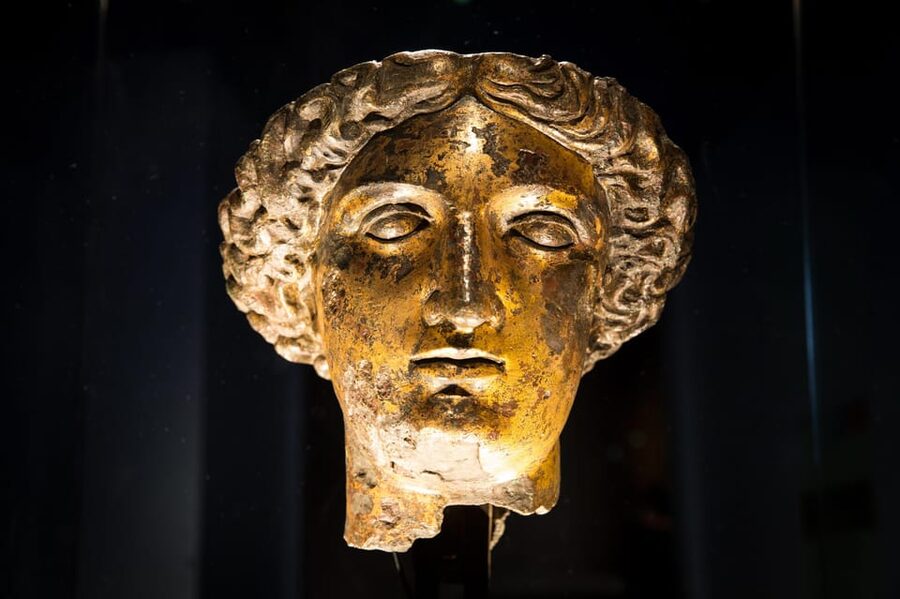
- Sulis Minerva gives the site its spiritual focus: Her gilt bronze head once belonged to the cult statue in the temple.
- Early entry helps: The museum and walkways can become crowded quickly, making the opening time especially useful.
- The spa water tasting is part of the ticket: You can sample water containing more than 43 minerals at a dedicated tap.
Start with the museum, not the pool
Once inside the Roman Baths, I recommend beginning with the museum rather than rushing straight to the famous water. The museum sets up the story of the site and introduces the people who lived in Roman Britain through objects they left behind.
The audio guide gives you a clear route and labels each main point. You can listen in English, Dutch, French, German, Italian, Japanese, Chinese, Korean, Polish, Russian, Portuguese, or Spanish. A handheld BSL video guide is also available.
The commentary is detailed without forcing you to keep moving. I like that you can pause, repeat information, or leave a section and return later. The route is marked with arrows, so you do not need to guess where to go next.
There is also a children’s version of the audio tour. It can make the visit easier for families, especially when younger children are more interested in characters and stories than display text. The adult and children’s versions contain different information, so families with enough time may find it worthwhile to sample both.
The handheld audio unit is simple to use, but it is not worn as headphones. You hold it up to listen, and that can become tiring over a long visit. One practical complaint is that holding the device for the full route may bother your shoulder or leave you wishing your hands were free, particularly if you are also managing children.
Other Roman history near Bath:
- Bath: City Walking Tour with Optional Roman Baths Entry
★ 4.7 · 1,401 reviews - Roman Baths and Bath City Walking Tour
★ 4.5 · 762 reviews - Bath: Guided City Walking Tour with Entry To The Roman Baths
★ 4.8 · 343 reviews
Meet the Gorgon above the temple
One of the museum’s most arresting objects is the Gorgon’s head. It once decorated the temple pediment, where it looked down from about 15 metres above people approaching the sacred area.
The interesting part is that the identification is not settled. You can consider whether this is really the mythical Gorgon or a representation of a water god. That uncertainty gives the object more force than a simple label would. You are looking at a large, powerful face that helped shape how people understood the goddess and the spring.
The display works well with the audio commentary because you get both the physical details and the wider religious setting. The baths were not simply a place to wash. They formed part of a religious spa where people came to seek healing and worship Sulis Minerva.
See the gilt bronze head of Sulis Minerva

The gilt bronze head of Sulis Minerva is another essential stop. This finely made head once belonged to the cult statue of the goddess in her temple.
I find it useful to think of this object as the site’s spiritual anchor. The Great Bath is the image most people carry away, but Sulis Minerva explains why the complex mattered. People came to the hot springs because the water was linked to divine healing, and the goddess watched over that sacred space.
The head is displayed as an object of skill as well as belief. Its commanding expression helps you picture the original statue and the effect it would have had inside the temple. This is one of the moments when the museum shifts from showing ruins to helping you imagine the complete Roman site.
Walk into the Great Bath

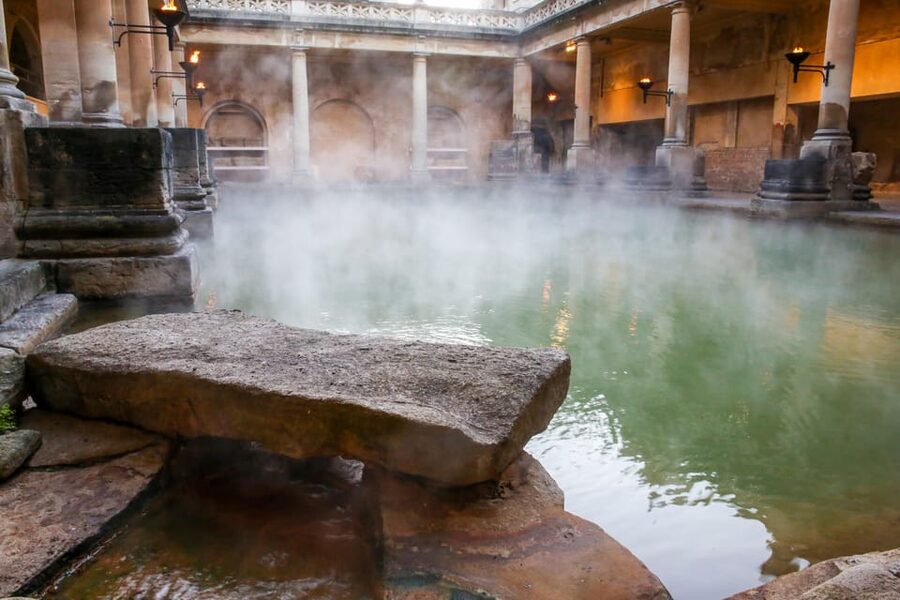
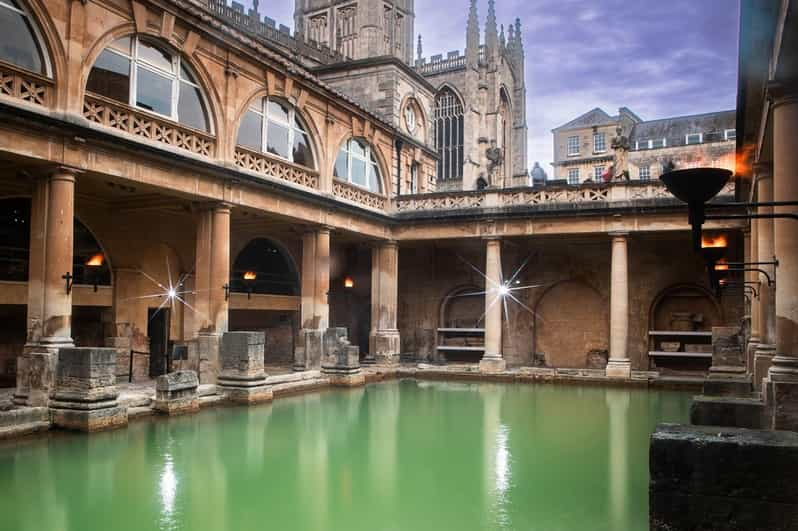
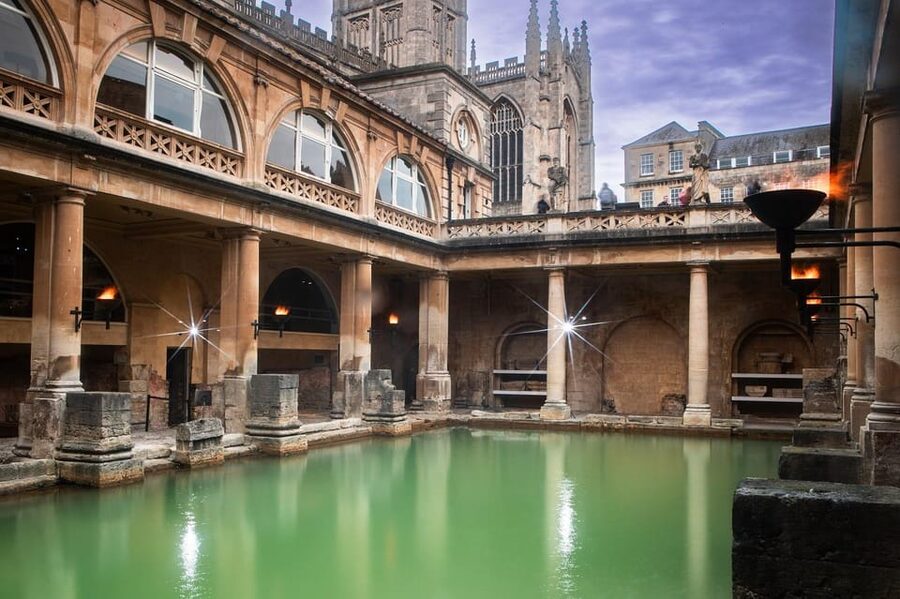
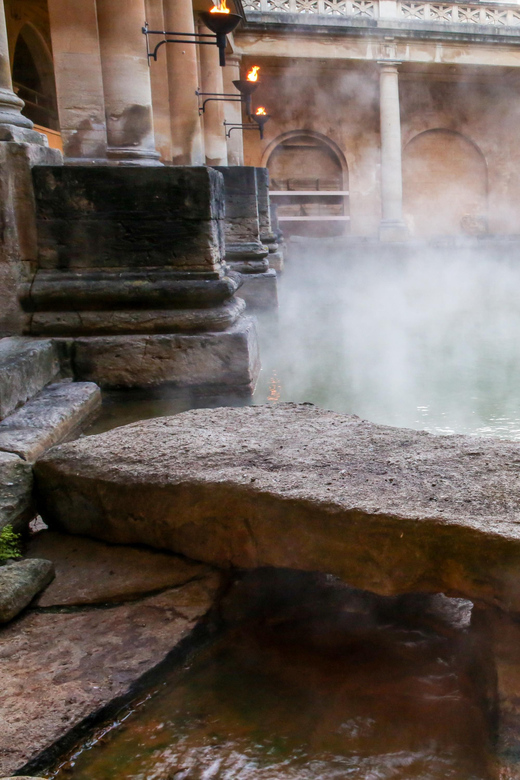
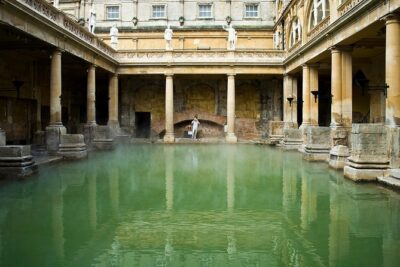
After the museum, the route opens onto the Great Bath. This is the moment most people anticipate, and it delivers the familiar view: warm greenish water, Roman stonework, and the rooftops of modern Bath above the open courtyard.
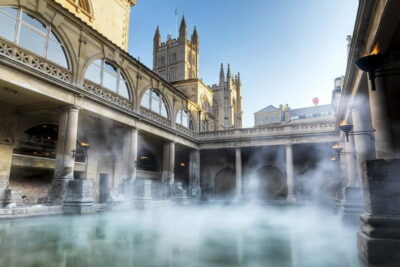
A stone walkway surrounds the bath, allowing you to see the pool from several angles. On a cold morning, steam can rise from the warm water and make the scene especially atmospheric. The water looks inviting, but you cannot use the bath. The value here is seeing the pool in its original setting and understanding its scale.
The Great Bath is also where the ancient and modern city meet most clearly. You are looking at Roman paving and masonry while Bath’s later buildings rise around it. The site is not isolated in a field. It sits in the middle of the city, with the present-day streets and rooftops directly above the remains.
Take your time here, but do not stop only at the first viewpoint. The audio guide adds useful context, and different parts of the walkway give you different views of the water and surrounding stonework.
A few more things to do in Bath worth a look
- London: Emirates Stadium Entry Ticket and Audio Guide
★ 4.7 · 5,513 reviews - London: British Museum Audio Tour & Priority Entrance Ticket
★ 4.5 · 631 reviews - Western Approaches Self Guided Tour
★ 5.0 · 505 reviews - Canterbury Cathedral: Entry Ticket with Audio Guide
★ 4.6 · 266 reviews
Follow the heated rooms and bathing spaces
The Great Bath is the headline, but the rest of the complex explains how the baths worked. Continue into the East Baths, where you can see heated rooms and facilities linked to massage.
The Roman bathing routine involved more than sitting in warm water. The sequence of rooms, temperature changes, exercise, cleansing, and treatment made the baths an important social and physical space. The site’s displays help you see the building as an operating complex rather than a single ancient pool.
You can also visit the Roman Gym and the ancient sauna, known as a laconicum. The names may sound formal, but the basic idea is easy to grasp: different rooms served different stages of bathing and exercise.
The West Baths add plunge pools, giving you a sharp contrast with the hot spring water. The Circular Bath completes the route with another distinctive bathing area. I like this part of the visit because it rewards patience. If you only photograph the Great Bath, you miss much of the engineering and layout that made the site special.
Subtle video projections are used in parts of the site to suggest how the Romans lived and used the baths. These do not replace the ruins. They help fill in missing walls, people, and activity without turning the place into a theme park.
Let the audio guide set your pace
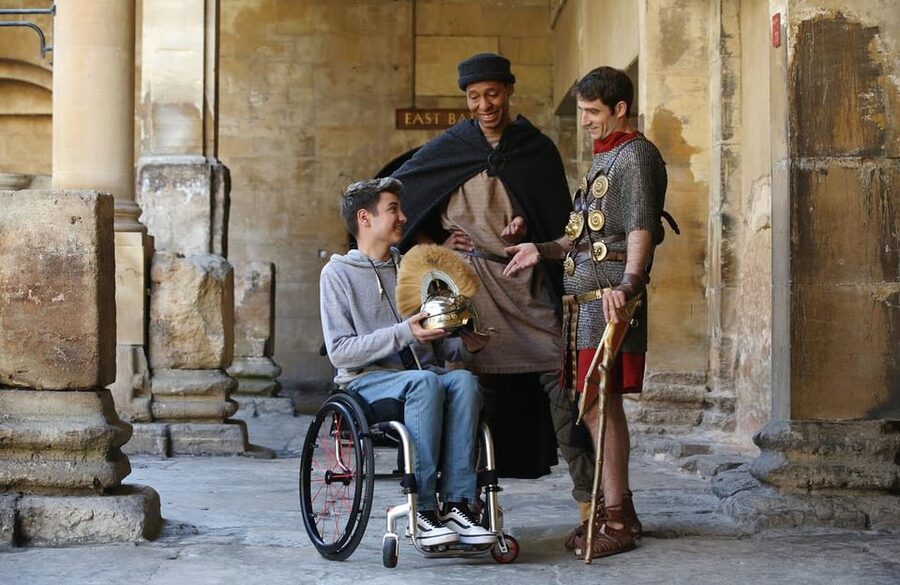
This is a self-guided visit, and that affects the experience in useful ways. You are not tied to a group schedule, so you can spend longer at the objects that interest you and move faster through sections that do not hold your attention.
I find the audio guide particularly helpful because the site contains a lot of information. Reading every panel would take time and can make the visit feel stop-start. Listening lets you keep looking at the masonry, objects, and reconstructions while receiving the explanation.
The route is easy to follow, with numbered points and directional signs. Seating is available at several points, which matters if you have a leg problem or simply need a break. One visitor needed about two and a half hours to take the site at a comfortable pace, so I would not schedule this as a quick 45-minute stop.
The main drawback is crowding. The walkways and museum rooms can feel tight when several groups arrive together, and the Great Bath loses some of its calm when surrounded by people. An early time is a smart choice. The site can become busy soon after opening, and early visitors have a better chance of pausing at the main displays.
Taste the spring water before leaving

Near the end of the visit, you can sample the spa water from a dedicated drinking tap. The water contains more than 43 minerals and has attracted people to Bath for centuries because of its claimed healing properties.
The tasting is brief, but it connects the modern visit with the reason people came here in the first place. You are not simply looking at an old pool. You are sampling the same natural spring source that gave Bath its religious and medical importance.
The flavor may not suit everyone. Mineral water can taste noticeably different from ordinary drinking water, so treat this as a small historical experience rather than a refreshment stop. If you need a longer rest or a comfortable drink break, the tasting point itself may not provide the most relaxing setting. One useful improvement would be a dedicated seating area nearby, especially for older visitors.
Is the $30.31 ticket good value?
At $30.31 per person, this is not a cheap museum admission. It is also more substantial than a short look at one archaeological feature.
Your ticket covers the Roman Baths, the museum, the audio guide, and the spa water tasting. The route includes major Roman remains, several bathing areas, religious objects, video projections, and access to a carefully arranged indoor and outdoor circuit.
I think the price works best when you give the visit time. If you rush through the museum, glance at the Great Bath, and leave after an hour, the cost may feel steep. If you listen to the commentary and explore the East Baths, West Baths, gym, sauna, and Circular Bath, the value becomes clearer.
You are paying for interpretation as much as for entry. The audio guide explains what the stones cannot show on their own. It also means you do not need to pay separately for a guided tour, since the recorded commentary covers the main route.
The ticket is valid for one day, but the supplied information does not list a fixed visit duration or a separate timed tour schedule. Check the available entry time when booking and remember that last entry is one hour before closing.
Access, bags, and practical planning

The Roman Baths are about 90 percent accessible to wheelchair users, and elevators help you reach different levels. That makes the site possible for many visitors with mobility needs, although the figure also means that some parts may not be fully accessible.
The attraction does not allow pets, baby strollers, or luggage and large bags. Plan to arrive with only what you need for the visit. This is especially important for families, since a stroller cannot be brought inside.
The meeting point is simple: go to the Roman Baths and redeem your voucher there. The visit finishes back at the same site. There is no transport segment or separate meeting point to manage.
This is a small-group activity category, limited to six participants, but the actual visit is self-guided rather than a private guided tour. You should still expect other people inside the public attraction, especially at popular times.
The site works in any weather because much of the museum is indoors, while the Great Bath and parts of the ruins are open to the air. Comfortable shoes are sensible, since the route covers several levels and includes plenty of standing and walking.
The shop is worth a quick look if you enjoy museum merchandise. It carries jewellery, prints, books, homeware, games, and bathing products inspired by the collection. You can also find goods from local independent makers, including honey, botanical gin, and handmade soaps.
Who will enjoy the Roman Baths most?
I would choose this for anyone interested in Roman engineering, ancient religion, archaeology, or the story behind Bath itself. It is also a strong choice for families with children around eight and older, since the children’s audio guide and visual displays give younger visitors more to do.
You will get the most from it if you enjoy setting your own pace. The audio commentary is extensive, and the route contains far more than the famous pool. If you prefer a short, informal attraction with little reading or listening, this may feel too detailed.
People with limited stamina can still manage the visit, thanks to seating and elevators, but allow plenty of time and take breaks. The handheld audio unit may be less comfortable if you need both hands free or have shoulder trouble.
I would also recommend this to first-time visitors to Bath who want context before exploring the rest of the city. The baths explain the spring, the goddess Sulis Minerva, and the reason this settlement became important long before Bath’s Georgian streets were built.
Should you book the Roman Baths entry ticket?
Yes, if you want more than a quick photo of the Great Bath. The museum, Gorgon’s head, Sulis Minerva, heated rooms, plunge pools, sauna, and audio commentary make this a substantial visit, not a single-room attraction.
Book it if you value freedom to move at your own pace and can give the site around two hours or more. Choose an early entry time to reduce crowding, and remember that the ticket is non-refundable.
I would hesitate only if you dislike audio guides, need a very short activity, or expect to bathe in the water. For most people spending time in Bath, this is one of the clearest ways to understand the city’s ancient foundation.
FAQ
How long is the Roman Baths ticket valid?
The ticket is valid for one day. Check the available entry times when booking.
Is an audio guide included?
Yes. An audio guide is included in English, Dutch, French, German, Italian, Japanese, Chinese, Korean, Polish, Russian, Portuguese, and Spanish.
Is there a BSL guide?
Yes. A handheld BSL video guide is available.
Can I enter the Great Bath?
You can walk around the Great Bath and view it from the surrounding stone walkway, but the activity information does not state that visitors can enter or bathe in it.
Can I taste the spa water?
Yes. A spa water tasting from a dedicated drinking tap is included. The water contains more than 43 minerals.
Is the Roman Baths accessible by wheelchair?
The Roman Baths are 90 percent accessible to wheelchair users, and elevators are available to help with different levels.
Can I bring a stroller, pet, or large bag?
No. Pets, baby strollers, luggage, and large bags are not allowed.
What happens if I arrive near closing time?
Last entry is one hour before closing. Plan to arrive earlier so you have enough time to see the museum and bathing complex.
Just added in Bath
- Bath Tootbus Hop-on Hop-off Sightseeing Bus Tour★ 4.5 · 247 reviews
- Fun, Flexible Treasure Hunt Around Bath with Cryptic Clues & Hidden Gems★ 5.0 · 208 reviews
- ‘Stonehenge & Secret England’ from Bath for 2-8 curious adventurers★ 5.0 · 54 reviews
- BATH: 2-Hour Bath Walking Tour of Bridgerton Filming Locations★ 5.0 · 99 reviews
- Jane Austen’s Bath And History Trail★ 5.0 · 77 reviews
- Private Day Tour from Bath to the Captivating Cotswolds★ 5.0 · 51 reviews
- Stonehenge and Bath City Tour – Private tour from Bath★ 5.0 · 33 reviews
- The ‘Hidden Cotswolds’ Shared Tour from Bath for 2-8 people★ 5.0 · 83 reviews
Roman Baths Tours, compared.

Windsor, Stonehenge, Bath, and Roman Baths Day Trip
Read our review →
Stonehenge and Bath Day Trip from London with Optional Roman Baths Visit
Read our review →
City Walking Tour with Optional Roman Baths Entry
Read our review →
Stonehenge, Bath, Windsor and Roman Baths London Day Tours
Read our review →
Roman Baths Entry and Walking Tour with Blue Badge Tour Guide
Read our review →Browse the lists this tour appears in