
Reviewed · TOURS IN NORTHERN IRELAND
Belfast Troubles Tour: Walls and Bridges
Belfast’s past is written on its walls, murals, churches, and streets. This walking tour takes you from grand City Hall to the Peace Wall, then back through old lanes and modern neighborhoods, using the city itself as the classroom. I like the local perspective and the fact that guides such as Arthur Magee and Steve bring personal experience to a painful subject. I also like that the route covers Belfast beyond the Troubles, including music, industry, architecture, and the city’s hopeful future.
The main consideration is emotional weight. You’ll hear graphic descriptions of violence, and some stories are difficult. The walk lasts close to three hours and involves a fair amount of walking, so this suits you best if you want serious history rather than a light sightseeing stroll.
Key points to know before you book
- The Peace Wall is the emotional center: You have time to study the barriers, photograph them, and hear why they were built.
- Local guides give the tour its character: Arthur Magee and Steve are praised for personal stories, humor, balance, and clear explanations.
- It covers more than the Troubles: City Hall, the Cathedral Quarter, Belfast Entries, the Albert Clock, and First Presbyterian Church broaden the picture.
- It is a private tour: The maximum group size is 16, and the description identifies the experience as private.
- Expect serious material: The tour is for ages 14 and up and includes graphic content.
- The price buys time and context: At $33.29 per person for roughly three hours, it offers a useful introduction to Belfast’s recent past and present.
Why this walk matters in Belfast
You can see Belfast’s famous sights in an hour or two, but the city’s hardest questions take longer. Why are some neighborhoods still marked by flags and murals? Why does a wall remain in a city that has had peace for decades? What do Unionist and Nationalist identities mean in daily life?
This tour takes those questions seriously. It does not treat the Troubles as a simple tale of two sides, and it does not stop at political slogans painted on brick. You move through places connected to division, listen to explanations of religion, politics, economics, and identity, and then return to parts of central Belfast that point toward a different future.
The title, Walls and Bridges, gives you the basic idea. Walls refer to the physical barriers and the divisions people create between communities. Bridges refer to the effort needed to understand neighbors, question prejudice, and build a shared future.
That balance is one of the tour’s strongest features. You hear about conflict, but you also see Belfast’s churches, music scene, old passageways, industry, and changing city center. The result is a fuller picture than a tour devoted only to murals and barricades.
Other tours people book in Belfast:
- Titanic Belfast Entrance Ticket: Titanic Visitor Experience Including SS Nomadic
★ 4.5 · 3,698 reviews - Cab Tours Belfast Famous Black Taxi Tours
★ 5.0 · 3,633 reviews - A History of Terror – Belfast City Centre Walking Tour
★ 5.0 · 2,883 reviews
Starting at City Hall with Belfast’s grandest building
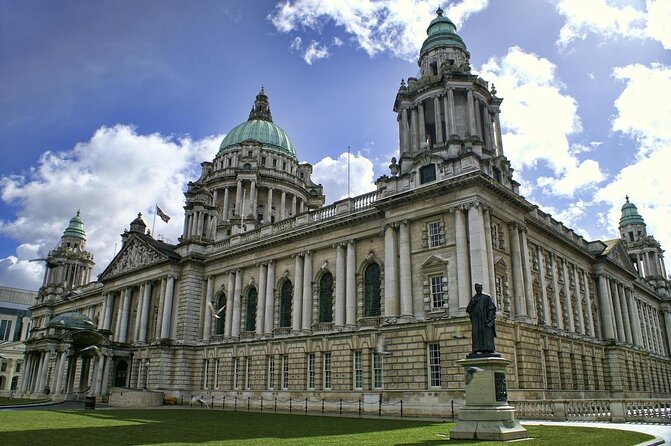
The walk begins at Belfast City Hall, an easy meeting point in the center. The building is not just a place to gather. It helps explain the confidence and wealth Belfast once drew from industry and commerce.
The dome rises 174 feet, and the interior uses several kinds of marble, including Italian marble and Cipollino marble from Greece. Stained glass adds another layer of display. Even if you only pause outside, the building makes a strong first impression.
I like beginning here because the tour does not open with violence. You first see the civic pride of the city, then learn how Belfast’s political and social divisions developed around that world. It gives you a broader frame before the walk reaches the Peace Wall.
The first stop is brief, around 10 minutes. That is enough for an explanation and some photographs, but not enough for a long architectural visit. If you want to explore City Hall’s interior in detail, you may need separate time.
City-center symbols, including the Big Fish and Albert Clock
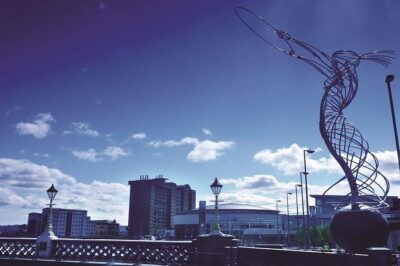
The route includes the Big Fish, a modern sculpture by Dan George near the center of Belfast. Its Celtic design reflects the city’s engineering, industry, and communities. It is a quick stop, but it helps shift your attention from the conflict to Belfast’s wider identity.
You also visit the Albert Memorial Clock, often called Belfast’s leaning tower. It rises 113 feet and leans about four feet from the perpendicular because of the ground beneath it. The tower marks the area around which Belfast developed and includes a statue of Prince Albert.
The clock has a place in film history too. It appeared in Odd Man Out, the 1947 film noir starring James Mason. The stop lasts only about five minutes, so treat it as a sharp piece of local context rather than a full attraction visit.
These details matter because Belfast is not only a political story. Its buildings reveal ambition, industry, civic pride, and the city’s place in popular culture. The tour keeps reminding you of that.
Murals on Divis Street and the story told in paint
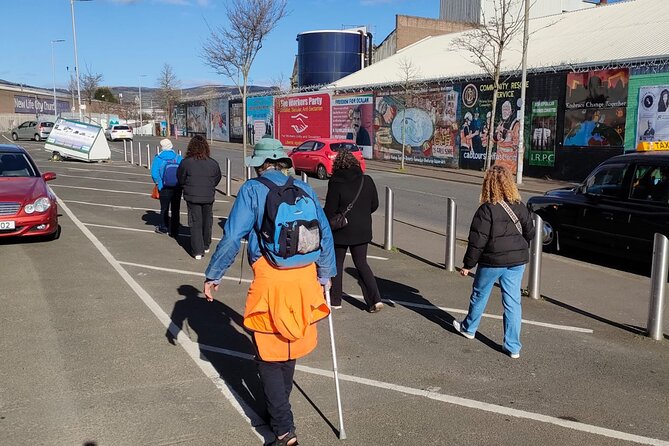
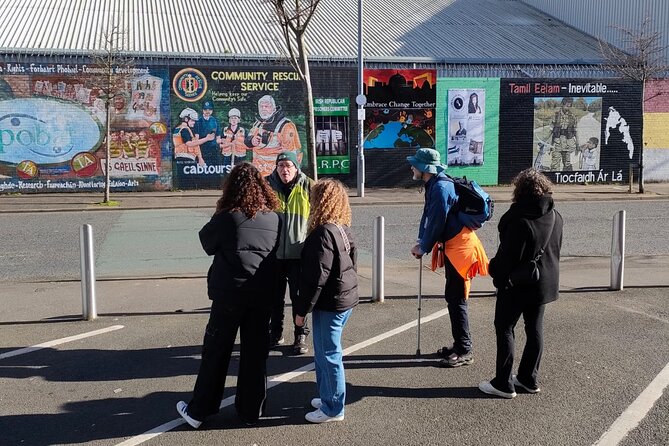
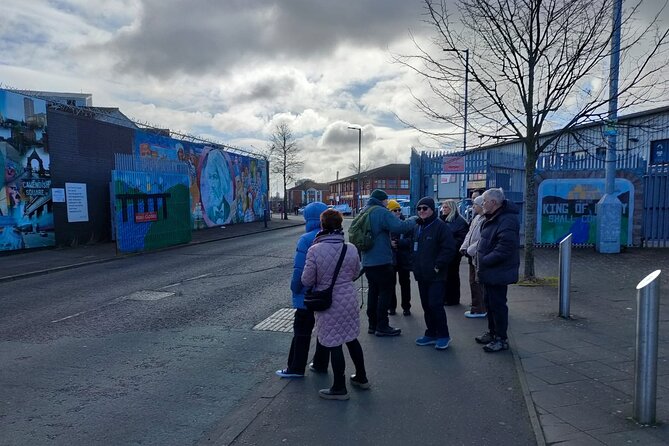
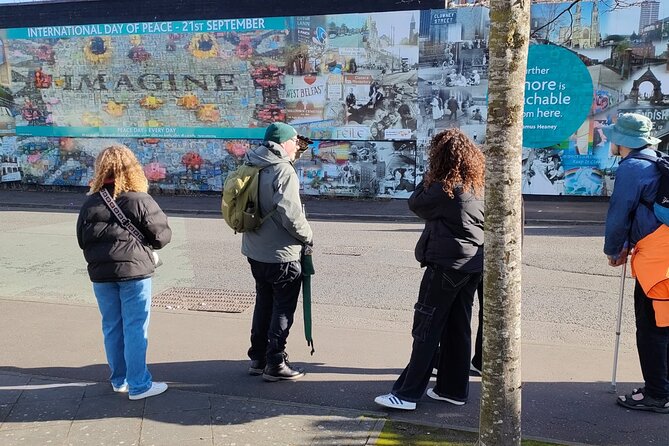
Near Divis Street, you see part of the International Wall of Murals. Murals in Belfast are not merely decoration. They have served as political messages, memorials, statements of identity, and a way for communities to speak to the outside world.
The guide explains the images and their setting rather than leaving you to guess what you are seeing. That is important. A mural can look powerful in a photograph but lose its meaning if you do not know who created it, which community it represents, or what event it refers to.
You have around 10 minutes here. It is enough to examine the artwork and take photographs, although the material may feel stark. The walk does not present every mural as a neutral artwork. It asks you to consider how visual symbols can preserve memory, reinforce division, or create a public conversation.
This is also where a local guide adds real value. A map or audio recording can identify dates and groups. A person who has lived through the period can explain how the atmosphere affected ordinary life.
Same city, a very different afternoon:
- Game of Thrones and Giant’s Causeway Full-Day Tour from Belfast
★ 5.0 · 2,291 reviews - Private Black Taxi Belfast City Tour
★ 5.0 · 2,188 reviews - City Sightseeing Belfast Hop-On Hop-Off Bus Tour
★ 4.5 · 2,012 reviews - Giants Causeway & Castles Tour from Belfast: Guided tour
★ 5.0 · 1,432 reviews
At the Peace Wall, the tour becomes more personal
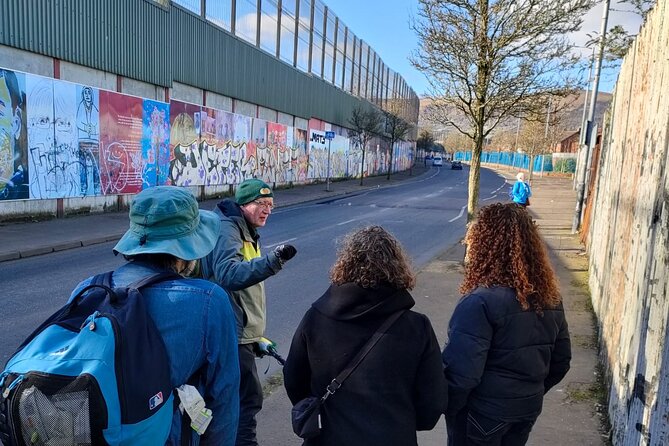
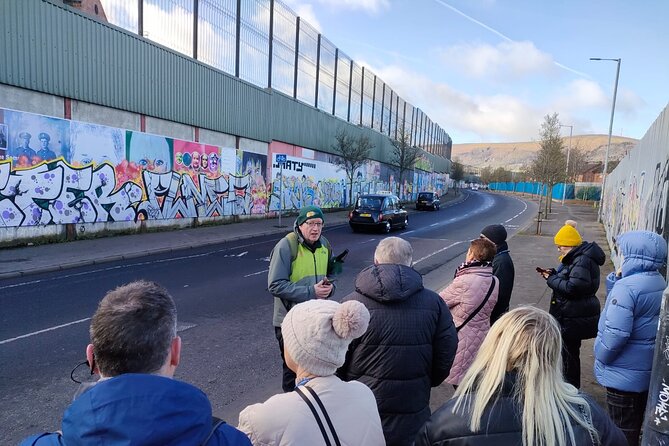
The Peace Wall is the central stop. These barriers separate communities and reach about 16 metres high, with mesh at the top that was designed to stop petrol bombs. You have roughly 15 minutes to look carefully, take photographs, and hear why the walls were built.
The physical scale surprises many people. A wall that high is not a symbolic line painted on a road. It is a major barrier cutting through neighborhoods. Even after hearing the historical explanation, seeing it at close range gives the subject a harder edge.
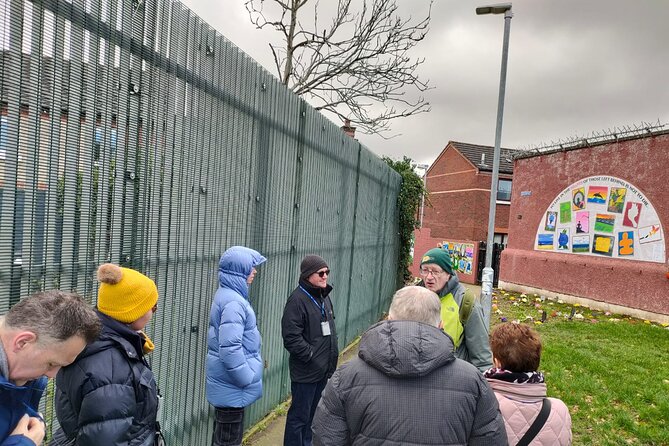
The tour also brings you through areas associated with both sides of Belfast’s divide. That matters because it avoids the easy habit of treating one neighborhood as the whole story. You are encouraged to consider how fear, discrimination, political belief, religion, and personal experience shaped lives on both sides.
Arthur Magee is especially well suited to this kind of conversation. He is described as having lived through the Troubles and uses personal memories alongside history and politics. His humor can make a difficult walk easier to follow, but the material remains direct. The humor is not used to dismiss the suffering.
Headsets may be provided so you can hear the guide clearly while walking. That is useful near roads or in a group, though you should still expect an outdoor walking experience rather than a quiet museum visit.
The Cathedral Quarter shows another Belfast
After the walls and murals, the walk moves back toward the city center and the Cathedral Quarter. This district has cobbled streets, colorful murals, old entries, pubs, and restaurants. It is now one of Belfast’s main social areas and has strong links to music and nightlife.
The stop lasts about 10 minutes. You will not have time for a meal or a full pub visit during the tour, but you get a sense of how the center has changed. The district helps make an important point: Belfast is not frozen in the years of conflict.
You may still see reminders of politics and identity here, but the mood is different from the Peace Wall. It is a place where people gather, listen to music, eat, and spend an evening. That contrast helps you understand the city’s present without pretending that the past disappeared.
Belfast Entries and the streets most people miss
The Belfast Entries are historic passageways tucked between larger streets. You might walk past them without noticing, which is why a guide is useful. The route winds through these narrow lanes, connecting them with stories of revolution, intrigue, trade, and pubs.
This is one of my favorite parts of the itinerary because it changes the scale of the tour. The Peace Wall is large and unmistakable. The entries are small, easy to miss, and full of clues about how people moved through old Belfast.
The stop lasts about 10 minutes. It is not a major attraction in the usual sightseeing sense, but it gives the walk texture. You begin to notice the city as a collection of layers rather than a series of famous monuments.
First Presbyterian Church offers a different ending
The final stop is First Presbyterian Church on Rosemary Street, within sight of City Hall. The church dates from 1783 and has an elliptical interior that John Wesley admired when he preached from its pulpit.
This is an especially useful stop because it complicates the familiar story of religious division. The church’s members took important positions on civil and religious freedom, showing that Belfast’s political history cannot be reduced to a simple Catholic and Protestant split.
You have around 10 minutes to look inside and take photographs. The building provides a calm setting after the more difficult material at the Peace Wall. It also puts the end of the walk close to the starting point, which is convenient if you have plans elsewhere in the city.
The church is included in the tour, but the visit is still short. If you care deeply about religious architecture or Irish political history, you may want to return later with more time.
What the guide adds to the experience
The guide is the main reason to choose this walk over a self-guided route. The subject is too complicated for a few plaques and a mural map. You need someone who can explain terms, answer questions, and show how public events affected daily life.
Arthur Magee receives especially strong praise for his storytelling, humor, and direct approach. Steve is also noted for informative commentary and personal stories. The supplied information does not promise a specific guide for every departure, so you should not book on the assumption that one particular person will lead your walk.
The best guides on this route do several things well:
- They explain the background before discussing the conflict.
- They present competing experiences without pretending every claim has equal weight.
- They use humor carefully, as a way to keep people listening rather than to make light of suffering.
- They connect politics with economics, music, religion, and ordinary life.
- They leave room for questions and further discussion.
The tour has a maximum of 16 people and is described as private. That should allow more direct contact with the guide than a large bus tour. If you want a quiet, fully individual experience, confirm the group arrangement when booking, since the listed maximum is still larger than a one-to-one tour.
Price, pace, and who should book
At $33.29 per person, the price is fair for a walk lasting about two hours and 40 minutes to three hours, especially because it includes a local professional guide and covers several parts of Belfast. You are paying for interpretation, not entry fees. Most stops are outdoors and free, with First Presbyterian Church listed as included.
The value is strongest if you are new to Belfast or know only the basic outline of the Troubles. In one walk, you get the main context, several landmarks, personal commentary, and a look at both painful divisions and the city’s present-day direction.
The pace is steady rather than rushed, but you should have moderate physical fitness. There is a fair amount of walking, and the route includes streets, lanes, and outdoor stops. Wear comfortable shoes and bring clothing suited to Belfast’s changeable weather, though the supplied details do not specify a particular dress requirement.
This is not a family entertainment tour. The minimum age is 14, and graphic content is included. Teenagers and adults who are ready for difficult material may find it worthwhile. Younger children are not the target audience.
You can cancel for a full refund up to 24 hours before the start time. If the minimum number of participants is not reached and the tour is canceled, you will be offered another date or experience, or a full refund.
Should you book the Walls and Bridges walk?
Book it if you want to understand Belfast rather than simply photograph it. The Peace Wall and murals are powerful on their own, but the guide’s context makes them far more meaningful. The visits to City Hall, the Albert Clock, the Cathedral Quarter, Belfast Entries, and First Presbyterian Church also keep the tour from becoming a single-subject account of violence.
Skip it if you want a relaxed sightseeing stroll with no graphic material or political discussion. This is a serious walk, and some parts may stay with you after the tour ends.
For most first-time visitors with an interest in modern Irish history, I would choose this early in a Belfast stay. It gives you a framework for the city, and you can then return to places that deserve more time. Go with an open mind, expect blunt facts, and allow close to three hours. The result is a more honest understanding of Belfast, including its wounds, its contradictions, and its effort to build bridges.
FAQ
Where does the Belfast Troubles Tour begin?
The tour begins at Belfast City Hall, Belfast BT1 5GS, United Kingdom.
Where does the tour end?
It ends at First Presbyterian Church on Rosemary Street, Belfast BT1 1QB, within sight of Belfast City Hall.
How long does the tour last?
The walk lasts approximately two hours and 40 minutes to three hours.
What language is the tour offered in?
The tour is offered in English.
How much does the tour cost?
The listed price is $33.29 per person.
Is the tour private?
The experience is described as a private tour, with a maximum of 16 travelers.
What places are included?
Stops include Belfast City Hall, the Big Fish, the International Wall of Murals near Divis Street, the Peace Wall, the Albert Memorial Clock Tower, the Cathedral Quarter, Belfast Entries, and First Presbyterian Church.
Is the tour suitable for children?
The minimum age is 14. The tour is not aimed at children and includes graphic content.
How much walking is involved?
You should expect a fair amount of walking and have a moderate level of physical fitness.
Can I cancel for a refund?
You can cancel at least 24 hours before the start time for a full refund. Cancellations or changes made less than 24 hours before the start time are not refunded or accepted.
Just added in Belfast
- Best of Belfast Walking Tour★ 5.0 · 399 reviews
- Belfast Political Tour-Conflicting Stories Walking Tour★ 4.5 · 459 reviews
- Belfast Eclectic Walking City Center Experience, The Marti Way★ 5.0 · 348 reviews
- Guided Day Tour of Giant’s Causeway from Belfast by Comfortable Coach★ 5.0 · 740 reviews
- From Belfast: Game of Thrones, Iron Islands & Giant’s Causeway★ 5.0 · 923 reviews
- Belfast’s Political Mural Taxi Tour★ 5.0 · 1,180 reviews
- Belfast black taxi tours★ 5.0 · 1,166 reviews
- Giants Causeway & Castles Tour from Belfast: Guided tour★ 5.0 · 1,432 reviews
Tours in Northern Ireland, compared.
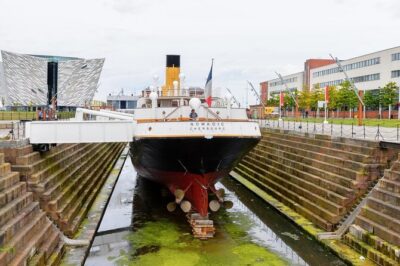
Titanic Belfast Entrance Ticket: Titanic Visitor Experience Including SS Nomadic
Read our review →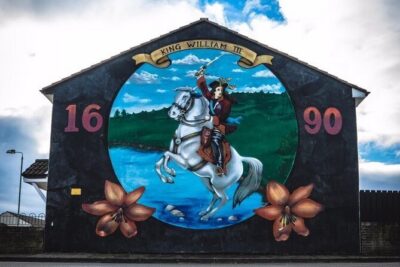
A History of Terror – Belfast City Centre Walking Tour
Read our review →
Game of Thrones and Giant’s Causeway Full-Day Tour from Belfast
Read our review →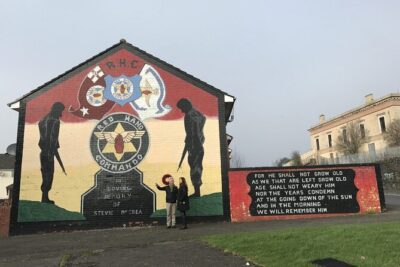
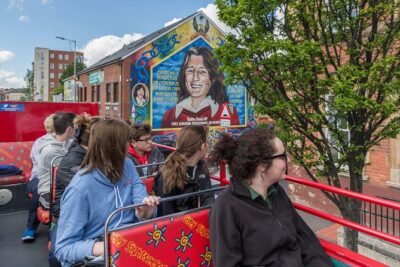
City Sightseeing Belfast Hop-On Hop-Off Bus Tour
Read our review →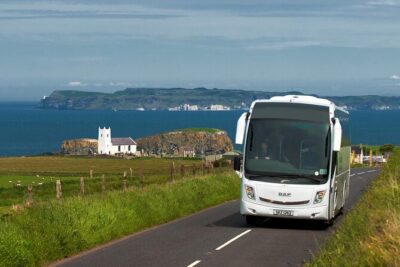
Giants Causeway & Castles Tour from Belfast: Guided tour
Read our review →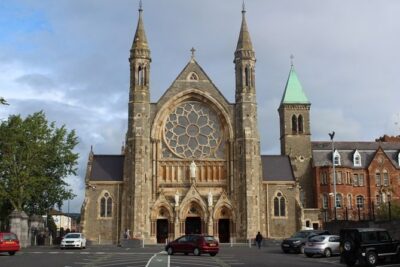
Browse the lists this tour appears in