Reviewed · TOURS IN LONDON
Booze, Brothels & the Bard: London’s Bawdy Borough
Southwark’s old nickname, London’s Bawdy Borough, is not empty marketing. For centuries, this patch of south London sat outside the City’s control, making it a useful home for brothels, prisons, theaters, taverns, and other activities that respectable authorities preferred not to see. This walking tour follows that unruly past from Borough Station to Shakespeare’s Globe.
I like the small group limit of 15, which makes it easier to hear the guide and ask questions. I also like the way the stops connect several sides of Southwark: medieval prostitution, Dickens, Shakespeare, old prisons, market life, and the remains of a bishop’s palace. The possible drawback is that many sites are viewed from outside, and the Globe itself requires a separate ticket if you want to go in.
Key points to know before you book
- Two miles in two hours: The route is manageable, but it is a continuous walking tour with frequent stops.
- A darker side of London: Expect frank discussion of prostitution, prisons, crime, poverty, and public punishment.
- Tom Currie’s guiding style: Tom is friendly, clear, witty, and happy to take questions, based on his recent tours.
- Mostly exterior sightseeing: The tour shows the locations and surviving fragments, but entry tickets are not included.
- A strong route for first-time visitors: You get useful bearings around Borough Market, London Bridge, Bankside, and the Globe.
- Best for ages 13 and up: The themes and language are aimed at older children and adults.
Why Southwark earned its bawdy reputation
Begin outside Borough Station on Borough High Street, where your guide will wait with a Historic London Tours sign. This is a practical meeting point, close to the start of the route and easy to find by Underground.
The first thing to understand is Southwark’s legal position. For much of its past, the area lay beyond the authority of the City of London. That mattered. Activities restricted or pushed out elsewhere could operate here, including brothels, theaters, gambling houses, taverns, and prisons.
The tour uses this setting to explain more than scandal. You see how power worked in medieval and early modern London, how institutions controlled people, and how ordinary residents lived beside places of punishment and entertainment. The adult subject matter gives the tour its hook, but the wider story is about law, money, religion, and social class.
The guide’s job is important here. A list of dates would quickly become dull. Tom Currie has been praised for giving concise explanations, answering questions, and using humor without losing the thread. That suits a two-hour walk, where you need enough detail to make the places memorable without being buried in it.
Other tours people book in London:
- From London: Harry Potter Warner Bros Studio Tour
★ 4.7 · 26,588 reviews - Magical London: Harry Potter Guided Walking Tour
★ 4.7 · 22,044 reviews - London: Madame Tussauds London
★ 4.6 · 20,915 reviews
Marshalsea Prison and the real cost of debt
The first major stop is the site of Marshalsea Prison. Only fragments remain, so you are not entering a complete prison complex. That limitation matters, but the surviving evidence gains force when a guide explains what once occupied this part of Southwark.
Marshalsea is closely tied to Charles Dickens, whose father was imprisoned there for debt. Dickens later drew on the experience in his writing, giving the prison a strong place in the story of London’s poor and financially trapped.
This is one of the tour’s most useful connections. Dickens is not presented simply as a famous author. You begin to see how a real Southwark institution shaped his understanding of debt, family hardship, and the gap between public respectability and private trouble.
I would pay close attention here, since the remains can be easy to overlook on your own. Without context, a small surviving section may seem like just another old wall. With the story attached, it becomes a reminder that imprisonment once reached far beyond violent crime.
Crossbones Garden and the Winchester Geese
Next comes Crossbones Garden, a memorial space associated with women who worked as prostitutes in the medieval period. These women were known as Winchester Geese because they were licensed by the Bishop of Winchester, whose authority covered part of Southwark.
The name is memorable, but the subject deserves more than a colorful label. The tour shows how prostitution could be regulated, taxed, and tolerated while the women involved remained socially marginal. The area’s reputation was not simply the result of lawlessness. Powerful institutions gained money and control from activities they publicly condemned.
Crossbones also brings a more human note to the walk. You are looking at a place linked with people who were often excluded from formal records and respectable burial grounds. It helps balance the tour’s amusing names and bawdy tales with the hard lives behind them.
The stop is brief, around five minutes, so do not expect a long visit or a formal museum presentation. Its value comes from the guide’s explanation and the way it connects to the bishop’s palace later in the route.
The Hop Exchange, the George Inn, and old drinking culture
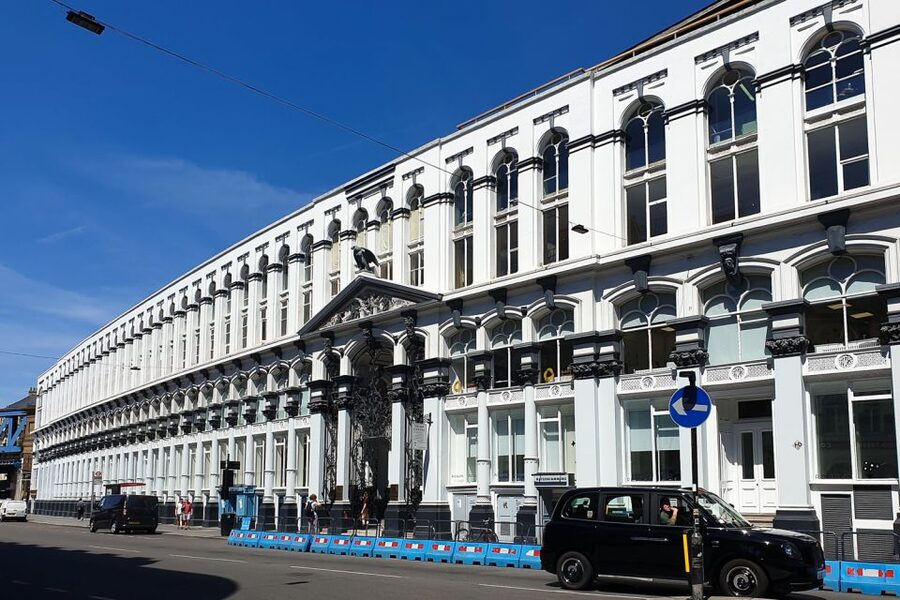
The Hop Exchange offers a change of mood. Its history points to London’s trade in hops, an essential ingredient in brewing. That makes it a useful bridge between the tour’s booze theme and the commercial life that supported Southwark’s taverns and inns.
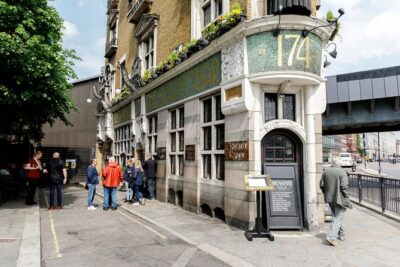
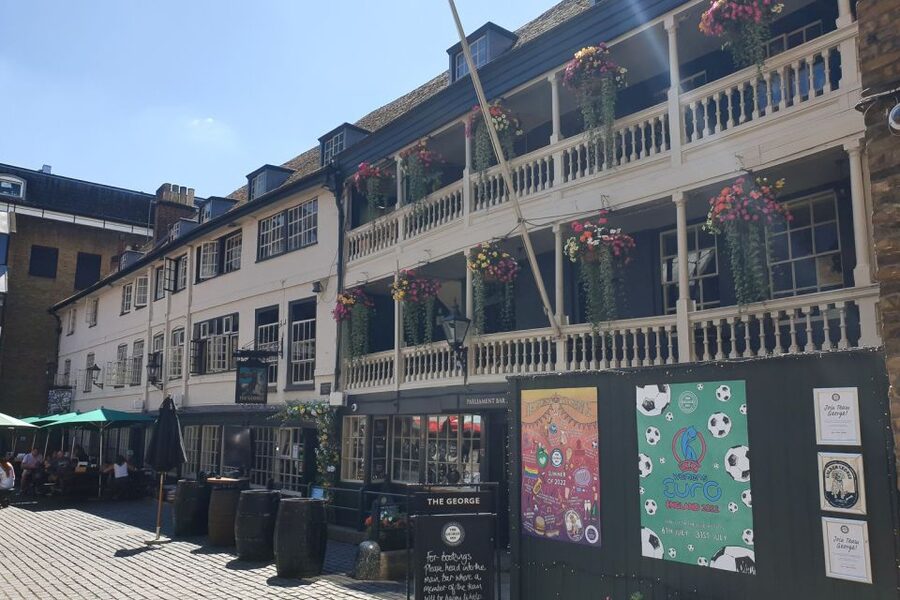
From there, the walk reaches the George Inn, one of the area’s best-known historic coaching inns. It helps you picture Southwark before modern transport, when roads, coaches, travelers, merchants, and drinking houses shaped daily life.
The George is also connected with the literary side of the walk. Southwark’s inns and theater district drew writers, actors, and audiences, and this is where the tour starts to move naturally toward Shakespeare.
Do not expect a long meal break here. The guide visits the site as part of the route, not as a pub stop. If you want time for a drink or a proper look around, plan to return after the tour.
Same city, a very different afternoon:
- Stonehenge, Windsor Castle, and Bath from London
★ 4.5 · 18,662 reviews - London: Warner Bros. Studio Tour with Transfers
★ 4.7 · 17,586 reviews - London: Tower Bridge Entry Ticket
★ 4.7 · 15,560 reviews - London: Westminster Abbey Entrance Ticket
★ 4.6 · 11,254 reviews
Borough Market, where the route meets present-day London
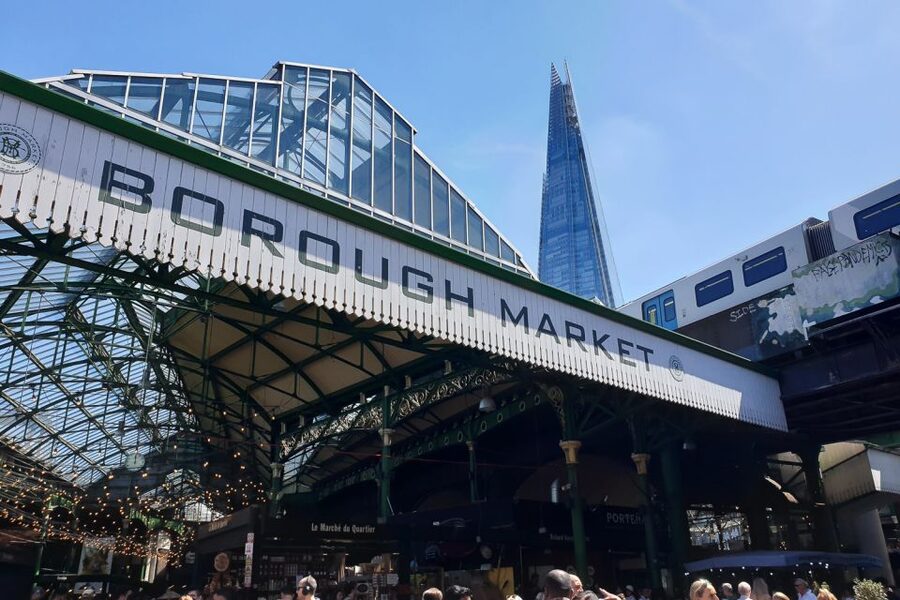
Borough Market is one of the oldest and largest markets in London. It is also the busiest section of this walk, especially on a Sunday. The market is still a working food destination, so you will see modern crowds and commerce rather than a preserved historical exhibit.
That contrast is useful. The tour does not pretend Southwark stopped in the past. Instead, the market shows how trade remains part of the area’s identity. The setting has changed, but food, business, movement, and public gathering still bring people here.
You should allow for a slower pace through this part of the route. The guide may need to steer the group around other pedestrians, and you may not be able to stand in one place for long. A small group helps, but this is not a quiet museum tour.
If you want to return for food, come back later. During the walk, focus on the explanation and on getting a clear sense of where Borough Market sits in relation to the cathedral, London Bridge, and Bankside.
The Old Operating Theatre and Southwark Cathedral
The Old Operating Theatre Museum and Herb Garret is included as a guided stop, but the tour does not include a separate museum visit. That distinction is worth noting before you book. You will learn where it is and why it matters, but you should not expect a full indoor tour within the two-hour route.
The location adds medical history to the usual stories of crime and theater. It reminds you that Southwark’s past involved hospitals, surgery, poverty, and practical attempts to deal with illness, not only brothels and taverns.
Southwark Cathedral provides another shift in tone. Its long religious history helps explain the power of the Bishop of Winchester and the institutions that shaped the borough. The cathedral is worth seeing inside if you have time later, since the walking tour mainly provides an exterior introduction.
One useful tip is to mark the cathedral for a return visit. The tour can show you why it matters, but the schedule does not leave much time for quiet interior sightseeing.
London Bridge and the remains of Winchester Palace
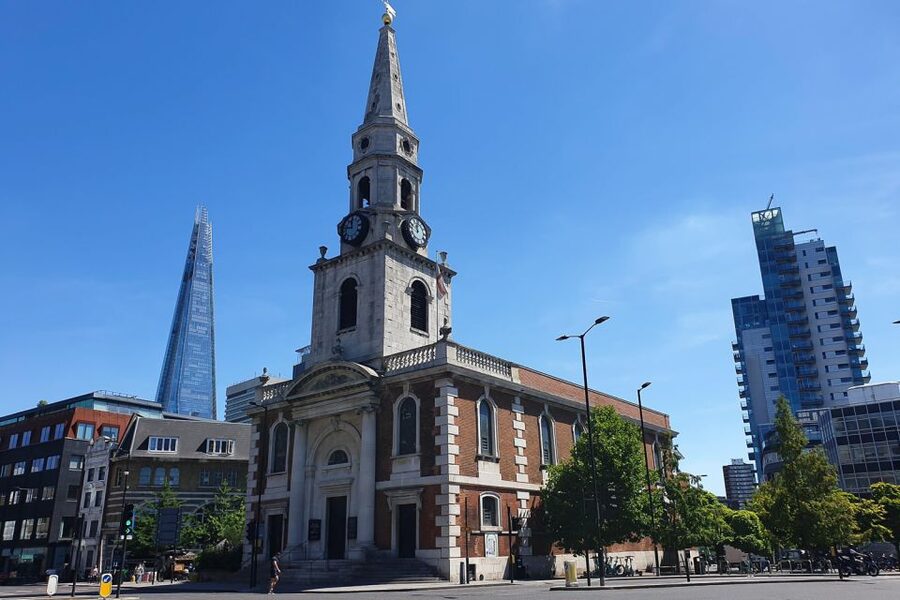
At London Bridge, the tour reaches one of the area’s key crossings. The bridge connected the City with Southwark and helped turn the borough into a place of trade, travel, entertainment, and official control.
The location also helps explain why Southwark mattered so much. This was not an isolated neighborhood at the edge of nowhere. It sat beside a major route into London, bringing people and money through the area every day.
Winchester Palace is one of the most atmospheric stops. The surviving ruins are only part of a much larger medieval residence, once linked to the Bishop of Winchester. The remains can look modest, so the guide’s explanation does the heavy lifting. You learn how a powerful religious figure could have a palace in the same district associated with prostitution.
That contradiction is central to the tour. Southwark’s bawdy economy did not exist apart from authority. It operated alongside religious power, commercial power, and the legal systems that regulated it.
The Clink Prison and Southwark’s prison story
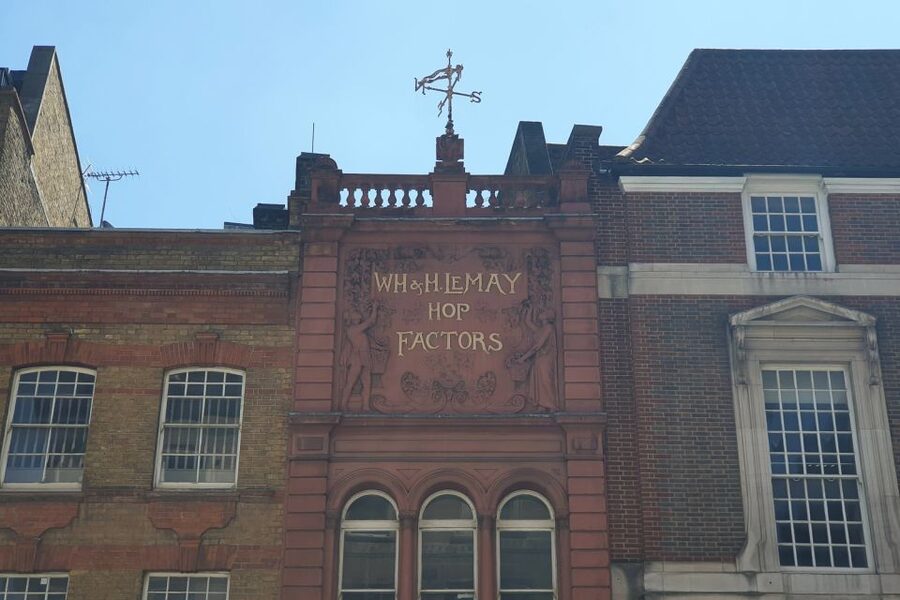
The Clink Prison Museum marks another important point in the route. The prison is one of Southwark’s most famous names, and its reputation has influenced the word clink as a slang term for jail.
The walking tour visits the location and explains its role, but entry to the museum is not included. If prison history interests you, you can return with a separate ticket. During the tour, the outside view and the guide’s account are enough to place the prison within the larger story.
I like the way Marshalsea and the Clink are treated as separate chapters. Marshalsea brings in debt and Dickens. The Clink adds the older connection between Southwark, punishment, and the authorities who used the borough to contain people considered troublesome.
The two stops also show why this is not just a salacious stroll. The tour asks who was punished, who profited, and who had the power to define respectable behavior.
Shakespeare’s original Globe site and the modern theater
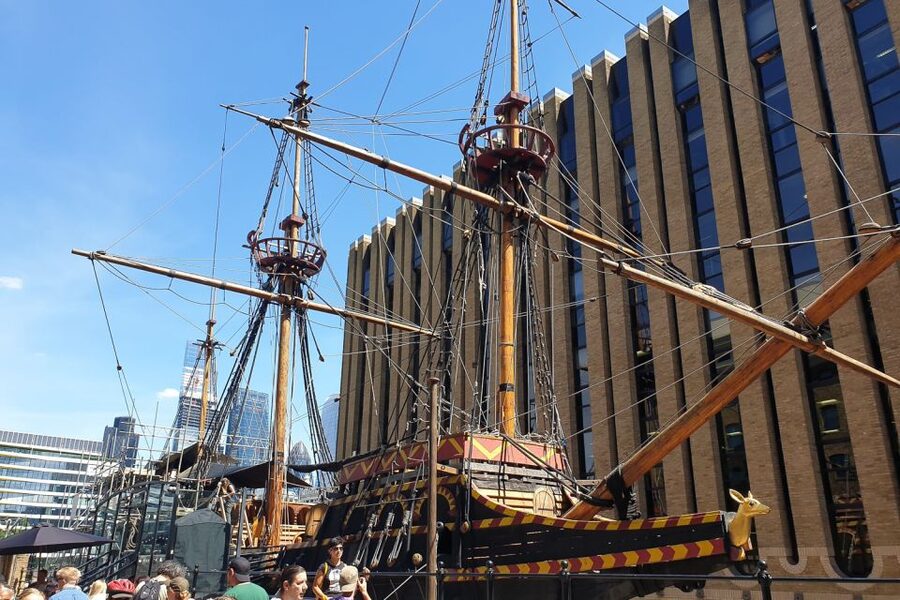
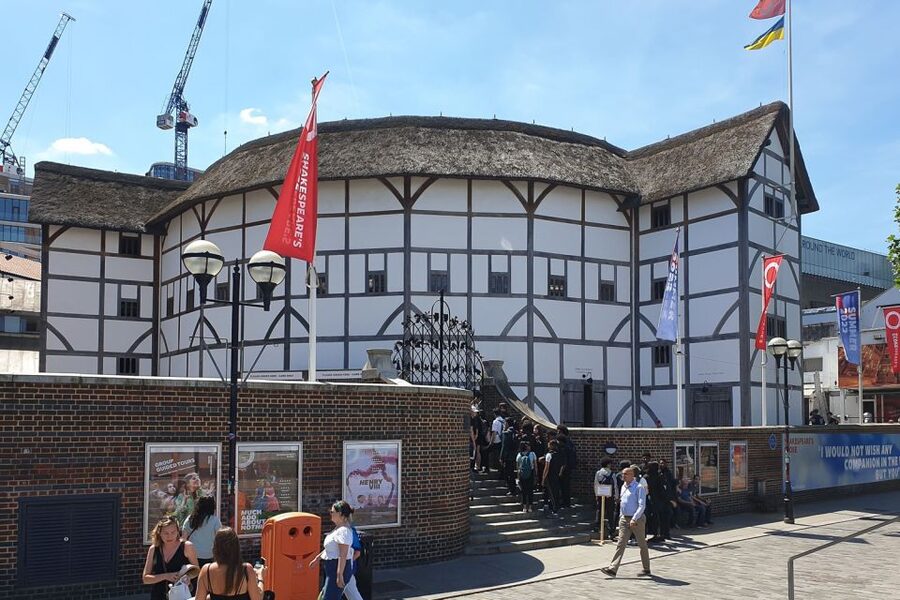
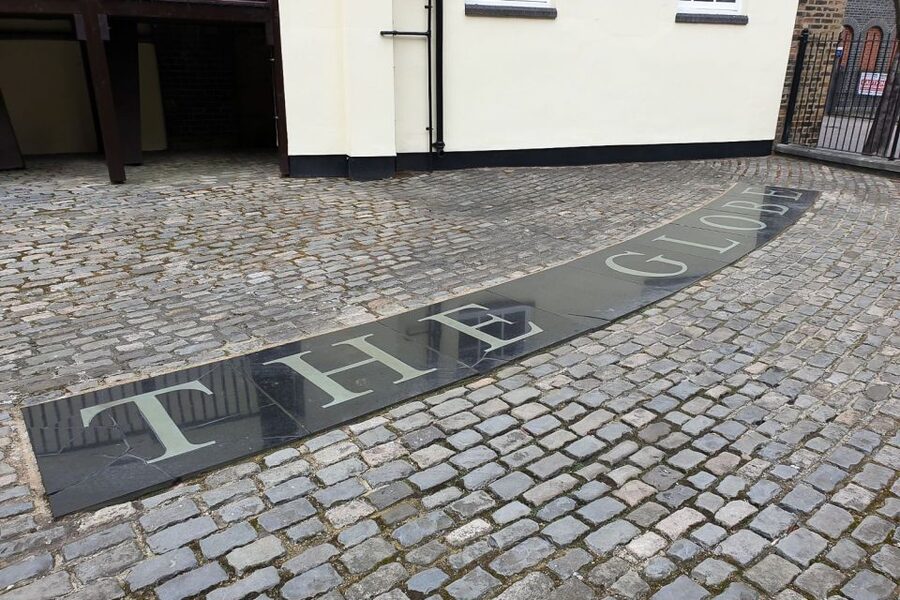
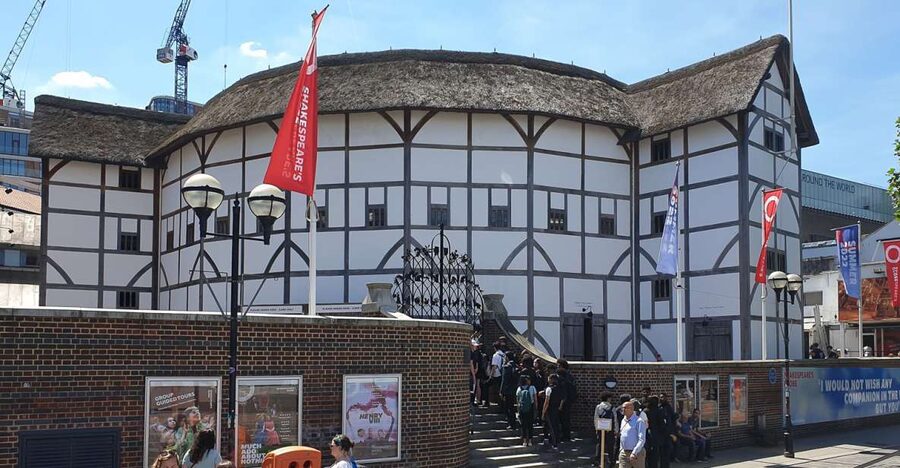
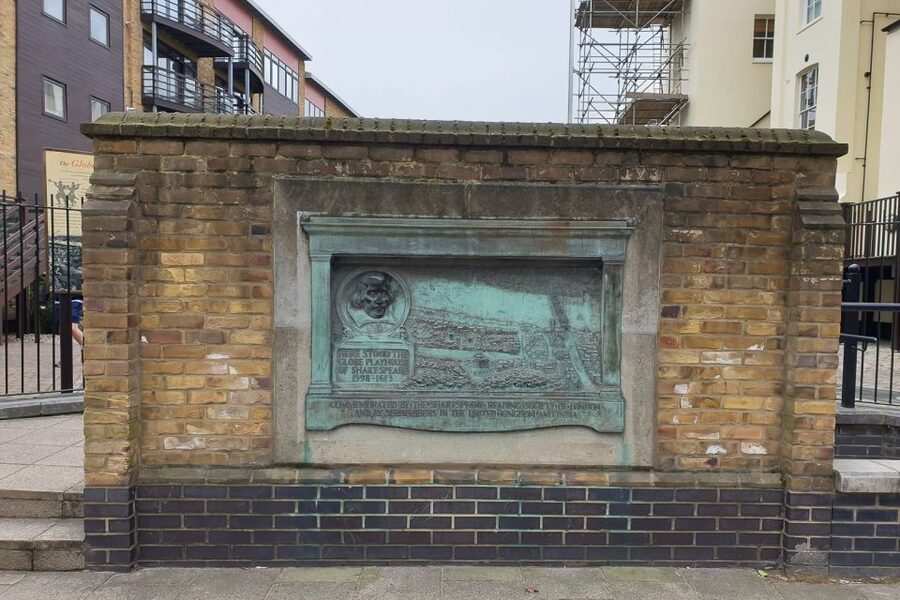
The final section follows Southwark’s theater history. You will see the original site of the Globe Theatre and then Shakespeare’s Globe, the modern reconstruction near the Thames.
The original site is another place where a small marker or modest remains can mean more once you know what happened there. Shakespeare’s theater was part of the same Southwark world as the inns, markets, prisons, and brothels. Theater audiences crossed paths with all of them.
The reconstructed Globe gives you a clear visual finish to the story. It is not the original building, and this two-hour tour does not include admission. If you want to see the inside, attend a performance, or visit the exhibition, you need a separate ticket and extra time.
One point to plan for: the tour moves on after the guide’s introduction. If you want a full Globe experience, do not schedule the walk immediately before another fixed booking unless you have enough breathing room. The tour ends near Shakespeare’s Globe, which makes a return visit convenient.
What the two-hour format feels like
The route covers about two miles, or 3.2 kilometers, over roughly two hours. The distance is not extreme, but you are on your feet for the whole walk, with stops of about five minutes at many locations.
That format works best if you like a steady stream of short stories. You will not spend twenty minutes at one building. Instead, the guide builds a picture through many connected points, moving from prison to market, palace to theater.
A group of no more than 15 people is a real advantage. You should be able to hear the guide more easily than in a large city group, and questions are less likely to get lost. Recent tours led by Tom Currie have been praised for a relaxed manner, clear explanations, and careful attention to the group.
The pace may feel quick if you want detailed photographs or long visits inside buildings. The tour is designed as an introduction to Southwark, not as a series of museum admissions.
Is $26 good value?
At $26 per person, I consider this a fair price for a focused, guide-led introduction to one of London’s most layered districts. You are paying for two hours of local explanation and route planning, not entry to attractions.
The value is strongest if you are new to Southwark or would otherwise walk past these places without understanding them. Marshalsea, Crossbones Garden, Winchester Palace, and the original Globe site are easy to treat as isolated points. A guide turns them into one connected story.
The value is weaker if you want indoor access to the Globe, the Clink, the Old Operating Theatre, or Southwark Cathedral. Those visits need separate time and, where applicable, separate admission. Think of this tour as a map and introduction that helps you decide which places deserve a longer visit.
The booking terms also offer useful flexibility. You can cancel up to 24 hours ahead for a full refund, and the reserve-now, pay-later option lets you hold a place without paying immediately.
Who should take this walk?
I would choose this tour if you enjoy social history, literary connections, old London, and stories that are a little bawdy. It suits adults and older teenagers who can handle frank discussion of prostitution, prisons, poverty, and crime. Children under 13 are not permitted.
It is also a good choice for a first day in the Borough and Bankside area. The route gives you bearings for Borough Market, London Bridge, Southwark Cathedral, the Clink, and the Globe, so you can return later with a better plan.
You may want a different experience if you prefer grand interiors, long museum visits, or a slow photography walk. The tour is talk-led and exterior-focused. Its strength is the guide’s storytelling and the way the stops fit together.
Should you book Booze, Brothels & the Bard?
Book it if you want London history with its polished image removed. The tour connects Dickens, Shakespeare, the Winchester Geese, debtors, bishops, markets, and prisons in a compact two-mile route.
I especially recommend it if you have already seen the obvious London sights and want a more local-feeling look at Southwark. Just keep your expectations clear: you are buying a small-group walking introduction, not admission to every attraction along the way.
Wear comfortable shoes, leave room for crowds around Borough Market, and consider returning to the Globe or Southwark Cathedral afterward. At $26, this is a strong pick for curious adults who like their history served with a little scandal and a lot of context.
FAQ
Where does the tour begin?
The tour begins just outside Borough Station on Borough High Street. Look for the guide holding a Historic London Tours sign.
Where does the tour end?
The walk ends near Shakespeare’s Globe Theatre, close to London Bridge Station and the Bankside area.
How long is the tour?
The tour lasts about two hours and covers approximately two miles, or 3.2 kilometers.
What language is the tour in?
The live tour guide speaks English, and English is the listed tour language.
Is the Globe Theatre admission included?
No. The walk visits the original Globe site and Shakespeare’s Globe, but a separate ticket is needed for entry to the theater.
Are children allowed on the tour?
Children under 13 are not permitted. The content includes prostitution, prisons, crime, and other adult themes.
Can I cancel my booking?
Yes. You can cancel up to 24 hours in advance for a full refund. A reserve-now, pay-later option is also available.
Just added in London
- 3-Day Stonehenge*, Glastonbury, Bath & the South West Coast Tour from London★ 4.5 · 32 reviews
- Private Guided Tour of Harry Potter Locations – English/ Italian★ 5.0 · 33 reviews
- Private Tour London Highlights, entries Westminster Abbey, The Tower of London★ 5.0 · 93 reviews
- 2 Hour Walking Tour from Buckingham Palace to Big Ben★ 5.0 · 32 reviews
- 30 Major London Attractions Walking Tour With Photos★ 4.5 · 51 reviews
- 007 Shadow Of Spectre★ 5.0 · 135 reviews
- Private Guided Tour of the British Museum – Tickets Included★ 5.0 · 193 reviews
- Bath, Avebury and Lacock Village Small-Group Day Tour from London★ 4.5 · 121 reviews
Tours in London, compared.
Magical London: Harry Potter Guided Walking Tour
Read our review →
Stonehenge, Windsor Castle, and Bath from London
Read our review →