
Reviewed · WALKING TOURS
Discovering Birmingham 2 hour Walking Tour to the Jewellery Quarter
Birmingham’s best stories are often found away from the main roads. This two-hour walk slips through a little-used canal route into the Jewellery Quarter, then links churches, cathedrals, squares, and postwar city planning in one compact route. It is a useful way to see how Birmingham grew from Georgian industry into the modern city you see today.
I like the local point of view and the guide’s habit of using objects, props, and funny stories to make the past easier to grasp. I also like that the walk returns to the Library of Birmingham, so you finish where you began and can carry on exploring without solving a transport puzzle.
The main consideration is pace. Two hours covers a lot, and the group can reach 40 people. The audio receiver helps, but you will get more from the walk if you can keep moving and are comfortable on foot in rain or cold weather.
Key points to know before you book
- The Jewellery Quarter is reached by canal: You use a route that many locals have never taken, giving the walk a sense of discovery without needing a long excursion.
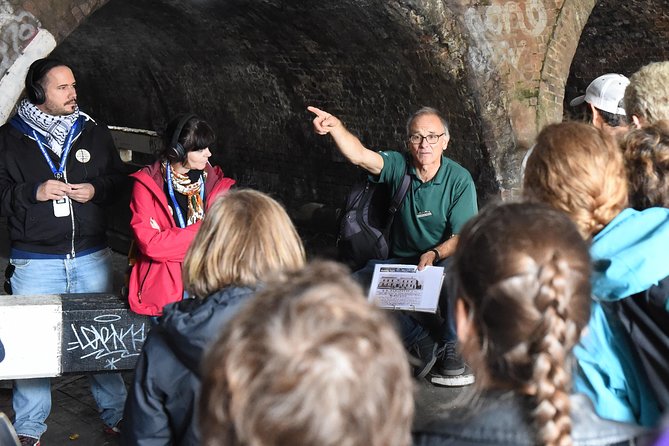
- The guides make the past lively: Jonathan Berg is associated with the tour, and Bernard, Ann, and Maria have also led walks. Expect stories, props, and occasional humor rather than a dry lecture.
- The route connects old and new Birmingham: Georgian architecture, Victorian religious buildings, postwar roads, and fresh redevelopment all appear within two hours.
- The audio receiver is a real help: You can hear the guide from some distance, useful when the group spreads out around squares or narrow streets.
- The price is modest for a city introduction: At $20.80 per person, the walk costs less than many longer paid attractions and gives you a map in your head for the rest of your stay.
- Weather matters: Tours generally continue in poor weather, so bring a proper coat or umbrella. In icy conditions, the route may change.
Starting at Centenary Square
The meeting point is outside the Library of Birmingham in Centenary Square, with a 1:30 pm start. This is a sensible place to begin because the square gives the guide room to introduce Birmingham through the buildings and public spaces around you.
Allow a few minutes to find the exact spot, especially if you are unfamiliar with central Birmingham. The tour returns here at the end, which makes the start simple and lets you leave any onward plans flexible.
The first section lasts about 20 minutes. Rather than rushing straight toward the Jewellery Quarter, the guide uses Centenary Square to explain how the city presents itself today. You begin with public architecture, civic space, and the visible signs of a city still changing.
I find this a good opening style for Birmingham. You are not simply handed a list of dates. You start by looking around and asking why the square has this shape, why certain buildings face one another, and what the city wants you to notice.
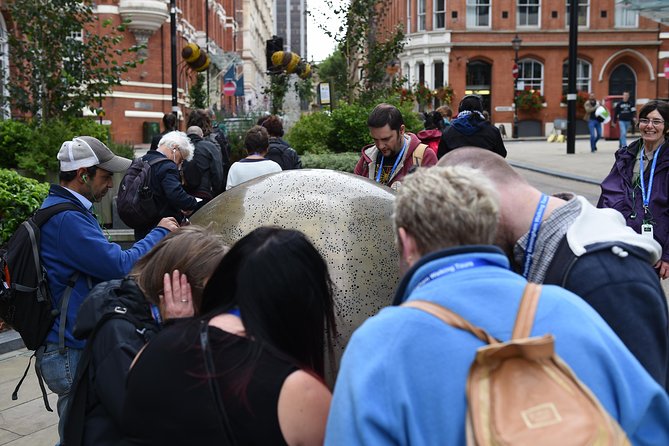
The guide may also help you spot public art and details that are easy to pass without a second glance. Jonathan Berg has written about Birmingham’s public art and sometimes brings objects or props along, turning the pavement into a small outdoor museum. That approach suits people who learn best through stories and things they can see.
More walks around England:
- Oxford University Walking Tour With University Alumni Guide
★ 5.0 · 6,905 reviews - Tour for Muggles The Ultimate Harry Potter Walking Tour in London
★ 5.0 · 4,684 reviews - London Jack The Ripper Guided Walking Tour
★ 5.0 · 3,131 reviews
Entering the Jewellery Quarter by canal
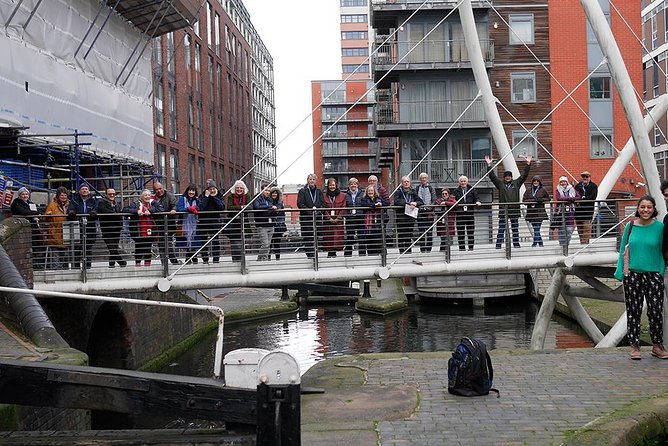
The most distinctive part of the route is the entry into the Jewellery Quarter. Instead of following the most obvious road, the walk uses a less familiar canal route. The tour describes it as a path that even many local people do not use, so this is where the experience feels most different from a standard city orientation.
The canal section also changes the mood. Birmingham can seem like a city of broad roads and large civic buildings when you first arrive. Along the water, the city feels more tucked away, and you get a clearer sense of the older industrial network that helped the area grow.
The guide explains how the Jewellery Quarter developed from Georgian times and how different types of business took root there. You will not just hear that the area was connected to jewellery. You will learn how work, trade, and changing business needs shaped the district over time.
The route then brings that story into the present. Modern businesses and new buildings now share space with older structures, and the guide points out how the Quarter is finding a place in current Birmingham. That contrast is one of the walk’s strongest features: you see an area that is not frozen as a museum district, but still carries clear signs of its working past.
Do not expect a long stop inside workshops or a formal industrial museum visit. The value here is in walking through the area and having its layout explained. If you like street-level city stories, this section will likely be the heart of the tour.
Georgian architecture and the Jewellery Quarter church
The walk pauses outside a church known locally as the Jewellery Quarter church. It is an example of Georgian architecture from 1779, and the guide uses the building to add a religious and architectural layer to the district’s industrial story.
The stop is viewed from outside, so this is mainly an appreciation of the façade, setting, and period details. If you want a long interior visit, this tour is not designed for that. Its strength is the way it keeps moving and places the building within the wider story of Birmingham.
I like this kind of stop because it prevents the Jewellery Quarter from becoming a single-theme visit. The district is not only about workshops and trade. Its churches, streets, canals, and civic connections show how a full community developed around work.
Birmingham Cathedral and a possible look inside
From the Jewellery Quarter, the walk turns back toward central Birmingham and reaches St Philip’s Cathedral, usually referred to here as Birmingham Cathedral. This is an English Baroque building and one of the city’s key landmarks.
The scheduled stop is short, about five minutes. That tells you something useful about the tour. You will get an informed look at the cathedral and its place in the city, but you should not book this walk expecting a slow architectural inspection.
On some occasions, if time allows and no event is taking place, the group may go inside to see the Edward Burne-Jones stained glass. This is an appealing possibility, but not a guarantee. Plan your expectations around an exterior visit, and treat an interior look as a bonus.
The brief timing can work well for a first day in Birmingham. You see the cathedral, learn why it matters, and keep enough time for the wider route. If the Burne-Jones glass is especially important to you, set aside separate time to return, since the walk may not be able to provide a full visit.
A few more things to do in England worth a look
- 2 Hour Leeds Highlights Walking Tour
★ 5.0 · 206 reviews - Dochgarroch: Loch Ness and Caledonian Canal 2-Hour Cruise
★ 4.7 · 1,959 reviews - Loch Lomond: Island Discovery 2-Hour Cruise
★ 4.6 · 1,576 reviews - Loch Ness and Caledonian Canal 2-Hour Cruise from Dochgarroch
★ 4.5 · 1,158 reviews
St Chad’s and the cost of putting cars first
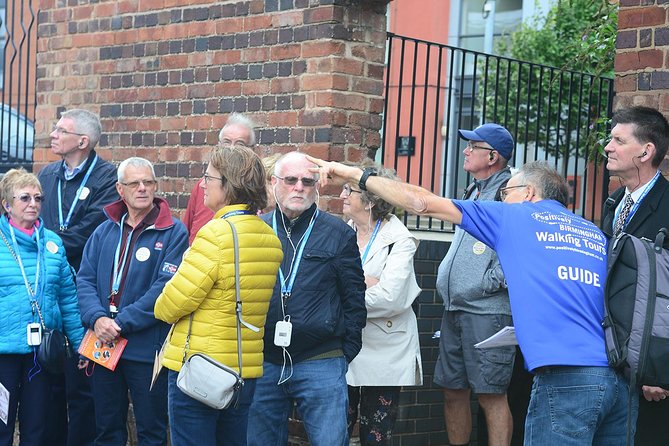
Another strong section comes from the view of St Chad’s Cathedral near the inner ring road. Here, the guide uses the setting to discuss postwar redevelopment and the period when the car shaped urban decisions.
This is more than a quick church sighting. You are encouraged to look at the road, the building, and the relationship between them. The question is whether Birmingham’s redevelopment was planned well, and what was lost or made harder when traffic took priority.
I value this part because it avoids presenting the city as a neat sequence of attractive old buildings. Birmingham has changed in uneven ways. Some decisions improved movement for cars but weakened connections for people on foot. Seeing St Chad’s from the inner ring road gives that issue a physical form.
The stop also makes the walk useful beyond sightseeing. You begin to understand why some parts of central Birmingham feel easy to cross while others feel divided by roads. That is the sort of context that helps you navigate the city with more awareness later in your stay.
Victoria Square and the route back
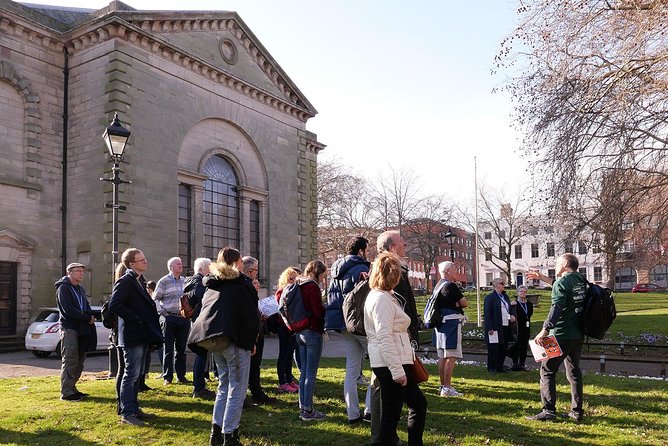
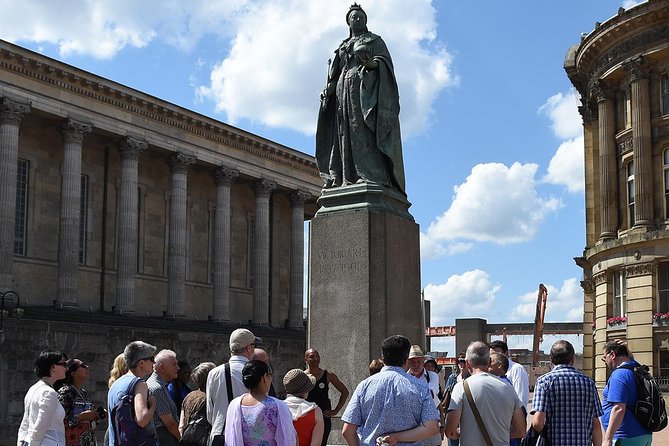
The walk continues through Victoria Square, after taking in St Philip’s and the streets between the cathedral areas and the city center. This is one of several important squares used to explain Birmingham’s civic core.
The stop lasts around 10 minutes, enough for the guide to connect the spaces you have already seen. By this point, the route has moved from Centenary Square to the Jewellery Quarter, then back through the cathedral district and central streets. Victoria Square helps tie those areas together.
I like the return route because it gives you a second look at central Birmingham with more context. Buildings that seemed unrelated at the start may now fit into a story about civic ambition, transport, work, worship, and redevelopment.
This is also a practical moment to listen closely for orientation tips. The tour does not simply point at landmarks and send you on your way. It builds a mental map of the city, which can make your own walking afterward more rewarding.
Chamberlain Square and the modern city
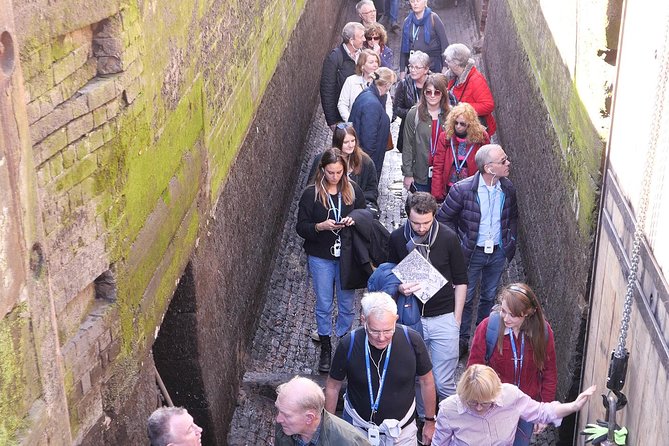
The final named stop is Chamberlain Square, a renovated public space near the Library of Birmingham. Here, the focus turns firmly toward the city’s future and the way Birmingham is reshaping its center.
The stop is short, around five minutes, but its position at the end makes sense. You have already seen older architecture, industrial routes, and the problems caused by postwar road planning. Chamberlain Square gives the guide a place to discuss how the city is reconfiguring itself now.
This creates a useful old-to-new arc without forcing Birmingham into a simple progress story. You see what the city inherited, what went wrong in parts of the redevelopment, and how newer public spaces are trying to repair connections and improve the center.
The tour then ends back at the Library of Birmingham. Since there are no required entry tickets, you can decide afterward if you want to enter any building or continue around the square at your own pace.
A guide-led walk with a personal touch

The guides are central to the experience. Jonathan Berg is named as a guide and is associated with Birmingham’s public art. Bernard, Ann, and Maria have also led the tour, so the exact style may vary by date.
What you can expect is a talk with plenty of local detail, humor, and visual aids. Jonathan is known for bringing historical objects and props, sometimes describing the approach as a museum on the streets. That makes the walk more active than a standard talk delivered while everyone stares at the same building.
The tone is also a major part of the value. A city walk can become a list of dates and names very quickly. Here, the humor helps keep the story moving, especially in wet weather. It does not remove the serious subjects, including industrial change and car-led planning, but it makes them easier to follow.
The audio receiver is included at no extra charge. You borrow it for the walk, which should help you hear the guide even when the group spreads out. This matters because a maximum group size of 40 is not tiny. The receiver cannot make a large group feel private, but it should reduce the strain of trying to catch every word.
Is $20.80 good value?
At $20.80 per person, I consider this a reasonable price for a two-hour introduction to central Birmingham. You are paying for a local guide, a planned route through areas that are easy to miss, and the receiver that helps you follow along.
The value is strongest if this is your first visit or if you want a better framework for exploring on your own. The walk does not include paid attractions, so you are not buying a bundle of entrance tickets. You are buying interpretation and access to a route you might not create for yourself.
A useful extra is that the guide has given participants a book on some occasions, and the tour’s wider program includes books and maps connected with Birmingham. Do not assume a free book is guaranteed on every departure, but the possibility adds to the personal feel of the experience.
The tour is also valuable for local residents. You may have passed through the city for years without taking the canal route or noticing the details in its public spaces. The walk is designed to connect those familiar places in a fresh way.
Practical advice for the two-hour walk
Start at the Library of Birmingham in Centenary Square and arrive ready to walk at 1:30 pm. The tour finishes at the same meeting point, so you do not need to arrange a return transfer.
Wear sensible shoes and bring a waterproof coat or umbrella. The tour usually goes ahead in poor weather, and rain can make canal paths and city pavements less pleasant. If conditions become icy, the route may be adapted.
You need a moderate level of fitness. The supplied details do not describe the route as strenuous, but you will be walking for about two hours, with stops rather than a seated presentation. Service animals are allowed, and the start is near public transport.
English is the only language offered. Confirmation arrives when you book, and free cancellation is available up to 24 hours before the start time. Changes or cancellations inside that 24-hour window are not accepted for a refund.
Who should book this Birmingham walk?
I would choose this tour for a first afternoon in Birmingham, particularly if you want a broad city introduction without spending half a day inside museums. It suits people who enjoy architecture, urban change, public art, canals, and stories about how a city works.
It is also a good fit for local people planning a staycation. The canal entry into the Jewellery Quarter and the discussion around St Chad’s can show you parts of familiar Birmingham in a different light.
You may want another kind of activity if you prefer long interior visits, a small private group, or a single subject such as jewellery making. This walk covers a lot of ground and several periods, so it offers range rather than an exhaustive study of one site.
Should you book it?
Book it if you want a friendly, story-led introduction to Birmingham that links the Jewellery Quarter with the city center. The canal route, Georgian church, cathedrals, public squares, and redevelopment stories give the two hours a clear sense of place.
I would especially recommend it early in your stay. You finish with a better map of Birmingham and plenty of ideas for where to return. Just bring rain gear, expect a moving group rather than a private tour, and remember that the cathedral interior is only possible when time and events allow.
FAQ
Where does the Birmingham walking tour start?
It starts at the Library of Birmingham in Centenary Square, Birmingham B1 2ND, UK.
What time does the tour begin?
The tour starts at 1:30 pm.
Where does the tour end?
The activity ends back at the meeting point at the Library of Birmingham.
How long does the walking tour last?
The tour lasts approximately two hours.
Is the Jewellery Quarter reached by canal?
Yes. The route enters the Jewellery Quarter through a less-used canal route and explains how the area developed from Georgian times into the modern city.
Does the tour include entry tickets?
No entry tickets are required. The guide may enter Birmingham Cathedral with the group if time allows and no conflicting event is taking place, but this is not guaranteed.
Just added in England
- Four hour walking wine tasting tour of Manchester’s best bars★ 5.0 · 136 reviews
- Rock and Goal Manchester Walking Tour★ 5.0 · 587 reviews
- 1-Hour and a Half Walking Guided Tour in Medieval Newcastle★ 5.0 · 87 reviews
- Show Tickets for Viva Decades Rewind! Music of the 80s, 90s & Now★ 4.5 · 386 reviews
- Guided City Walking Tour of Newcastle★ 5.0 · 548 reviews
- Brighton Bar Crawl★ 5.0 · 377 reviews
- Pilgrims’ Path walk across the sands to Holy Island★ 5.0 · 89 reviews
- SEA LIFE Brighton Admission Ticket★ 4.0 · 468 reviews
Walking Tours, compared.

Magical London: Harry Potter Guided Walking Tour
Read our review →
Underground Vaults Walking Tour in Edinburgh Old Town
Read our review →
Oxford University Walking Tour With University Alumni Guide
Read our review →
Edinburgh Castle: Guided Walking Tour with Entry Ticket
Read our review →
Edinburgh Castle Guided Walking Tour in English
Read our review →
Tour for Muggles The Ultimate Harry Potter Walking Tour in London
Read our review →
University and City Walking Tour with Alumni Guide
Read our review →Browse the lists this tour appears in