
Reviewed · TOURS IN ENGLAND
The Original Uncomfortable Cambridge™ Tour
Cambridge’s grand colleges tell only part of the story. This 90-minute walking tour looks at the people and institutions left out of the postcard version, from medieval conflict between the town and university to debates over slavery, women’s access, Black students, and LGBTQIA+ memory.
I like the small cap of 15 people, which gives the student guide room to ask questions and keep the walk conversational. I also like the sharp focus: instead of rushing through every famous building, you stop at a few important places and examine the uncomfortable stories attached to them. The main drawback is that college interiors are not included, and the route is not a good fit if walking is difficult.
Key points at a glance
- A different Cambridge story: Discuss race, gender, empire, sexuality, class, and university power alongside better-known events.
- Eight stops in about 90 minutes: The route links King’s College, Great St Mary’s, Trinity Hall, the Backs, Darwin College, Queens’ College, and St Catharine’s College.
- Student-led and conversational: Guides such as Shubham and Malak use short bursts of information and interactive discussion.
- Small group size: The maximum is 15 people, a useful limit for a discussion-based walk.
- Outdoor access rather than college entry: Admission to the colleges is not included, so you are paying for interpretation and conversation, not interior visits.
- Good value for curious visitors: At $27.56 per person, the tour costs less than many formal sightseeing experiences, but it does not replace a ticketed college visit.
Cambridge beyond the postcard
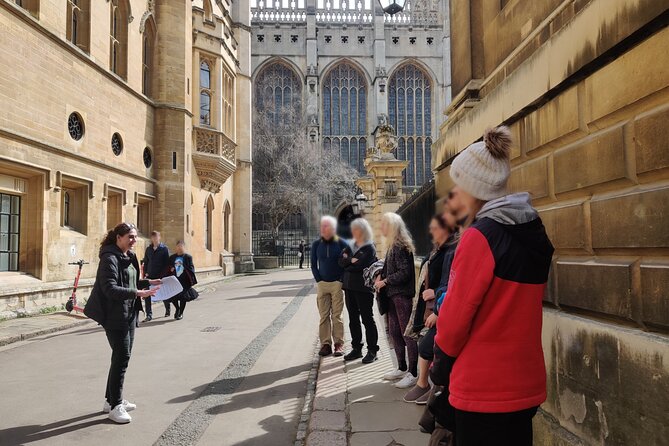
The usual Cambridge walk points toward towers, courtyards, famous scholars, and scenic college views. This experience asks you to look again. The buildings remain important, but the guide uses them to discuss power: who was admitted, who paid for the university, who was remembered, and who was pushed aside.
That change in focus matters. Cambridge can feel polished to the point of being untouchable. Here, you get a more questioning version of the city. A college is not treated only as a beautiful old institution. It becomes a place where money, politics, race, religion, gender, and public memory all meet.
The tone is not designed for a quick stream of dates and names. The guide gives information in short sections, then leaves room for questions and discussion. That format suits the subject. Sensitive topics can become flat when presented as a long lecture. A smaller group and an interactive guide make the material easier to consider.
The experience is currently rated 4.9 out of 5, with 98 percent of participants recommending it. That fits the strongest feature of the tour: the quality of the conversation depends heavily on the student guide. Shubham and Malak are two guides specifically praised for being engaging, thoughtful, and good at making the subject feel approachable.
Other tours people book in Cambridge:
- Cambridge University Walking Tour by Alumni™ Kings College Option
★ 5.0 · 2,336 reviews - Cambridge University With Alumni: Optional Kings College Entrance
★ 5.0 · 1,987 reviews - Punting Tour in Cambridge
★ 4.5 · 1,690 reviews
Starting at King’s College and Great St Mary’s
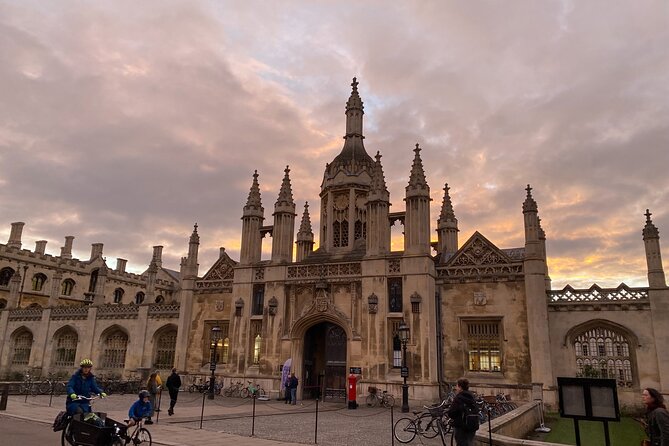
The route begins at the front of King’s College, one of Cambridge’s most recognizable landmarks. This is a fitting place to set up the tour because the college represents the image many people bring with them: famous, beautiful, and closely linked to the story of English education.
You spend about 10 minutes here before moving on. Admission to King’s College is not included, so this is an exterior stop rather than an interior college visit. If you want to see the chapel or other areas that require a ticket, plan that separately.
The first substantial discussion takes place at Great St Mary’s Church. The church is used to explain the old tensions between Cambridge town and university. This conflict is one of the best foundations for understanding the city. Cambridge was not simply a university placed inside a town. Its students and institutions affected local life, money, law, and authority.
You get about 15 minutes here. Admission is free, but the tour does not promise a full church visit. The value is the setting and the explanation of how medieval university power shaped relationships with local residents.
This opening section gives you a useful habit for the rest of the walk. You are encouraged to look at familiar buildings and ask who controlled them, who benefited from them, and who had to live with their decisions.
Trinity Hall and the question of university money
At Trinity Hall, the guide stops near the Old Schools building to discuss problematic donations to the university. This is one of the more important ideas on the route because old institutions often present their buildings and endowments as if they appeared without conflict.
The point is not simply to identify a donor or repeat a scandal. It is to ask what money allowed Cambridge to build, expand, and thrive, and what obligations might come with wealth tied to exploitation or injustice.
You spend around 10 minutes here. Trinity Hall admission is not included, and the stop takes place outside. That is worth knowing if you are hoping to walk through several college courts. You will see the surroundings, but the discussion is the main event.
I find this kind of stop especially useful for visitors who already know the basic Cambridge story. It gives you a way to question the clean version of institutional history without pretending that the buildings have no artistic or educational value.
The Backs and Oliver Cromwell
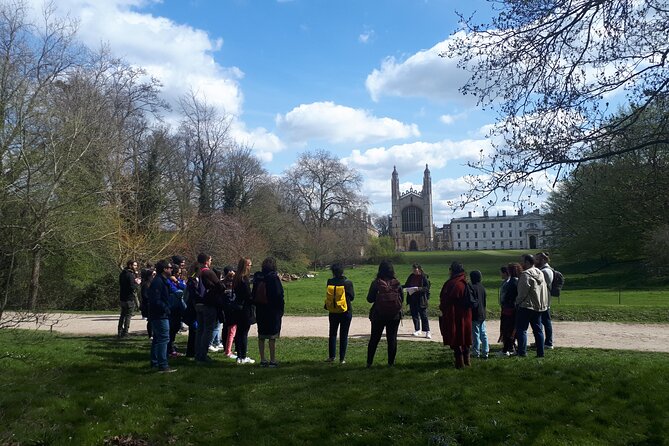
The walk then reaches the Backs, Cambridge’s famous open stretch beside the colleges. This is the most scenic part of the route, but the guide does not use it as a pause from serious history. Instead, you discuss the English Civil War and the legacy of Oliver Cromwell.
The Backs provide space to take in the setting while considering a period when the future of England’s government, religion, and monarchy was fiercely contested. Cromwell’s reputation remains complicated. He can be presented as a defender of Parliament, a religious reformer, or a military ruler, depending on the story being told.
You spend about 20 minutes here, the longest single stop. That gives the guide room to explain the conflict and connect it to Cambridge. The stop is free and outdoors, so your experience will depend on the weather. The tour can be canceled in poor weather, with a different date or a full refund offered.
This section also gives the walk some breathing room. The subject matter is weighty, and the open setting helps break up the tighter streets and college facades. Bring sensible shoes and expect to remain on foot throughout.
Same city, a very different afternoon:
- Cambridge: Guided River Cam Punting Tour
★ 4.7 · 1,469 reviews - Cambridge: University Alumni Tour with Kings College Option
★ 4.7 · 1,282 reviews - Cambridge: Alumni-Led Walking Tour w/ King’s College Option
★ 4.8 · 1,177 reviews - Shared Guided Punting Tour of Cambridge
★ 5.0 · 787 reviews
Darwin College and women at Cambridge
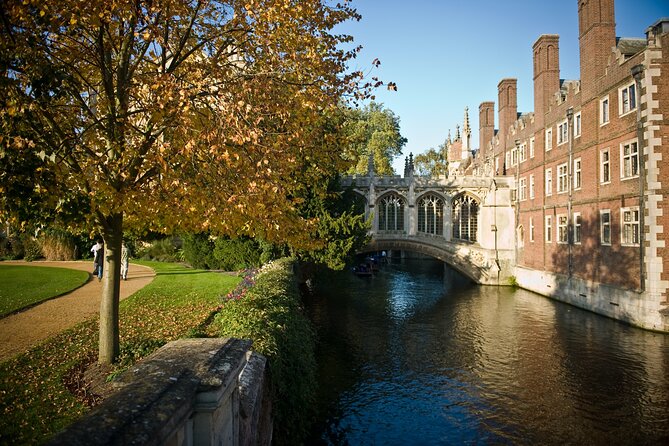
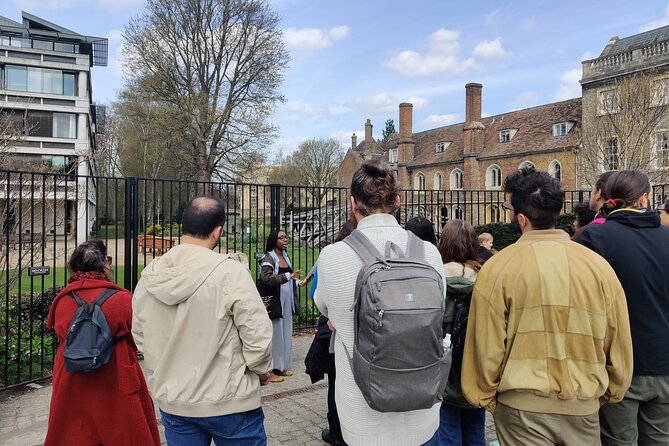
At Darwin College, the guide uses a map of the colleges and the site opposite the former New Hall College to discuss the long path toward women becoming full members of the university.
This is not only a story about whether women could attend lectures. It concerns status, access, recognition, and belonging. The distinction between studying at Cambridge and being granted full membership is exactly the kind of detail that a standard sightseeing walk may skip.
The stop lasts about 10 minutes. Darwin College admission is not included, and you should expect an exterior discussion rather than a college visit.
For me, this is one of the route’s most useful stops because it shows how institutions can change slowly even when education itself appears progressive. The college map also helps you place the story across Cambridge rather than treating it as one isolated decision.
Queens’ College and the history of Black students
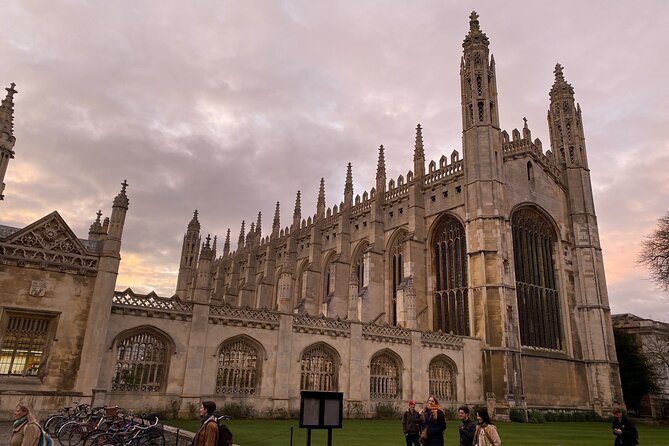
Queens’ College is the setting for a 15-minute discussion about Black students at Cambridge University. Again, the tour uses a prestigious college to raise questions about who had access to its education and how Black students have been represented in university history.
The subject is important because a university’s international reputation can hide unequal experiences within its walls. You are not asked to view Cambridge only as an abstract center of learning. You are asked to consider the people who studied there, the barriers they faced, and the way their presence fits into the institution’s public story.
Admission to Queens’ College is not included. If you want to visit inside, you will need to make separate arrangements. The tour gives you context for the college, but it is not a substitute for an admission ticket.
The length of this stop is helpful. Fifteen minutes is enough to establish a story without turning the walk into a full academic seminar. The short sections also keep the pace moving.
St Catharine’s College, slavery, and repatriation
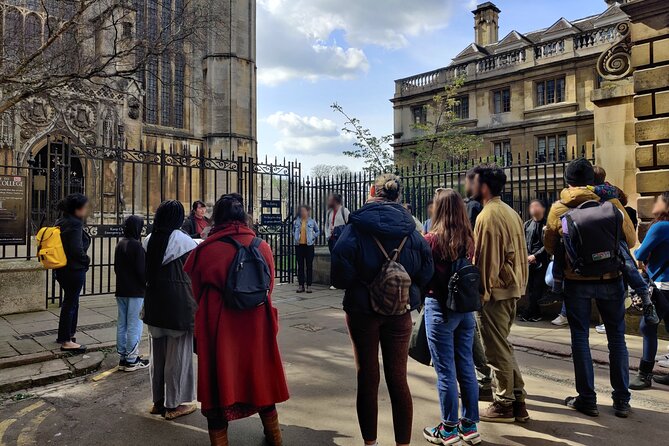
At St Catharine’s College, you discuss controversies linked to histories of enslavement and the return of objects. This is a complicated topic, and the value of the stop lies in showing that university history is not finished simply because an old building has been preserved.
Questions about objects can involve ownership, consent, cultural meaning, and the responsibilities of modern institutions. The route puts those questions in a real Cambridge setting rather than treating them as distant global issues.
You spend about 15 minutes here. St Catharine’s College admission is not included, so once again the conversation takes place from the outside.
This part of the route may be uncomfortable, which is the point. The tour is not designed to keep the city’s image tidy. If you prefer sightseeing that avoids difficult subjects, this will not be your ideal Cambridge walk. If you want a more honest account of how historic institutions are being questioned today, it is a strong reason to book.
Returning to King’s Parade and LGBTQIA+ memory
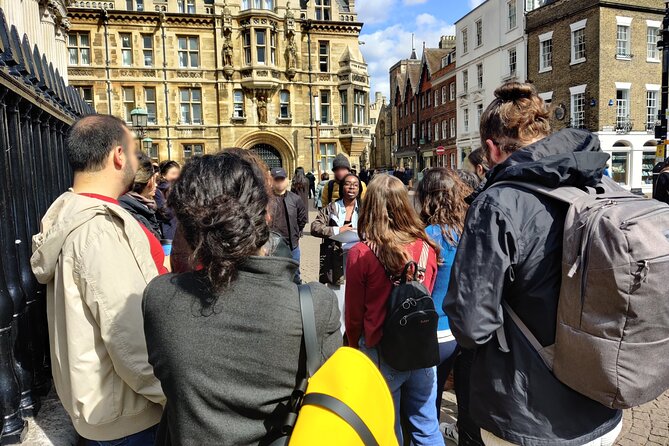
The walk finishes back near King’s College, at King’s Parade. The final discussion considers LGBTQIA+ histories and memory.
Ending here works well. You return to one of Cambridge’s most recognizable spaces, but you now have more questions about what public memory includes and what it leaves out. A college or church can look unchanged while the way people understand its past continues to shift.
The final stop is listed at about 15 minutes. The tour ends at King’s Parade, Cambridge CB2. Since the meeting information also identifies the Cambridge Tourist Information Centre at The Guildhall, 11 Peas Hill, as the starting point, check your confirmation carefully for the exact meeting instructions. The route itself begins with King’s College, so clear directions matter.
What $27.56 buys you
At $27.56 per person, this is a reasonable price for a focused small-group walk. You are paying for a Cambridge University student guide, a carefully chosen route, and conversation about subjects that are rarely the main focus of a standard city tour.
The value is strongest if you already plan to see the colleges separately. The tour does not include admission to Trinity Hall, Newnham College, Queens’ College, St Catharine’s College, or King’s College. It also does not include a ticketed interior visit to those institutions.
That limitation keeps the price down, but it changes how you should judge the experience. This is not a bargain college-entry ticket. It is an interpretation-led walk. You pay to understand the places you see, not to tour their rooms.
The small group helps justify the cost. A maximum of 15 people is much better suited to questions than a large crowd. It also means the guide can keep the discussion focused instead of speaking over a mass of people at every stop.
Group discounts are available, which may help families or friends traveling together. The tour is offered in English and uses a mobile ticket.
Who will enjoy this walk most?
I would choose this tour if you want Cambridge to be more than pretty buildings and famous names. It suits visitors interested in social history, university politics, public memory, race, gender, empire, religion, and LGBTQIA+ history.
It is also a good choice for locals or repeat visitors. You do not need to be new to Cambridge to learn something from a route that questions the usual presentation of the city. The short format works well before another appointment or as an afternoon addition to a longer visit.
You should think twice if your main goal is entering college courtyards. Since admission is not included, you may prefer a conventional college tour alongside this experience.
The walk is not recommended for people who have difficulty walking. Most people can participate, and service animals are allowed. Since it is an outdoor activity that requires good weather, wear shoes you can walk in and be prepared for a date change if conditions are poor.
Should you book The Original Uncomfortable Cambridge Tour?
Book it if you want a candid, discussion-based look at Cambridge and are willing to question the polished version of the university. The combination of a 15-person limit, student guides such as Shubham and Malak, and a clear focus on overlooked stories gives the tour a purpose beyond sightseeing.
Skip it if you want detailed interior access, a gentle overview, or a purely architectural walk. For the right audience, $27.56 is a fair price for 90 minutes of thoughtful context. Just confirm the meeting instructions, remember that college admission costs extra, and bring curiosity as well as comfortable shoes.
FAQ
How long does The Original Uncomfortable Cambridge Tour last?
The tour lasts approximately 1 hour and 30 minutes.
Where does the tour start and finish?
The listed meeting point is the Cambridge Tourist Information Centre at The Guildhall, 11 Peas Hill, Cambridge CB2 3PP. The route begins at King’s College and finishes at King’s Parade, Cambridge CB2. Check your booking confirmation for the exact meeting instructions.
What is included in the tour?
A Cambridge University student guide is included. The tour is offered in English and uses a mobile ticket.
Are college admission tickets included?
No. Admission to Trinity Hall, Newnham College, Queens’ College, St Catharine’s College, and King’s College is not included.
How large is the group?
The tour has a maximum of 15 participants. Group discounts are available.
Can I cancel for a full refund?
Yes. You can cancel up to 24 hours before the experience start time for a full refund. Cancellations or changes made less than 24 hours in advance are not accepted for a refund. If poor weather or an insufficient number of participants causes cancellation, you will be offered another date or experience, or a full refund.
Just added in Cambridge
- Town Food Tour in Saffron Walden★ 5.0 · 32 reviews
- Tangential Cambridge: Group Walking Tour of Sights and Highlights★ 5.0 · 79 reviews
- Cambridge University Walking Tour★ 5.0 · 316 reviews
- Walking Tour of Cambridge★ 5.0 · 305 reviews
- Rowing experience in Cambridge! No experience required★ 5.0 · 182 reviews
- Fun, Flexible Treasure Hunt Around Cambridge with Cryptic Clues & Hidden Gems★ 5.0 · 142 reviews
- Cambridge University Ghost Tour by Alumni™★ 5.0 · 117 reviews
- Private | Cambridge Walk & Punt Tour by Alumni™ & King’s Chapel★ 5.0 · 45 reviews
Tours in England, compared.

Stonehenge, Windsor Castle, and Bath from London
Read our review →
Stonehenge, Windsor Castle and Bath with Pub Lunch in Lacock
Read our review →
Oxford University Walking Tour With University Alumni Guide
Read our review →
Tower of London and Crown Jewels Exhibition Ticket
Read our review →
Browse the lists this tour appears in