
Reviewed · WALKING TOURS
J & M York City Walking Tours
York’s long story unfolds quickly on this walk, from Roman emperors and Viking streets to medieval guilds, castle earthworks, and the crooked lanes around the Shambles. You begin near Constantine the Great and finish close to the Shambles, the river, Jorvik Viking Centre, and York Castle Museum, so the route also helps you get your bearings.
I like the way the tour connects famous sights with details you could easily miss, such as St Cuthbert’s Church, the old Jewish quarter, the Dutch House, and a guild’s role in women’s working lives. I also like the guides’ easy teaching style. Nick is often praised for clear delivery, wit, good pacing, and helpful advice for the rest of your visit.
The main limitation is scope. Two hours is enough for a broad introduction, not a full visit inside the Minster, castle, or museums. You also walk only a section of the city walls, which may disappoint anyone expecting a long wall walk.
Key points at a glance
- Two thousand years in two hours: Roman York, Constantine, Viking Jorvik, medieval guilds, royal power, and the story of Dick Turpin all appear along the route.
- A useful first-day walk: The finish near the Shambles, Jorvik Viking Centre, Castle Museum, Clifford’s Tower, and the river makes it easy to continue exploring.
- Major sights plus overlooked corners: You see York Minster and the Shambles, but also St Cuthbert’s Church, Ogleforth, Hungate, and the old Jewish quarter.
- Guides who make the facts manageable: Nick and James are noted for clear speaking, humor, strong pacing, and patient answers.
- Good value at $18.02: You get a two-hour orientation without paying separate admission fees, though the tour does not include entries to attractions.
- Expect a city walk, not a museum tour: The Minster and York Castle Museum are seen from outside, and only a short section of the walls is covered.
Why this walk is a smart introduction to York
York can feel confusing at first. The streets bend, old gates have several names, and layers of Roman, Viking, medieval, and later history sit almost on top of one another. This tour gives you a simple thread to follow.
At $18.02 per person, the price is modest for a two-hour guided walk. You are mainly paying for orientation and explanation. That matters in York, where a plain-looking street may have a Roman foundation, a Saxon name, a Viking connection, and a medieval trade story waiting behind it.
The tour is offered in English and has a maximum group size of 30. That is not the same as a private walk, but it keeps the format manageable. The strongest comments focus on the guides’ speaking style, their command of local facts, and the way they answer questions without losing the group’s rhythm.
I would book this near the start of a York visit. The walk gives you a map in your head, then places nearby attractions in sensible order. One particularly useful feature is the ending near the Shambles and other central sights. You can carry on with a museum or river walk rather than spending time finding your way back across town.
More City Tours in York:
- York: City Sightseeing Hop-On Hop-Off Bus Tour
★ 4.6 · 954 reviews - York: City Highlights Small Group Walking Tour
★ 4.9 · 867 reviews - City Sightseeing York Hop-On Hop-Off Bus Tour
★ 4.5 · 545 reviews
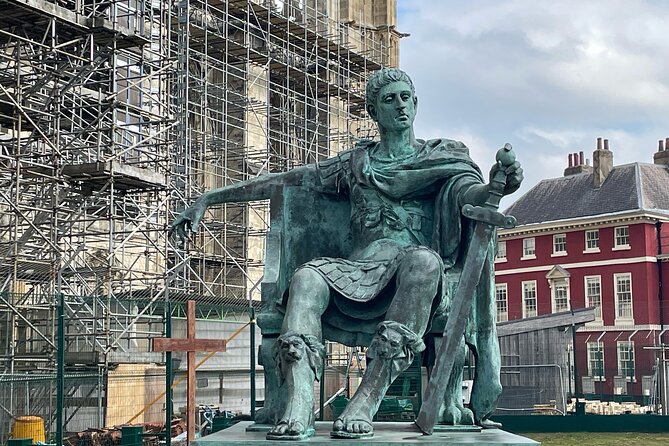
Starting with Constantine beside York Minster
The meeting point is Constantine the Great, 4 Minster Yard, York YO1 7JB. The statue marks an important moment in York’s Roman story. Constantine visited York and was proclaimed emperor here in AD 306 after the death of his father, Constantius Chlorus.
You will hear how Constantine’s later support for Christianity affected the Roman world and why York matters in that story. It is a strong opening because it places the city in an international setting before the walk turns to lanes, churches, and local trade.
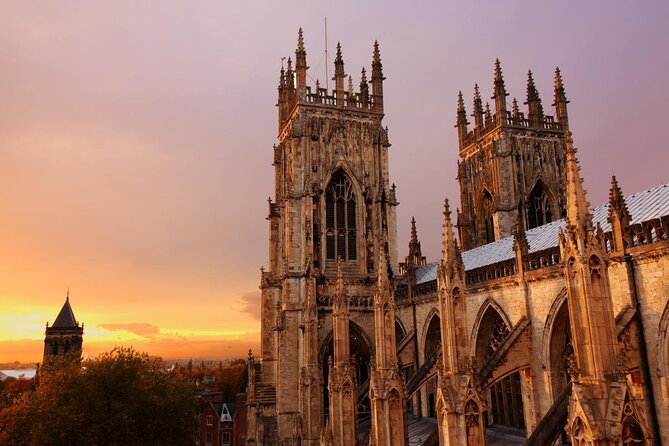
York Minster is the first major sight. The cathedral took 252 years to build and is described as the largest Gothic cathedral in Northern Europe. The route allows about 20 minutes here, but admission is not included. The walk is not an interior cathedral tour. Minster guides offer separate one-hour tours inside, so you can decide later if that extra visit suits your schedule.
That distinction is important. If your main goal is to study the stained glass, towers, or interior architecture, plan another block of time and budget for admission. On this walk, the Minster works as a landmark and a starting point for understanding York’s religious and civic importance.
The castle mound and York’s darker stories
The route next reaches the motte of the castle built in 1069. A motte is the raised earth mound that supported a castle’s main stronghold. From the grounds, the guide explains the castle’s violent beginnings and the darker stories tied to the site.
You do not enter a complete medieval castle on this portion of the walk. Instead, you walk around the mound and use the surviving setting to picture what once occupied the site. That approach suits York, where much of the past is visible through fragments, earthworks, reused buildings, and street patterns rather than one perfectly preserved monument.
This is also where the tour’s storytelling matters. A list of dates would make the castle feel remote. A good guide links its construction to power, defense, and control of the city. The guide’s job is to make the ground under your feet meaningful.
Guilds, traders, and the lower medieval city
One of the more unusual sections takes you down into the medieval levels of York. Here, the focus shifts from kings and battles to commerce. You hear about one of York’s wealthiest guilds, the traders who helped the city prosper, and the important role women played within that guild.
This is a valuable change of pace. York’s story is often told through cathedrals, monarchs, and walls, but trade made daily life possible. Guilds governed work, protected commercial interests, and shaped civic power. The mention of women adds an angle that many quick city walks skip.
The exact conditions of the medieval streets are not recreated for you, but the lower levels help explain why York can feel like a city built in layers. You are not simply walking along an old street. You are moving through different heights and periods of the city.
More Walking Tours in York:
- Shadows of York: Ghost Walk and Horrible History.
★ 5.0 · 1,403 reviews - Private Historical Walking Tour of York
★ 5.0 · 1,324 reviews - York: Harry Potter Guided Walking Tour
★ 4.5 · 1,231 reviews - York: Witches and History Old Town Walking Tour
★ 4.7 · 928 reviews
The Shambles and St Margaret’s shrine
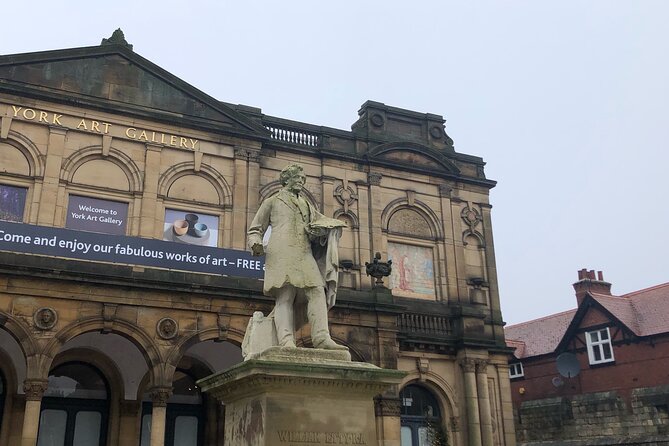
The Shambles gets about 10 minutes. This narrow medieval street was associated with butchers, and its overhanging buildings create the enclosed feel that makes it one of York’s best-known lanes.
The guide takes you toward the shrine of St Margaret Clitheroe and adds stories behind the street rather than treating it as a quick photo stop. You will have time to look, but not enough for a long shopping visit. The Shambles is often crowded and visually busy, so the guide’s explanation helps you see more than the famous timber fronts.
It is worth remembering that the Shambles is only one part of the walk, not the whole experience. The route uses it as a bridge between popular York and the less obvious places around it. That is one reason I would not book this solely for photographs. You get more from the tour if you want context.
St Cuthbert’s Church and the Devil’s Door

At St Cuthbert’s Church, the stop is brief, about six minutes. The church includes Roman brickwork and elements of Saxon and Norman construction, making it a compact lesson in how York’s buildings were altered and reused over time.
The unusual feature is the Devil’s Door. The guide explains the story behind the name and separates the old belief from the physical facts of the doorway. This is the sort of stop that can disappear from a standard sightseeing route. It may not take long, but it gives you a more personal sense of how people once understood churches and the buildings around them.
Do not expect a lengthy church visit. The value is in the detail and in seeing a place you might otherwise pass without stopping.
A short walk on the medieval walls
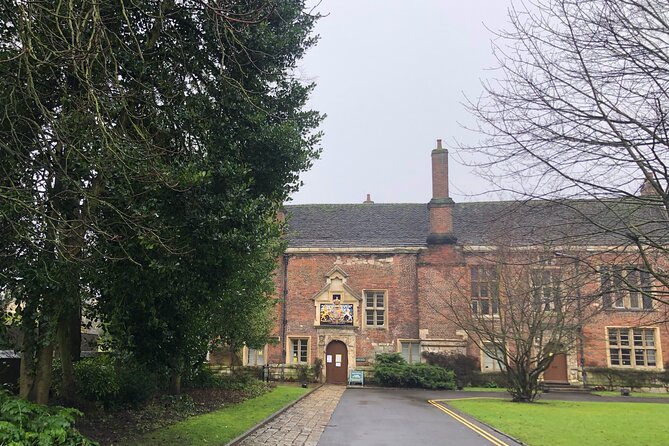
The city walls section lasts about 15 minutes. You see traces of Roman defenses, Danish earthworks, medieval changes, sieges, and Victorian alterations. The route also passes near the old Jewish quarter.
This is a layered view of the walls rather than a full circuit. York’s walls are extensive, and covering a longer stretch would take the group away from the central sights. If you want to walk a major section from gate to gate, save time for that separately.
The short wall segment still earns its place. It shows how defense changed as the city changed, and it gives you a chance to look across York from a raised route. Just set your expectations correctly: this is a history stop with some wall walking, not a dedicated rampart hike.
Hungate, the Black Swan, and local texture
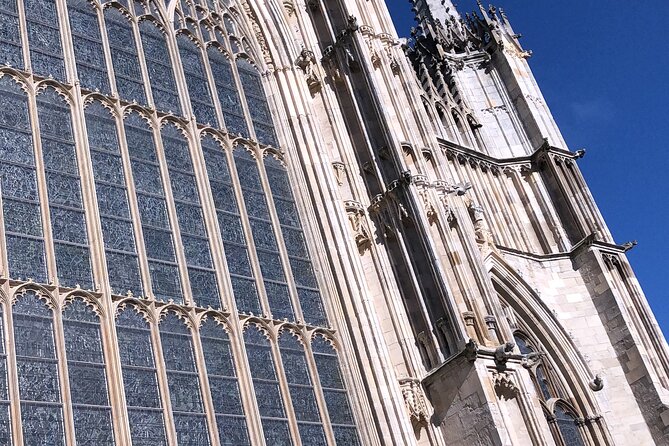
The Black Swan stop takes about five minutes and brings you into the old Hungate parish. You hear about famous residents and links to the Battle of Quebec. Nearby architecture reflects the Irish heritage of the area, and the guide may point out one of York’s well-known black cats.
This is a good example of the tour’s range. The walk is not limited to grand monuments. It includes neighborhood clues, local stories, and buildings whose significance may not be obvious from the pavement. The Black Swan also lets the guide connect York with events beyond England, showing how residents and buildings were tied to wider military and migration stories.
The stop is short, so do not expect a full exploration of Hungate. Think of it as a window into the district.
Merchant Taylors, markets, and city power
The Merchant Taylors’ Hall appears near the walls, with about four minutes devoted to the guild. The guide explains how guilds became an economic center of cities such as York, why the Taylors mattered, and how the organization continues to play a role today.
From there, the route reaches Shambles Market for about five minutes. The market helps explain York’s economic growth in practical terms. Goods, traders, customers, and regulations shaped the city just as surely as churches and castles did.
These are quick stops, but they add balance. You are not only hearing about rulers. You are seeing how ordinary work and organized trade helped determine the city’s layout and success.
Monk Bar and Ogleforth’s old street plan
Monk Bar is one of York’s six gates. The guide explains its role in city defense, the legend of the Wild Men of York, and the gate’s more unpleasant uses. The stop takes about five minutes.
York’s gates are easy to treat as attractive pieces of old masonry. The stories give them purpose. A gate controlled movement, protected the city, and could also serve grim practical functions. Monk Bar helps you understand that the walls were working infrastructure, not just a scenic boundary.
Ogleforth follows for another five minutes. This Saxon street leads to the Dutch House, whose architecture helps explain changes after the Great Fire of London and the rise of insurance policies. That is a surprisingly wide topic for a short York stop. It connects local building design with national changes in risk, property, and urban planning.
Kings Square and Viking Jorvik
At Kings Square, the guide explains the meaning behind York’s street names and points to the city’s Viking heritage. You also learn about the center of Jorvik, the Viking settlement that gave York much of its later identity.
This is a useful place to pause because modern York can hide its Viking foundations. Street names and the shape of the center provide clues, but you need someone to interpret them. The stop gives you a basic framework for understanding the Jorvik Viking Centre, which is close to the tour’s end.
If Viking York is your main interest, consider visiting the center separately after the walk. This tour introduces the subject but does not replace a museum visit.
Dick Turpin and the final stop
The walk finishes at York Castle Museum, where the guide discusses the older buildings, prison reform, former uses of the site, and the real story behind Dick Turpin. You look from outside, and admission is not included.
Dick Turpin’s reputation has gathered plenty of legend, so the chance to separate the historical person from later storytelling is useful. The stop also shows how York’s prison buildings changed purpose over time. It is a fitting end because it brings together crime, punishment, architecture, and popular memory.
The stated ending is All Saints, Pavement, on High Ousegate, though it may vary. It is about six minutes on foot from the starting point and close to the Shambles, Jorvik Viking Centre, Castle Museum, Clifford’s Tower, the river walk, and other central sights. That location makes the tour easy to fold into a full day.
Pace, group size, and practical comfort
The advertised duration is about two hours. The listed stop times add up to a little under that, leaving room for walking between points, questions, and the guide’s stories. Wear comfortable shoes and expect uneven historic streets, frequent stops, and a fair amount of standing.
Most people can take part, and service animals are allowed. The meeting area is near public transportation. Alcoholic drinks are not included, though that is not really relevant to a walking tour of this length.
The tour requires suitable weather and a minimum number of participants. If poor weather or low numbers force a cancellation, you can choose another date or receive a full refund. You can cancel for a full refund up to 24 hours before the start time. Changes or cancellations inside that window are not accepted.
Who will get the most from this York walk
I would choose this tour for a first visit, a short stay, or a morning when you want a clear sense of the city before choosing museums. It also suits anyone who prefers stories and local detail over a simple parade of photo stops.
History fans will appreciate the range, from Roman emperors and Danish earthworks to guilds, churches, prisons, and Victorian changes. Families may like the darker tales and odd details, though the two-hour format involves steady walking and listening.
I would look elsewhere if you want a full Minster interior tour, a long walk on the city walls, or extended time at every museum. You will need to pay separate admission for the Minster or York Castle Museum, and the guide only takes you around the outside of those places.
Should you book J & M York City Walking Tours?
At $18.02, this is a sensible buy if you want York explained rather than simply photographed. The 4.7 rating from 480 reviews and 95 percent recommendation rate fit the tour’s strongest qualities: clear guides, good pacing, useful local facts, and a route that moves beyond the Minster and Shambles.
Book it early in your stay, ideally before choosing your other sights. Nick is especially praised for his clear voice, humor, patience, and practical suggestions, while James is also noted for a friendly and informative approach. Just remember the tradeoff: this is a broad city orientation, not a series of full attraction visits. If that matches your plan, it offers a lot of York for a modest price.
FAQ
How long does J & M York City Walking Tours last?
The tour lasts approximately two hours.
How much does the tour cost?
The listed price is $18.02 per person.
What language is the tour offered in?
The tour is offered in English.
Where does the tour start?
It starts at Constantine the Great, 4 Minster Yard, York YO1 7JB, UK.
Where does the tour end?
The planned ending is at the Parish of All Saints, Pavement, High Ousegate, York YO1 8RZ. The ending point may vary.
Are York Minster and York Castle Museum admissions included?
No. The walk discusses York Minster and York Castle Museum from outside, and admission tickets are not included.
How many people can join the tour?
The maximum group size is 30 people.
Can I cancel for a full refund?
Yes. You can cancel at least 24 hours before the start time for a full refund. Cancellations or changes made less than 24 hours before the start are not accepted.
What happens if the tour is canceled because of weather or low numbers?
You will be offered another date or experience, or you can receive a full refund.
Just added in York
- City Sightseeing York Hop-On Hop-Off Bus Tour★ 4.5 · 545 reviews
- York: The Deathly Dark Ghost Tour★ 4.8 · 780 reviews
- The Best of York on Foot in a Small Group★ 5.0 · 783 reviews
- York: 60-Minute ‘Happy Hour’ Cruise For All Ages★ 4.2 · 852 reviews
- York: City Highlights Small Group Walking Tour★ 4.9 · 867 reviews
- From York: North Moors and Whitby Tour★ 4.8 · 810 reviews
- Wizard Walk of York – WINNER Best Tour & Best of York Award★ 5.0 · 918 reviews
- York: City Sightseeing Hop-On Hop-Off Bus Tour★ 4.6 · 954 reviews
Walking Tours, compared.

Magical London: Harry Potter Guided Walking Tour
Read our review →
Underground Vaults Walking Tour in Edinburgh Old Town
Read our review →
Oxford University Walking Tour With University Alumni Guide
Read our review →
Edinburgh Castle: Guided Walking Tour with Entry Ticket
Read our review →
Edinburgh Castle Guided Walking Tour in English
Read our review →
Tour for Muggles The Ultimate Harry Potter Walking Tour in London
Read our review →
University and City Walking Tour with Alumni Guide
Read our review →Browse the lists this tour appears in