
Reviewed · HISTORICAL TOURS
The Magnificent and Mysterious History of Glasgow
Glasgow’s past is not tidy, and that is the point of this walk. In a little over two hours, you move from grand civic buildings and national heroes to old markets, a music hall, a pizza shop, medieval streets, and the city’s oldest church. The stories include ambition, faith, trade, war, charity, and a few deliciously odd turns.
I like the way the tour helps you get your bearings quickly, especially if you are staying around Merchant City. I also like the mix of famous sights and small details, from the Duke of Wellington’s traffic cone to the old candle makers’ street. The main caution is pace and structure: there is a lot to absorb, and some people may find the tour too stop-focused or too long.
Key points to know before you book
- More than 20 central sights: The route links George Square, Merchant City, Trongate, High Street, Glasgow Cathedral, and the Cathedral district.
- A strong local-history focus: Expect stories about merchants, religious life, public statues, hospitals, war, trade, and Glasgow’s artistic character.
- Guides with personality: Bruce and Henry Bell are praised for clear explanations, humor, and lively storytelling. Your guide may vary.
- Plan for a real walk: Walking between the main stops takes about 40 to 45 minutes, with plenty of commentary along the way.
- The finish is not at the start: You begin at George House in George Square and finish near Ramshorn Church on Ingram Street.
- Good value at $17.91: With free entry at the listed stops and a maximum group size of 15, the price is modest for a city orientation walk.
Why this Glasgow walk works as a first introduction
This tour gives you a useful map of central Glasgow, but it is not just a march between postcard sights. It follows the way the city grew: civic power around George Square, commercial power in Merchant City, entertainment and trade along Trongate, and religious and educational institutions farther east.
That order matters. Glasgow can feel scattered at first, with grand Victorian buildings beside modern shops, old churches tucked behind busy streets, and murals appearing on plain walls. The guide connects those pieces. You begin to see how money, faith, industry, charity, and civic pride shaped the city.
The tone is direct and informal. Bruce is praised for humor, local knowledge, and a comfortable but fairly quick pace. Henry Bell is described as clear, entertaining, and well prepared. The guides also appear willing to answer questions, which helps when the route raises bigger subjects such as Glasgow’s merchant wealth, its religious past, and the city’s sometimes rebellious character.
Still, this is primarily a wide-ranging overview, not a specialist tour of one topic. If you want detailed architectural analysis or a long discussion of Glasgow’s connection to slavery, empire, or industrial politics, you may need to ask questions or explore further on your own.
A few more things to do in Glasgow worth a look
- Glasgow: Pubs & History Walking Tour with Beer Tasting
★ 5.0 · 81 reviews - London Small Group Tour of Historical Pubs
★ 5.0 · 10,422 reviews - A History of Terror – Belfast City Centre Walking Tour
★ 5.0 · 2,883 reviews
George Square sets the city’s tone
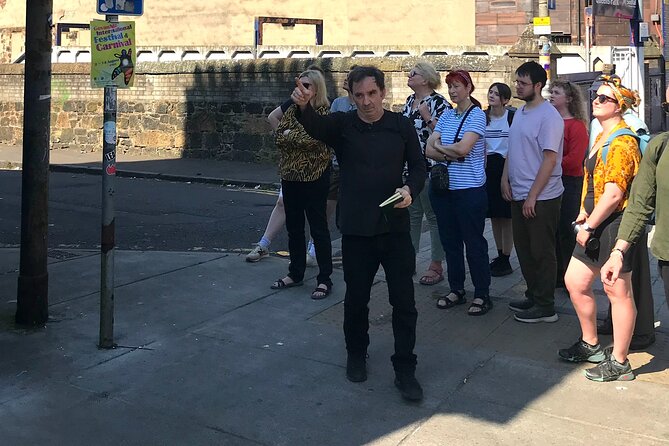
The walk begins at George House, 50 George Square. Allow time to find the meeting point and arrive ready to listen, because the opening section provides much of the background for the rest of the route.
The first major sight is Glasgow City Chambers, a grand headquarters for the city council. The exterior sculpture offers a clue to how Glasgow wanted to present itself in the nineteenth century. This is more than a quick photograph stop. The building introduces themes of civic pride, public wealth, and the way Glasgow’s leaders viewed their city.
Nearby, the Glasgow War Memorial honors citizens who died in the First World War. The stop is brief, but the symbolism marks a change in Glasgow’s story. The tour then turns to George Square’s statues, including Sir Walter Scott and Robert Burns.
The Scott monument reflects Scotland’s modern national image, while the Burns statue carries a more popular story. It was funded through small public contributions, with some people giving as little as five pence. About 30,000 people attended its unveiling. If your guide has the same flair for Burns as one previous guide, you may hear a poem recited beside the statue.
George Square can take longer than expected. That is useful if you want context before walking, but one person found the opening section slow. Construction has also affected parts of the square in the past, including access to some sights. Conditions can change, so do not assume every building or interior will be available on your date.
Merchant City reveals Glasgow’s money and manners
From the square, the route moves into the Merchant City area. This is where the tour begins to explain how commerce shaped modern Glasgow.
The Merchant’s House represents the city’s trading elite. Its position in the center and its formal appearance show how important merchants became. The nearby Trades Hall tells a different side of the story. It represented carpenters, tanners, dyers, and other trades, while also helping members who became too old to work.
Together, these places show that Glasgow’s business world had layers. Wealthy merchants controlled trade and civic influence, while craft organizations provided support within working communities. You get a more useful picture of the city when these institutions are considered together.
The route also passes an eighteenth-century Georgian townhouse with a notable family story. The exact amount of time here is short, but it adds domestic detail to the larger account of merchants and institutions.
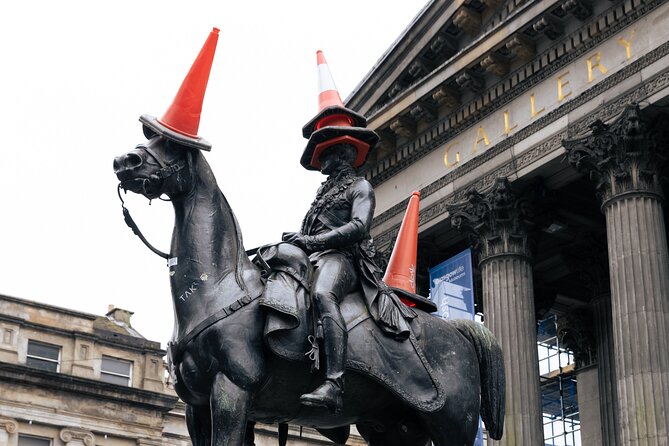
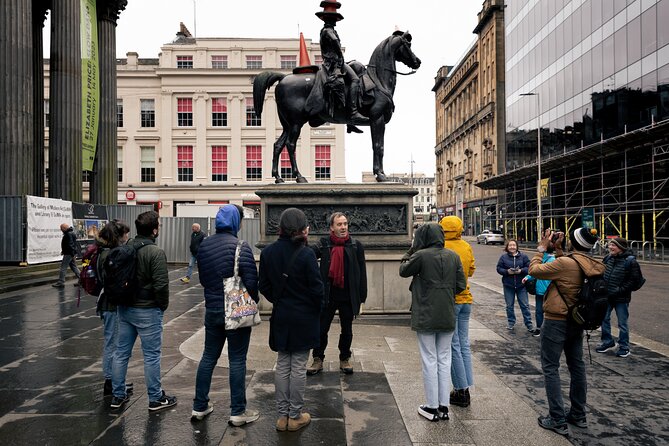
The Gallery of Modern Art occupies what was once a private mansion. Its changing uses reflect the way central buildings are repeatedly adapted as the city develops. Nearby, the Duke of Wellington statue offers a lighter moment. The military leader and former prime minister is famous in Glasgow for a traffic cone often placed on his head.
That joke is not just a photograph opportunity. It fits the city’s irreverent streak, and the guide uses it to show how Glasgow treats public symbols with a mix of affection and mischief.
Small details make the middle section memorable
One of the tour’s pleasures is the jump from major civic landmarks to places you might otherwise walk past. Paesano Pizza, for example, is a popular local restaurant, but its connection to a very unusual job opportunity gives the stop a bit of local flavor.
The route continues along an old street associated with candle makers. They worked apart from the main town because of the risk of fire. Later, markets and warehouses took over the area. Today it forms part of Glasgow’s cultural district.
This is where the walk feels most useful for first-time visitors. You are not only collecting names. You are learning how streets changed purpose over time. A former commercial quarter becomes a cultural area, while old buildings gain new lives as restaurants, clubs, theaters, galleries, or shops.
The Corinthian Club is another example. The building has served as a bank, courthouse, and county building before becoming a prominent club and wedding venue. The stop is short, but it reinforces one of the tour’s central ideas: Glasgow’s architecture often carries several different chapters.
The Saints of Ingram refers to a group connected with the old Merchants House, Trades House, and Hutchison’s Hospital. These institutions helped care for local people for many years. The tour uses them to show how charity and civic responsibility were organized before modern social services.
Same city, a very different afternoon:
- Guided Celtic Park Stadium Tour
★ 5.0 · 3,136 reviews - From Glasgow: Oban, Glencoe, Highland Lochs & Castles Tour
★ 4.9 · 2,123 reviews - City Sightseeing Glasgow Hop-On Hop-Off Bus Tour
★ 4.5 · 1,873 reviews - From Glasgow: Glenfinnan, Fort William, and Glencoe Day Trip
★ 4.7 · 1,753 reviews
The Old Fruitmarket and Trongate connect trade with culture
The Old Fruitmarket once served as a commercial center. The building remains, though its use has changed to retail. You can still walk through the old space and picture its earlier role.
This is a good place to pause and notice scale. Markets were not abstract economic systems. They were physical places where goods arrived, people worked, and neighborhoods earned their living. The surviving structure gives that past a shape you can see.
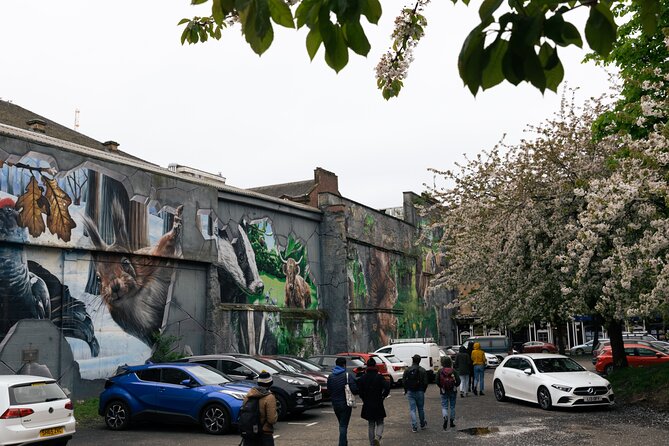
At Trongate 103, the route reaches an arts center that includes the Sharmanka Kinetic Gallery. The tour does not turn into a full gallery visit, but the stop points you toward Glasgow’s strong artistic side. Several people have especially liked the street murals seen along the route, including murals connected with St Mungo.
The city’s arts story is one of the areas where the walk could say more. You will see examples, but the commentary may not fully explain how Glasgow developed its cultural reputation. If art is your main reason for booking, use the tour as an introduction and plan extra time at galleries or mural sites afterward.
Music hall, market cross, and High Street
Britannia Panopticon Music Hall is one of the more unusual stops. It is described as the world’s oldest surviving music hall, and a young Stan Laurel performed there before becoming one half of a famous comedy partnership.
The stop offers a glimpse of working-class entertainment and popular culture. It also changes the mood after the more formal discussion of civic buildings and merchants. You see a city that did not live by commerce and religion alone. People came to music halls for comedy, performance, and an evening out.
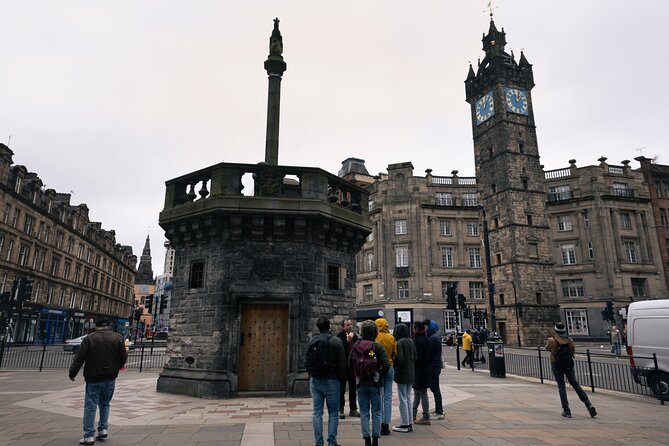
Mercat Cross recalls the medieval market system and the public proclamations once made there. From here, High Street brings the route into the medieval core of Glasgow.
The High Street section is one of the longest, at about 15 minutes. You pass the site of the old University, described as the fourth oldest in Britain, along with murals connected to St Mungo and other important buildings. This is a good stretch for understanding how the early city developed around institutions, worship, trade, and public life.
The route does require attention. You are listening while walking through active central streets, so it is easy to miss a detail if you are distracted by traffic, shops, or photographs. A quick pace helps the group cover ground, but it also means you should save some pictures for quieter moments.
St Mungo gives Glasgow its oldest story
The latter part of the walk turns toward Glasgow’s religious and medical past. The David Livingstone statue honors one of Scotland’s major explorers. It originally stood in George Square, a detail that shows how statues and civic spaces have been rearranged as the city changed.
The Ramshorn Theatre occupies a building that opened in 1824 on the site of an earlier church. Important Glasgow figures were buried there, and the building later served as a theater. It is now used for language studies by the University of Strathclyde.
The former church and the old hospital district make a strong pair. The Friends of Glasgow Royal Infirmary Museum relates to Glasgow’s oldest hospital, where medical innovations were developed. The stop is brief, so expect a pointer and explanation rather than a full museum visit.
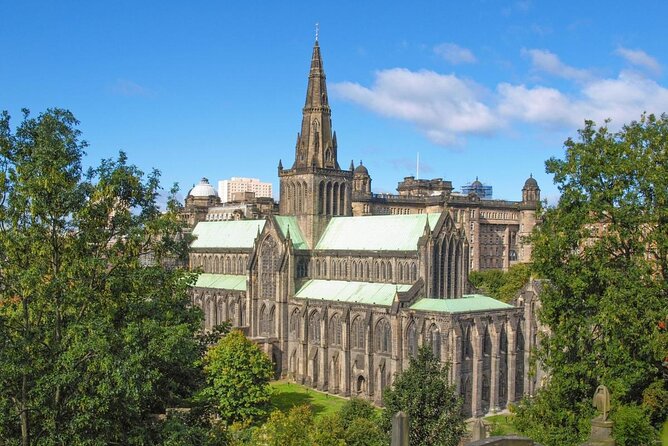
Glasgow Cathedral is the major finish point in the historical portion of the route. The building dates from the thirteenth century, though a church has occupied the site since the sixth century. The guide allows about 20 minutes here, giving you time to look inside and absorb the scale.
Access is not guaranteed on every departure. A private service once prevented entry, and construction has also affected some early stops. If seeing the interior is essential to you, treat it as a welcome possibility rather than the only reason to book.
The route also includes Provand’s Lordship, one of Glasgow’s oldest buildings apart from the cathedral. Dating from the fourteenth century, it gives the old city a domestic and practical counterpoint to the cathedral’s religious grandeur.
The St Mungo Museum of Religious Life and Art completes this section. The building was designed to look much older, while the museum presents different religions practiced around the world. It is a fitting final stop for a walk that has repeatedly returned to faith, charity, conflict, and community.
Timing, group size, and what the price buys you
The listed duration varies from about 2 hours 4 minutes to 2 hours 14 minutes, while the practical information says to allow roughly 2 hours 45 minutes. I would plan for the longer figure. The tour includes about 40 to 45 minutes of walking between main stops, and the guide may spend extra time answering questions or dealing with delays.
At $17.91 per person, the value is strong if you want a broad introduction to central Glasgow. There are no admission charges listed for the stops, so you are mainly paying for the guide’s time, local stories, route planning, and the chance to see many places efficiently.
The maximum group size is 15, which should allow for a personal feel. One group still found it hard to hear at times and would have preferred fewer people. Stand close to the guide, especially in noisy streets, and tell the guide if you are missing details.
The walk is offered in English and uses a mobile ticket. Service animals are allowed, and the starting point is near public transportation. Most people can take part, but you should be comfortable walking and listening for more than two hours.
Free cancellation is available up to 24 hours before the start time. Poor weather or too few bookings can also lead to a changed date or full refund. Since the experience depends on walking outdoors, check the forecast and wear sensible shoes.
Who should book this Glasgow history walk?
I would choose this tour if you have just arrived in Glasgow and want a clear first look at the center. It is especially useful if you are staying near Merchant City, since the route helps you understand the streets around you and points out places worth revisiting.
It also suits people who enjoy odd details and local characters more than a formal lecture. The cone on Wellington, the candle makers’ street, the Panopticon, the Burns statue, and the old hospital give the walk plenty of variety.
You may want a different experience if you dislike walking, need a slow pace, or want a tightly focused study of architecture. The tour covers a lot of ground, and one part of the group found it too long after George Square. It can also feel like a sequence of stops unless you actively ask the guide to connect the bigger themes.
Should you book it?
Book this walk if you want a lively orientation with real local color at a low price. Bruce and Henry Bell have both been praised for clear delivery, humor, and strong knowledge of Glasgow, though the guide on your date may be different.
Give yourself extra time afterward around Ingram Street, the cathedral area, or Merchant City. The tour does not finish where it starts, and the ending places you in an area worth exploring rather than sending you straight back to George Square.
Skip it only if you want a quiet, highly specialized tour or a short loop that ends at the starting point. For most first visits, the mix of grand buildings, medieval sites, murals, music history, and Glasgow’s sharper stories makes this a useful and entertaining beginning.
FAQ
How long does the tour last?
The published timing ranges from about 2 hours 4 minutes to 2 hours 14 minutes, while the additional information says approximately 2 hours and 45 minutes. Plan for the longer time so you are not rushed afterward.
Where does the tour start?
It starts at George House, 50 George Square, Glasgow G2 1EH, UK.
Where does the tour end?
It ends near Ramshorn Church at 98 Ingram Street, Glasgow G1 1EX, not back at George Square.
How much walking is involved?
Walking between the main attractions takes about 40 to 45 minutes. The tour also includes time standing at the various sights.
Is the tour offered in English?
Yes. The experience is offered in English.
What is the maximum group size?
The maximum is 15 people.
Are admission tickets included?
The listed stops show free admission. The tour includes exterior commentary and a look inside Glasgow Cathedral when access is available, but entry to every building is not guaranteed.
Can service animals join the tour?
Yes. Service animals are allowed.
What is the cancellation policy?
You can cancel up to 24 hours before the start time for a full refund. Changes or cancellations made less than 24 hours in advance are not accepted for a refund. If poor weather or too few bookings cancel the experience, you will be offered another date or a full refund.
Just added in Glasgow
- Walking Tour of Glasgow★ 5.0 · 96 reviews
- Watch Closely – An Evening of Magic★ 5.0 · 75 reviews
- Stirling Castle, Loch Lomond Walk & Whisky Distillery Tour from Glasgow★ 5.0 · 79 reviews
- Glasgow Evening Dining Experiences★ 4.5 · 38 reviews
- Standing Stones, Inveraray and Kilchurn Castles & Highland Tour starting Glasgow★ 5.0 · 258 reviews
- Scottish Whisky Distillery Tour★ 4.5 · 28 reviews
- St Andrews and the Kingdom of Fife from Glasgow★ 5.0 · 68 reviews
- Private Tour of Highlands, Oban, Glencoe, Lochs & Castles from Glasgow★ 5.0 · 169 reviews
Historical Tours, compared.
A History of Terror – Belfast City Centre Walking Tour
Read our review →
Old Town Walking Tour History and Tales in Edinburgh
Read our review →
Shadows of York: Ghost Walk and Horrible History.
Read our review →
Multi-Sensory Small-Group Historic Vaults Tour in Edinburgh
Read our review →
Browse the lists this tour appears in