Reviewed · WALKING TOURS
Falmouth Uncovered Walking Tour (Award Winning)
Falmouth’s past is not a polite parade of naval dates. It is a lively mix of pirates, smugglers, sailors, murderers, religious outsiders, musicians, and one former slave who became a local celebrity. This 90-minute walking tour uses those characters to make the town easier to understand and much more fun to explore.
I like two things here. First, the guides turn local history into stories you can remember, often with humor, period costume, or an accordion and sea shanty. Second, the route moves beyond the obvious shopping streets to older corners, harbour views, and Smithick Hill. The drawback is simple: Falmouth is hilly, and one section includes a short but steep climb and some stairs.
Key points before you book
- Pirates open the story: Begin with the Killigrew family, the ruthless founders who helped create Falmouth.
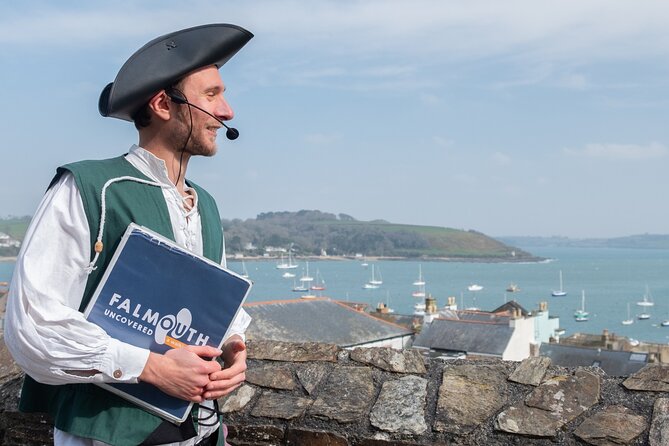
- Music is part of the tour: Guides such as Will and Bobby may use an accordion or melodeon and sing sea shanties as they walk.
- You see more than the main street: The route includes Gyllyng Street, Smithick Hill, Market Street, the harbour, and Prince of Wales Pier.
- The tone is lively: Expect humor, odd local characters, crime, scandal, and tales of Falmouth’s famous outsiders.
- Families can join in: Children receive an activity sheet, and the storytelling is designed to hold their attention.
- Plan for a climb: You need a moderate level of fitness, with hills and occasional stairs along the route.
Why Falmouth’s rough edges make the tour work
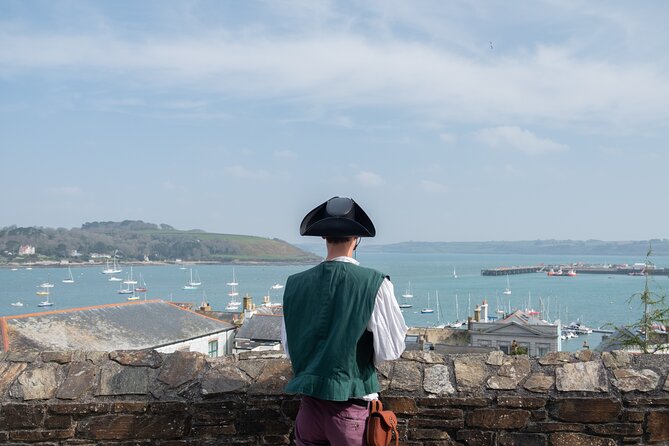
Falmouth can first appear to be a pleasant Cornish harbour town with shops, boats, and a handsome waterfront. This walk shows you the less tidy version. The town grew through maritime trade, but its streets also held violence, poverty, vice, religious tension, and people from many countries.
That gives the tour a welcome sense of character. You are not simply told when a building was built. You hear what sort of people lived nearby, how sailors shaped the town, and why Falmouth became known as a place of outsiders.
The presentation is a major part of the experience. Will is praised for his clear delivery, humor, music, and personal connection to the route. Bobby brings a different theatrical touch, including a pirate-style costume and his role as the newly appointed town crier. The guides do not all present the material in exactly the same way, but the common thread is enthusiasm and storytelling.
The tour has earned a 5 out of 5 rating from 267 ratings, with 100 percent of participants recommending it. That fits the experience described here: the appeal lies less in grand monuments and more in the guide’s ability to make ordinary streets feel full of stories.
More walks around England:
- Oxford University Walking Tour With University Alumni Guide
★ 5.0 · 6,905 reviews - Tour for Muggles The Ultimate Harry Potter Walking Tour in London
★ 5.0 · 4,684 reviews - London Jack The Ripper Guided Walking Tour
★ 5.0 · 3,131 reviews
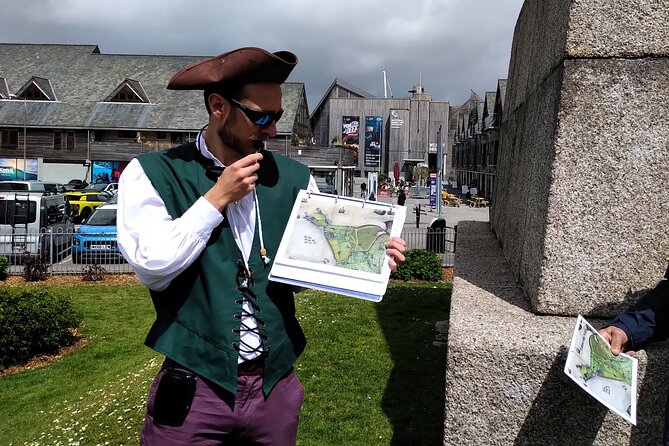
Starting at the Killigrew Monument
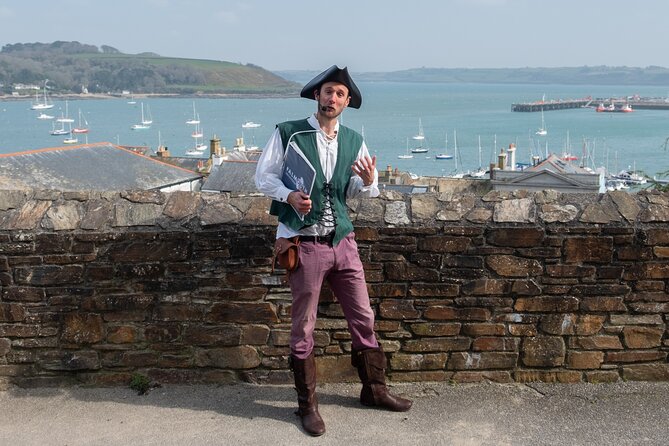
The walk begins at Grove Place Toilets, at Falmouth TR11 4AU, then heads to the Killigrew Monument. This is an effective opening because it places the town’s origins in the hands of a family with a distinctly rough reputation.
The Killigrews are presented as pirates who founded Falmouth. Their story sets the tone for everything that follows. You are not entering a museum lecture about respectable civic development. You are hearing how ambition, violence, seafaring, and opportunity helped shape the town.
Allow about 15 minutes here. Admission is included in the walk, and the stop is short enough to keep the opening moving. If you enjoy stories about powerful families and questionable behavior, this is likely to be one of the strongest starts to the tour.
The guide’s delivery matters at this point. A dry account of the Killigrews would lose much of its force. With costume, humor, or a musical flourish, the tale becomes an introduction to the sort of colorful local characters you will meet throughout the morning or afternoon.
Custom House Quay and Falmouth’s maritime rise
At Custom House Quay, the focus shifts from one family to the town’s growth as a maritime center. Falmouth went from very little to a port known around the world, and the quay gives you a fitting place to understand that change.
You spend about 15 minutes here. The key value is context. The harbour is not just a pretty view behind your photographs. It explains why Falmouth developed, who arrived, and how sea traffic brought money, work, conflict, and new ideas.
This stop should help you read the town more clearly for the rest of your visit. Streets and waterfront buildings make more sense once you understand that Falmouth’s identity grew from the sea.
The route also suits cruise passengers and first-time visitors. The starting point is easy to reach from the cruise port area, and the tour gives you a quick grounding in the town before you spend time shopping, visiting nearby sights, or exploring the harbour on your own.
Gyllyng Street and the town of outsiders
Gyllyng Street is one of the most revealing stops. The guide explains Falmouth during the age of sail, when the town was a meeting place for different nationalities and religious groups.
That mixed population is important. Falmouth was not presented as a sealed-off Cornish community. Sailors, merchants, workers, and newcomers rubbed shoulders in a port shaped by international movement. The phrase town of outsiders captures the unusual social character the guide wants you to notice.
This stop lasts about 20 minutes and also provides a view across Falmouth from above. That visual pause helps break up the storytelling. You get a chance to look at the town as a whole, then connect its streets and harbour with the stories you have just heard.
There is a small physical cost. The walk includes a climb toward the oldest street, and some visitors may find this section demanding. It is described as a short climb, but you should still wear sensible shoes and avoid assuming that a town walk means flat pavement throughout.
The guide does not rush the group. That matters on a route with hills. You have time to listen, look around, and keep up without feeling pushed along.
Same city, a very different afternoon:
- Stonehenge, Windsor Castle, and Bath from London
★ 4.5 · 18,662 reviews - London Big Bus Hop-On Hop-Off Tour with Optional River Cruise
★ 3.5 · 10,803 reviews - London Small Group Tour of Historical Pubs
★ 5.0 · 10,422 reviews - Beatles Magical Mystery Tour
★ 5.0 · 9,266 reviews
Smithick Hill, crime, and old street life
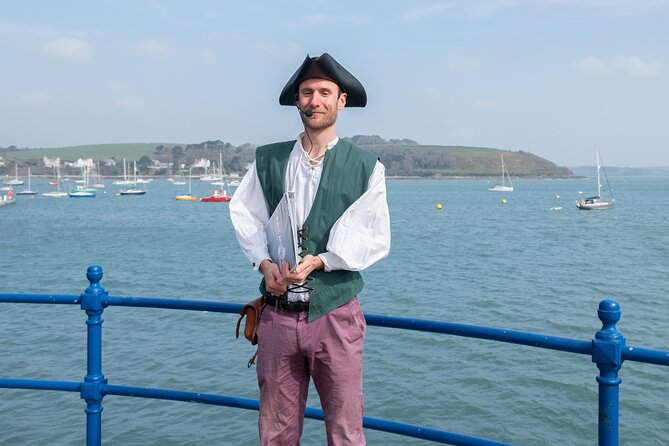
At Smithick Hill, the story takes a darker turn. This is where you hear about murders, violence, and general bad behavior on Falmouth’s streets.
The stop lasts about 20 minutes, making it one of the longer sections. That extra time allows the guide to build a picture of street life rather than simply list crimes. The point is not to make Falmouth seem dangerous today. It is to show that historic port towns were noisy, crowded, rough places where sailors, workers, strangers, and local residents all crossed paths.
This part will suit you if you like social history more than architectural detail. You learn about what happened in the streets and how people behaved, not just what buildings looked like.
It may be less appealing if you prefer a tidy sequence of dates and famous buildings. The tour is intentionally anecdotal. It follows memorable people and incidents, so the storytelling can sometimes feel more extended than the historical framework.
The hill and stairs also deserve attention here. You should have a moderate level of fitness. One participant in their eighties completed the walk, but the route is not ideal for every mobility level. The guide has adapted the route for guests’ abilities in the past, yet you should ask about current conditions if hills or stairs are a serious concern.
Market Street and Falmouth’s stranger stories
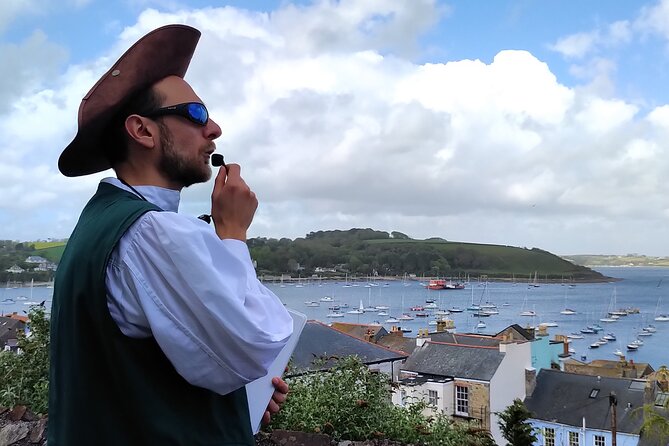
Market Street brings you into the heart of old Falmouth. You spend around 10 minutes here, hearing about the women who once worked the area and the arrival of people associated with one of the town’s most startling tales: the famous cannibal arrivals.
This is exactly the kind of material that makes the walk different from a standard town orientation. You are not only shown the main street. You are encouraged to picture the people who used it, the trades that operated there, and the behavior that polite town histories often leave out.
The stories can be macabre, but the tone remains playful rather than grim. Humor helps keep the walk accessible, especially for families and visitors who do not usually choose formal history tours.
Children receive an activity sheet, which gives younger members of the group something practical to do while the guide talks. The subject matter is not a preschool version of Falmouth, so parents should decide if their children are comfortable with tales involving crime and cannibalism.
Ending at Prince of Wales Pier
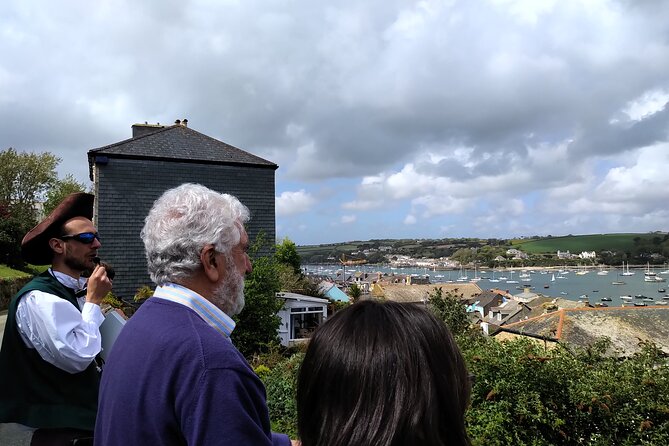
The final stop is Prince of Wales Pier, where the route ends surrounded by Falmouth Harbour. This is a strong finish because the walk returns to the water that shaped the town.
You spend about 10 minutes hearing the story of a former slave who became a local celebrity. It adds another layer to the theme of outsiders and newcomers. Falmouth’s story is not only about pirates and sailors. It also includes people who arrived from very different circumstances and found a place in local life.
The pier gives you time to take in the harbour after the denser street stories. You can finish with a clear sense of how the town’s geography, port, and social life connect.
Ending at Prince of Wales Pier is also useful for planning the rest of your day. You are left in the harbour area rather than returned to the starting point. That means you can continue exploring from there, but you should remember that the tour is not a loop.
Guides, music, and the value of performance
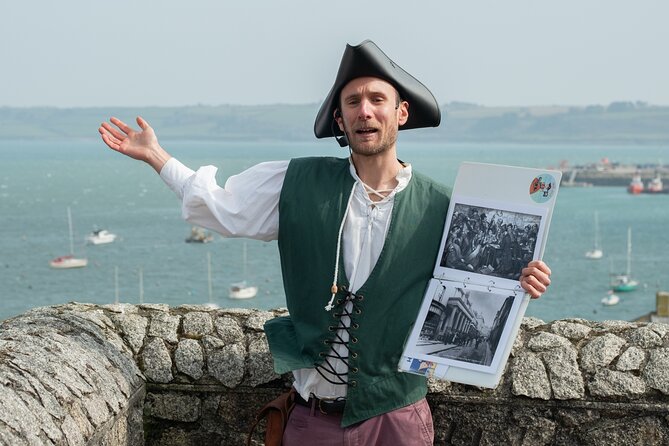
The strongest feature is the guide’s presentation. Will is repeatedly praised for his humor, clear speaking voice, local stories, and use of music. Bobby is described as an energetic guide in period costume, with a strong feel for Falmouth’s character. Another guide is noted for playing an accordion while walking.
The musical element is not just decoration. A sea shanty or tune gives the group a change of pace and helps place the port in a world of sailors and working waterfronts. A small loudspeaker is used, and it has been clear enough for people to hear and interact with the guide.
A costume can also help children and adults focus. Seeing a guide dressed in an old-style outfit or as a pirate makes the performance memorable without requiring a display case or formal museum setting.
The experience does depend on the guide assigned that day. That is worth saying plainly. The tour format is strong, but the precise balance of songs, jokes, personal stories, and historical detail may vary. Most of the praise centers on the guides’ energy and ability to make the town feel alive.
Price, group size, and practical value
At $22.18 per person, this is a reasonable price for a 90-minute guided introduction to Falmouth. You are paying for a focused route, live interpretation, local stories, music, and the ability to ask questions as you go.
The value is especially good if this is your first visit. You get the broad outline of Falmouth’s development, plus enough unusual detail to make later independent exploring more rewarding. I would book it early if your dates are fixed, since it is often reserved around 55 days ahead.
The maximum group size is 25 people. That is large enough to create a social tour but small enough for the guide to manage, especially with a microphone. One larger group of about 30 was handled well, though a group near the official limit may feel less intimate than a private walk.
The activity is offered in English and uses a mobile ticket. Confirmation arrives at booking. Service animals are allowed, and the starting point is near public transportation.
Wear shoes that can manage a short climb and occasional stairs. The tour requires reasonable fitness, though the pace is not described as rushed. It also depends on good weather. If poor weather cancels the walk, you can receive a full refund or move to another date. You can cancel for a full refund up to 24 hours before the start time.
Who should choose this Falmouth walk?
I would choose this tour if you want a quick, entertaining introduction rather than a long academic lecture. It suits first-time visitors, cruise passengers, families with older children, and anyone who likes local scandals, maritime tales, and unusual characters.
It is also a good match if you want to see corners of Falmouth you might skip on your own. The views from Gyllyng Street and the older streets around Smithick Hill add variety to the walk.
You may want another option if hills and stairs are difficult, if you want detailed modern social and economic information, or if you prefer architecture over anecdotes. One participant wanted more about how people live and make money in Falmouth today. This experience focuses mainly on the town’s past and its memorable characters.
Should you book the Falmouth Uncovered Walking Tour?
Book it if you want history with jokes, music, and a little mischief. The guide-led storytelling is the reason to come, not a long list of monuments. You will leave with a better sense of how pirates, sailors, outsiders, crime, trade, and the harbour shaped Falmouth.
The best practical choice is to take it early in your stay, or early on your day in town. It gives you names, streets, and stories to recognize later. Just allow for the hill, the stairs, and the possibility of changeable weather. At $22.18, it is a solid way to spend an hour and a half in Falmouth.
FAQ
How long does the Falmouth Uncovered Walking Tour last?
The tour lasts approximately 1 hour and 30 minutes.
Where does the tour start?
It starts at Grove Place Toilets, Falmouth TR11 4AU, UK.
Where does the tour finish?
The tour ends at Prince of Wales Pier, Falmouth TR11 3DF, UK.
What language is the tour offered in?
The tour is offered in English.
How much does the tour cost?
The listed price is $22.18 per person.
Is the tour suitable for children?
Yes. It is described as child-friendly, and an activity sheet is provided for children.
Do I need to be fit for the walk?
You should have a moderate level of physical fitness. The route includes hills and occasional stairs, including a short climb toward the oldest street.
How many people can join the tour?
The maximum group size is 25 people.
Are service animals allowed?
Yes. Service animals are allowed.
Can I cancel for a refund?
Yes. You can cancel at least 24 hours before the start time for a full refund. Cancellations or changes made less than 24 hours before the start time are not refunded or accepted.
What happens if bad weather cancels the tour?
You will be offered a different date or a full refund if poor weather causes the tour to be canceled.
Just added in England
- 3-Day Stonehenge*, Glastonbury, Bath & the South West Coast Tour from London★ 4.5 · 32 reviews
- Private Guided Tour of Harry Potter Locations – English/ Italian★ 5.0 · 33 reviews
- Private Tour London Highlights, entries Westminster Abbey, The Tower of London★ 5.0 · 93 reviews
- 2 Hour Walking Tour from Buckingham Palace to Big Ben★ 5.0 · 32 reviews
- 30 Major London Attractions Walking Tour With Photos★ 4.5 · 51 reviews
- 007 Shadow Of Spectre★ 5.0 · 135 reviews
- Private Guided Tour of the British Museum – Tickets Included★ 5.0 · 193 reviews
- Bath, Avebury and Lacock Village Small-Group Day Tour from London★ 4.5 · 121 reviews
Walking Tours, compared.

Magical London: Harry Potter Guided Walking Tour
Read our review →
Underground Vaults Walking Tour in Edinburgh Old Town
Read our review →
Oxford University Walking Tour With University Alumni Guide
Read our review →
Edinburgh Castle: Guided Walking Tour with Entry Ticket
Read our review →
Edinburgh Castle Guided Walking Tour in English
Read our review →
Tour for Muggles The Ultimate Harry Potter Walking Tour in London
Read our review →