
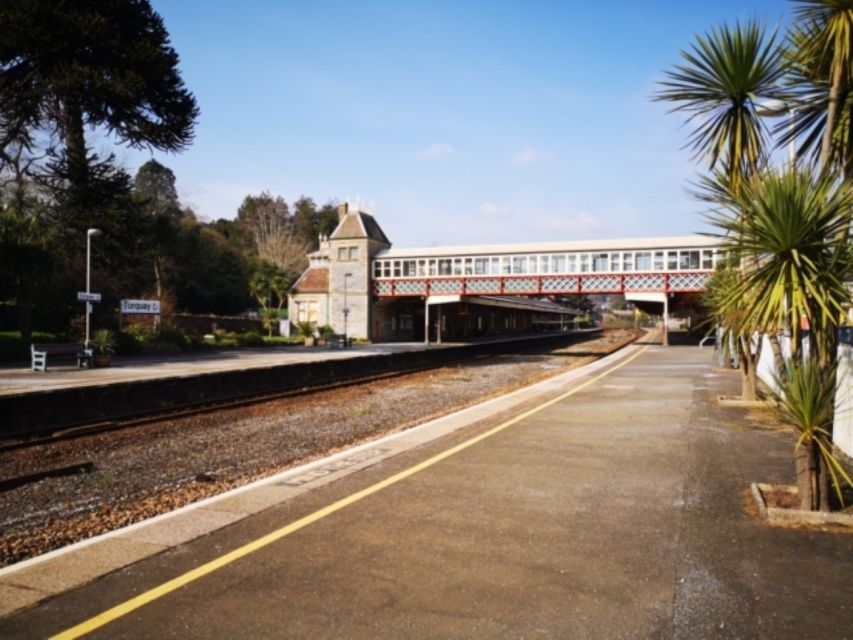
Reviewed · BRITAIN
Torquay: The extraordinary life of Agatha Christie tour
Agatha Christie’s Torquay was not just her birthplace. It was the setting that gave her characters their habits, her plots their locations, and her imagination some of its most useful ingredients. This 2.5-hour walking tour connects those pieces along the English Riviera, from the Pavilion and Princess Pier to Torre Abbey and the Grand Hotel.
I like the way the tour links Christie’s books to real places rather than treating her life as a list of dates. I also like Graham’s approach: he mixes solid detail with gentle humor, quizzes, photos, props, and a little theatrical fun. The one drawback is simple: even though the route is flat, three miles on foot can feel long in poor weather or if you need frequent rest stops.
Key points to know before you book
- Agatha’s Torquay years: Follow the story of the first 30 years of her life, from her childhood home to the places she knew as a young woman.
- Real locations with literary connections: See Princess Pier, the Pavilion, the Italian Gardens, Torre Abbey, and the area around the Grand Hotel.
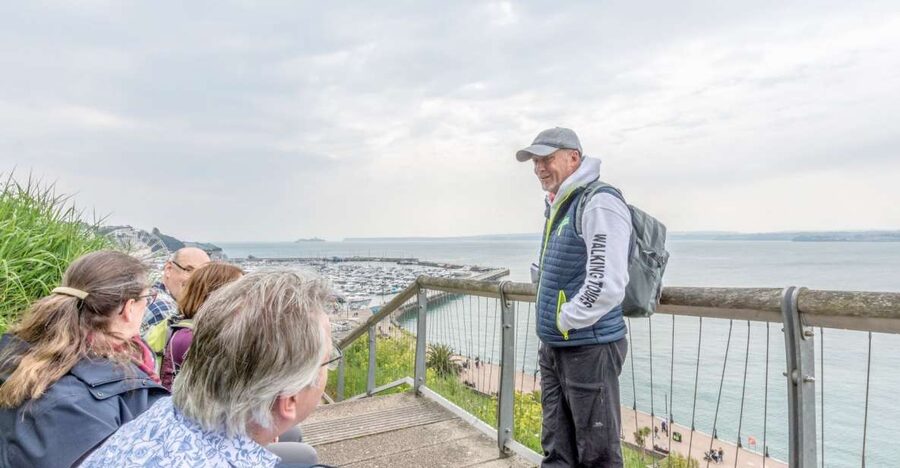
- A guide who keeps the pace lively: Graham is known for clear storytelling, local tips, photos, jokes, and a friendly manner.
- Hands-on Christie fun: Use a few props to become Poirot or Miss Marple, and take part in a playful murder scene near Agatha’s bust.
- A practical coastal walk: The route is roughly three miles and mostly flat, but comfortable shoes and weather-ready clothing still matter.
Starting with Agatha Christie’s first Torquay chapter
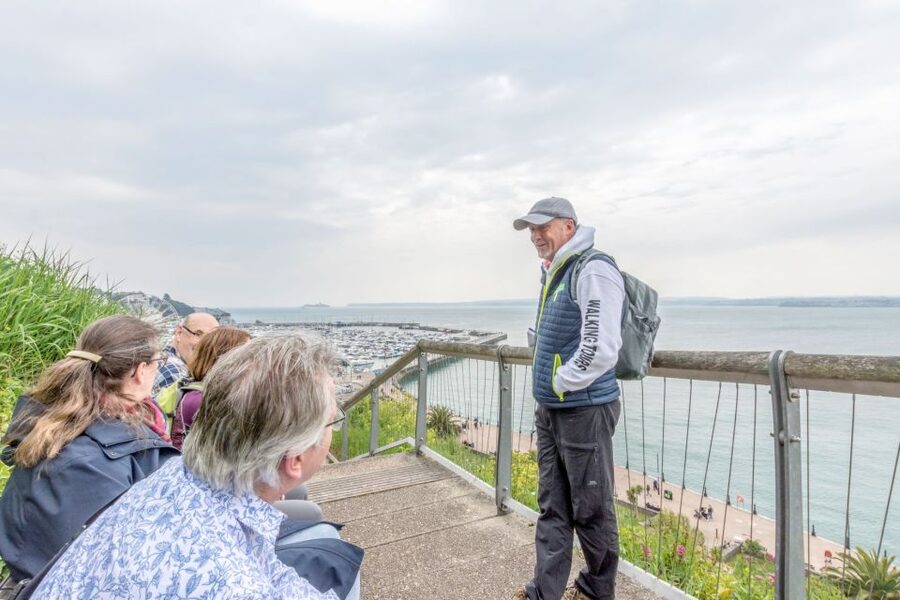
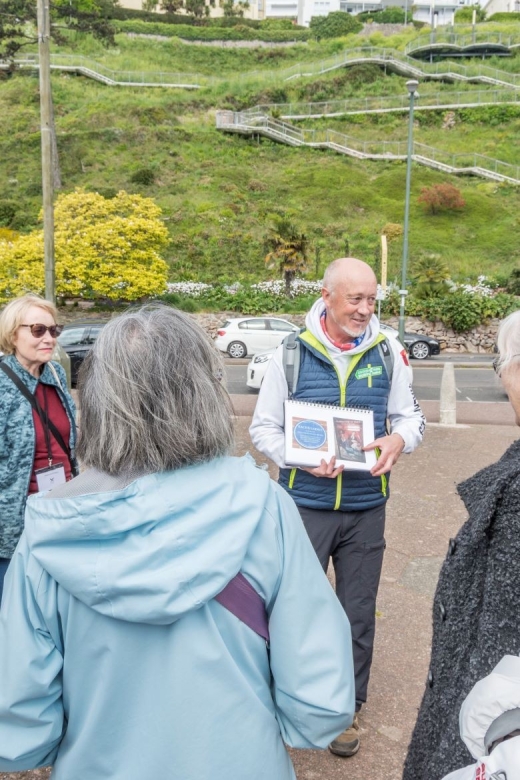
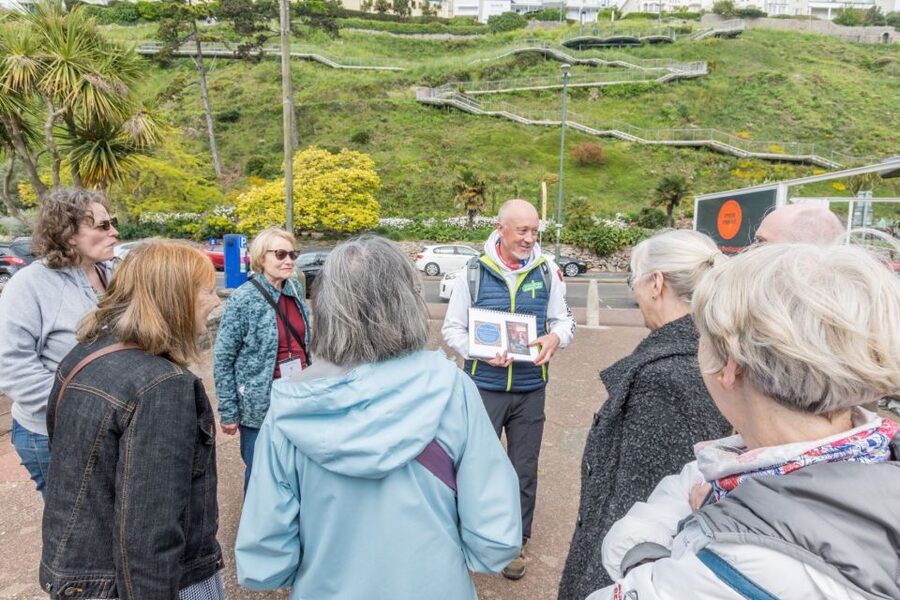
The tour begins at the English Riviera Tourist Information Office, close to the center of Torquay. Look for Graham in a yellow fluorescent jacket. This is a useful meeting point if you are new to town, since you can combine the walk with your first look at Torquay’s central seafront area.
Graham starts with Christie’s early years. Agatha spent the first 30 years of her life in Torquay, growing up in a large Georgian villa with views toward the sea. The important point is not simply that she was born here. Her surroundings gave her a strong sense of the people, manners, social gatherings, and seaside routines that later found their way into her fiction.
I appreciate this opening because it places Christie in a real community. You hear about the local people she met and the places she visited, then see how those experiences could feed a writer’s imagination. The tour is not limited to famous novels. It also considers the young woman Christie was before writing became her career.
Graham uses photographs and visual material to support the stories. That helps when you are standing outdoors and trying to picture Torquay as Christie knew it. His storytelling style is conversational, and the humor keeps the early biographical material from becoming a dry lecture.
Other tours people book in Britain:
- London: The London Eye Entry Ticket
★ 4.6 · 35,875 reviews - From London: Harry Potter Warner Bros Studio Tour
★ 4.7 · 26,588 reviews - Magical London: Harry Potter Guided Walking Tour
★ 4.7 · 22,044 reviews
The Pavilion and a seaside proposal
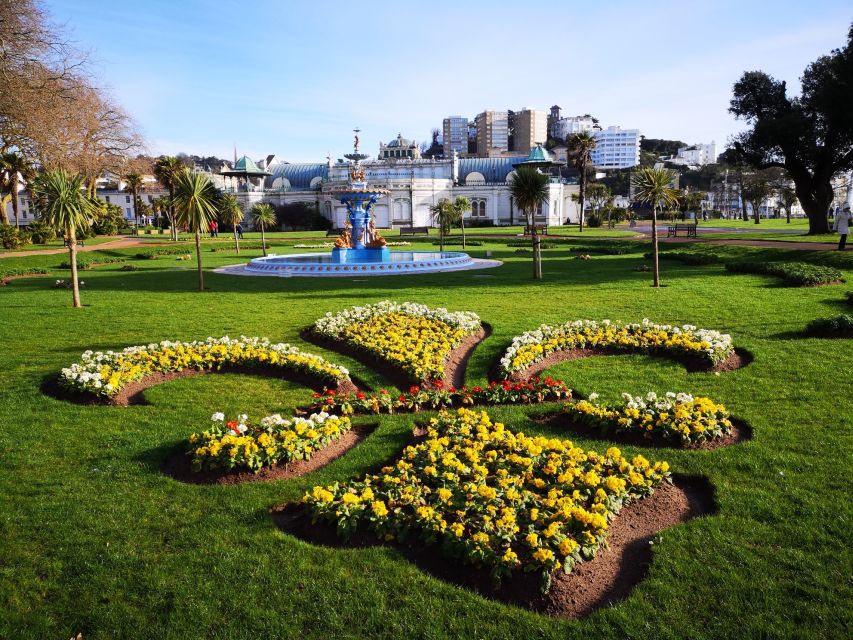
The route follows the coast toward Torquay’s famous Pavilion. This part of the walk gives you a pleasant change of pace: instead of hearing about Christie in an indoor museum, you are moving through the public places where she spent time.
The Pavilion is linked to an important personal moment. Agatha and Archibald Christie, her first husband, watched a concert here, and Archibald proposed to her afterward. The detail brings a familiar name out of the pages of biography and puts him into the same young, social Torquay world as Agatha.
You also get a sense of the town as a resort. Torquay’s seafront was a place for promenades, concerts, fashionable clothes, and social display. That atmosphere helps explain why Christie’s stories often work so well in enclosed social settings. A hotel, house, train, or village gathering can become a stage where everyone has something to hide.
The route is flat, but the coast can be exposed to wind. Graham has adjusted stops and gathering points to give people shelter when possible. Still, bring a jacket outside the warmer months, and do not assume a sunny forecast means the seafront will feel warm.
Princess Pier and a glimpse of 1910 Torquay
At Princess Pier, the tour reaches one of its most appealing historical stops. Agatha and her friends used to roller skate here, alongside wealthy Victorians taking their promenade in their best clothes.
You can stand in the same spot where Agatha stood in 1910. It is a small detail, but this is exactly the sort of detail that makes a walking tour worth doing. You are not only hearing about her connection to Torquay. You are placing yourself in a location she actually knew.
Princess Pier also shows the contrast between Christie’s quiet personal memories and the grand public image of the resort. Roller skating, promenading, concerts, and seaside society all formed part of the social world around her. You can see why Torquay remains an especially suitable place to explore her life. The town supplies atmosphere without needing a set or costume department.
This stop is also a good example of the tour’s limits. You are visiting public outdoor locations, not entering a Christie museum at every stage. The price covers the guided walk, but food, drinks, and admission to buildings are not included. If you want a more formal museum visit, plan that separately.
The Italian Gardens and Torre Abbey

The walk continues through the Italian Gardens and on to Torre Abbey, Torquay’s oldest building. These stops give the tour some visual variety, with gardens and historic surroundings replacing the open seafront.
Torre Abbey matters to Christie’s story because of a 1916 soiree arranged for Belgian refugees. At that event, Agatha met the man who helped inspire Hercule Poirot. You will hear how that meeting shaped one of the most recognizable detectives in fiction.
This is one of the tour’s strongest connections between ordinary life and literary invention. Poirot can seem entirely fictional, yet the character had a real-world spark. Christie noticed people, voices, habits, and mannerisms, then reshaped them into something larger and more lasting.
Torre Abbey is also where the tour explores Miss Marple. You will hear how Christie created her village detective and why she preferred writing Miss Marple stories to Poirot novels. That comparison adds useful depth. Poirot and Miss Marple are not simply two famous names. They represent different ways of seeing a crime, and Christie’s preference tells you something about the kind of character she most enjoyed writing.
The grounds are an especially pleasant place for this part of the story. You can listen while walking through an old setting rather than standing beside a busy road. Seats and toilet stops have been worked into the route when needed, although the exact timing can vary.
Same city, a very different afternoon:
- London: Madame Tussauds London
★ 4.6 · 20,915 reviews - Stonehenge, Windsor Castle, and Bath from London
★ 4.5 · 18,662 reviews - London: Warner Bros. Studio Tour with Transfers
★ 4.7 · 17,586 reviews - Edinburgh: Loch Ness, Glencoe & the Scottish Highlands Tour
★ 4.6 · 17,446 reviews
From a sister’s bet to a first published Poirot novel
The tour also covers Christie’s route into writing. Becoming an author was not originally her plan. A bet from her sister encouraged her to write the first Poirot novel that was published.
I like this part because it cuts through the idea that famous writers always know their calling from childhood. Christie’s career grew from encouragement, persistence, and a willingness to try something new. The story also gives you a better sense of her determination. Her later output was enormous, but it began with an experiment that could easily have remained just that.
The guide uses this point to connect Christie’s personal life with the scale of her achievement. She would eventually sell millions of novels each year, but the walk keeps bringing the story back to individual choices and local places.
If you have never read the books, you can still enjoy this section. The tour is designed around Christie’s life and Torquay, not as a test of literary expertise. Fans of television versions of Poirot and Miss Marple will recognize plenty of names, while newcomers get enough context to follow the story.
Nursing, poison, and the practical side of crime writing
When the First World War began, Agatha volunteered as a nurse and worked at Torquay’s Town Hall. Later, she moved to the dispensary, where she learned about medicines and poisons.
That experience influenced her use of poison in her novels. The point is not that Christie simply collected sinister ideas. Her work brought together observation and practical knowledge. The dispensary gave her a working awareness of substances that could later help her construct believable crimes.
This part of the tour adds balance to the glamorous image of Christie as a celebrated author. She worked, volunteered, learned, and adapted. Her books may feature country houses and elegant travelers, but her knowledge also came from useful jobs and wartime service.
Graham presents these details with enough drama to suit the subject, but the tone remains light. His humor includes plenty of bad jokes, which you will either enjoy or politely endure. Based on the way he runs the walk, you can expect participation rather than a formal lecture. There may be questions, small quizzes, and opportunities to join in.
The disappearance, the Middle East, and a second marriage
No Agatha Christie tour can avoid the eleven-day disappearance that led to one of the biggest manhunts in British history at the time. The tour recounts this unsettling chapter and explains how it affected Christie’s life afterward.
This section is handled as part of the wider story, not as a cheap mystery added for shock value. The disappearance forced Christie to leave the country and head to the Middle East. Her experiences there later helped inspire novels such as Murder on the Orient Express and Death on the Nile.
The Middle East chapter also led to Christie meeting her second husband, Max Mallowan. For you, this part of the walk shows how travel and personal upheaval fed into her work. Her settings were not random backdrops. Places she visited could become central to the mood and structure of a novel.
The topic is serious, so the guide’s ability to balance drama with care matters. Graham is known for adding theatrical touches and telling stories with feeling, but he also pays attention to the group. In hot weather, he looks for shade. In wind or rain, he seeks more sheltered places where possible.
The Grand Hotel and Christie’s wartime writing

The walk ends near the Grand Hotel, where Agatha and Archie spent their honeymoon. It is a fitting final location because the tour returns to the personal side of her story after covering war, travel, marriage, disappearance, and literary success.
Here you discuss how Christie’s writing helped keep the nation’s morale up during the Second World War. Her books provided escape and routine during a difficult period, and she would later receive a Damehood.
The ending also gives the tour a wider frame. Christie’s connection to Torquay was only one part of her life, but it was the foundation for many later chapters. You finish with a clearer sense of how the local girl from a seaside town became one of the world’s best-selling authors.
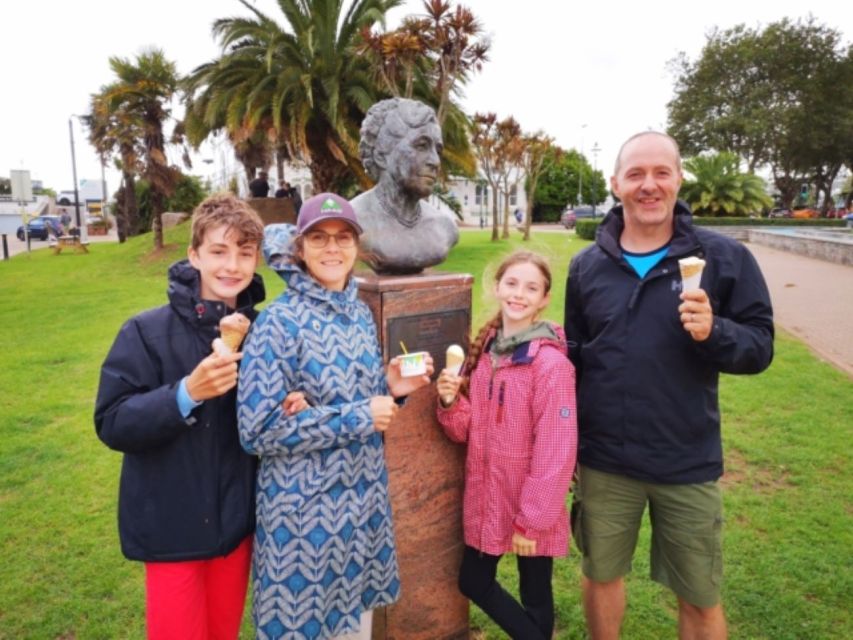
A playful activity near Agatha’s bust adds a memorable final note. With a few props, you can transform into Poirot or Miss Marple, then commit a mock murder in front of the bust. It is deliberately theatrical and a little silly. I would not count on it as a serious photo shoot, but it gives families and mixed-age groups an easy way to join the story.
The guide, pace, and value at $26
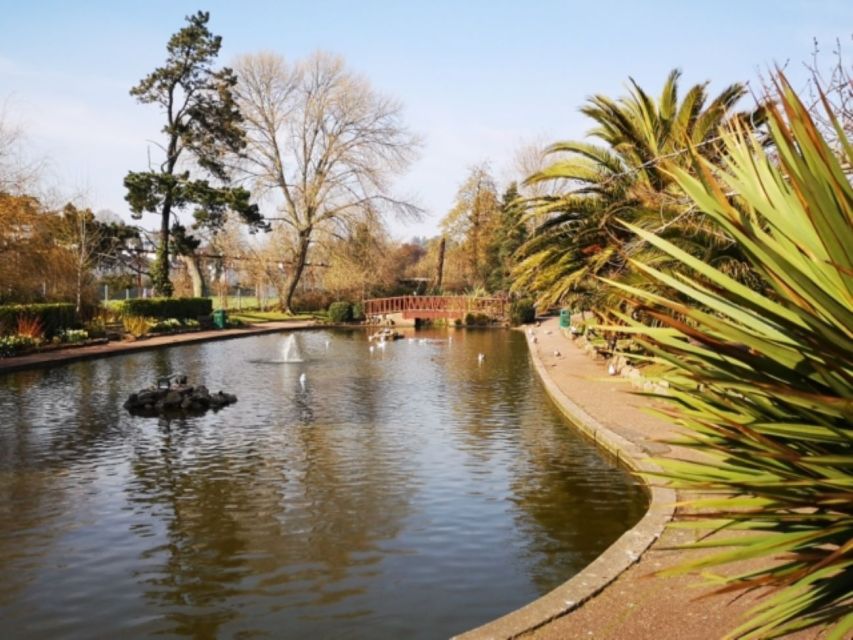
At $26 per person, this is good value if you want both a biography and a guided introduction to Torquay. You are paying for two and a half hours of local storytelling, several Christie-related stops, seaside views, and a route that also helps you get your bearings in town.
The strongest part of the value is Graham himself. His style combines facts, anecdotes, photographs, local history, and humor. He also offers suggestions for other things to do around Torquay and the surrounding area, which can be useful if this is your first visit.
The walk is usually described as roughly three miles and flat. One booking experience lasted about three hours, so allow a little flexibility if the group pauses often or the storytelling runs over. You should wear comfortable clothes and shoes. High heels are not allowed, and bikes, mobility scooters, handcarts, drones, alcohol, drugs, and bare feet are not permitted on the activity.
The tour is conducted in English. Some international participants have found Graham easy to follow, but you should have enough English to understand a live walking talk. There is no food or drink included, and you do not enter the buildings as part of the guided experience.
You can cancel up to 24 hours ahead for a full refund, and the reserve-now, pay-later option keeps your plans flexible. Those policies are useful if your Torquay schedule depends on the weather.
Who should take this Torquay walk?
I would choose this tour if you enjoy Christie’s novels, television adaptations, biography, or the process behind fictional characters. It works particularly well for someone who wants to connect Poirot and Miss Marple with the places that shaped their creator.
You do not need to have read every Christie novel. The walk also suits anyone looking for an entertaining introduction to Torquay, since the route includes local history and attractive parts of the seafront.
It may be less suitable if you want indoor attractions, detailed access inside historic buildings, or a very quiet academic lecture. The humor is part of the experience, and the walking route takes around three miles. People who need a fully step-free or scooter-friendly activity should check carefully before booking, since mobility scooters are not permitted.
Should you book the Agatha Christie tour?
Book it if you want Christie’s life presented through real Torquay places rather than a standard audio guide. The best reasons are the Princess Pier connection, the Torre Abbey stories about Poirot and Miss Marple, the wartime and dispensary material, and Graham’s lively delivery.
Skip it if you dislike walking, outdoor weather, audience participation, or playful jokes. For most Christie fans, though, $26 buys a well-paced local experience with plenty of specific detail. Schedule it early in your Torquay stay so Graham’s local suggestions can help shape the rest of your visit.
FAQ
Where does the Agatha Christie tour begin?
The meeting point is the English Riviera Tourist Information Office, postcode TQ2 5JG. The guide wears a yellow fluorescent jacket.
How long does the tour last?
The advertised duration is 2.5 hours. One experience ran closer to three hours, so allow some extra time if the group makes longer stops.
How far do you walk?
The route is roughly three miles and is described as flat.
Which places does the tour visit?
The route includes Princess Pier, the Italian Gardens, the Pavilion, Torre Abbey, and the area near the Grand Hotel.
Is the tour conducted in English?
Yes. The live guide and tour content are in English.
Are building admission fees included?
No. The activity includes the guided walking tour, but entrance into buildings is not included.
What should I wear?
Wear comfortable clothes and suitable walking shoes. High-heeled shoes are not allowed.
Can I cancel the booking?
Yes. You can cancel up to 24 hours in advance for a full refund. A reserve-now, pay-later option is also available.
Just added in Britain
- 3-Day Stonehenge*, Glastonbury, Bath & the South West Coast Tour from London★ 4.5 · 32 reviews
- Private Guided Tour of Harry Potter Locations – English/ Italian★ 5.0 · 33 reviews
- Private Tour London Highlights, entries Westminster Abbey, The Tower of London★ 5.0 · 93 reviews
- 2 Hour Walking Tour from Buckingham Palace to Big Ben★ 5.0 · 32 reviews
- 30 Major London Attractions Walking Tour With Photos★ 4.5 · 51 reviews
- Private Guided Tour of the British Museum – Tickets Included★ 5.0 · 193 reviews
- City Sightseeing Llandudno Hop-On Hop-Off Bus Tour★ 4.0 · 109 reviews
- 007 Shadow Of Spectre★ 5.0 · 135 reviews