
Reviewed · TOURS IN BRISTOL
St Mary Redcliffe Church Bristol: Guided Tour
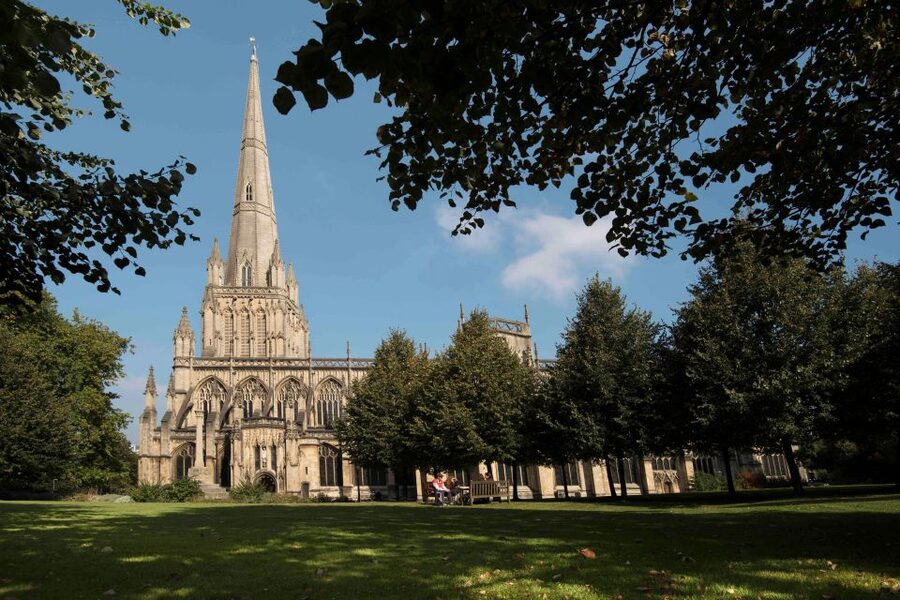
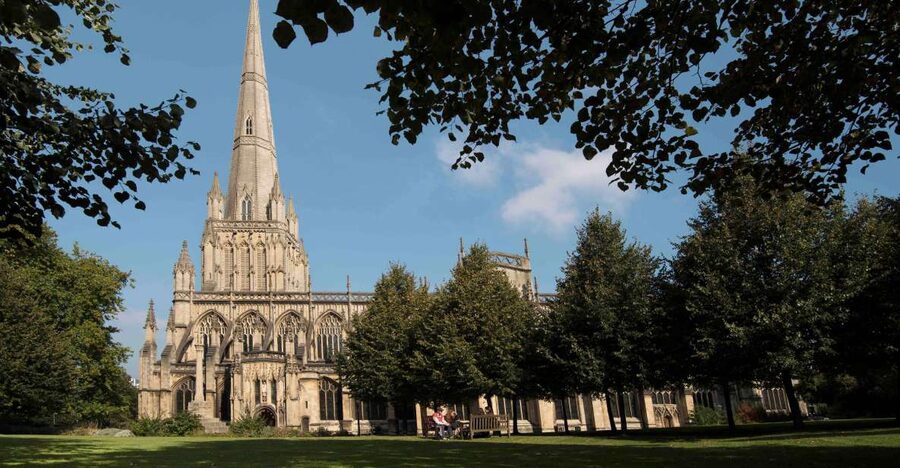
St Mary Redcliffe’s best surprise is not simply its huge Gothic interior. It is the chance to go where an ordinary church visit cannot take you, including the Chatterton Room, high above the North Porch, and to spot medieval marks that have been hiding in plain sight for centuries. The 90-minute tour also brings the building’s sea connections, merchant wealth, royal links, and artistic details into one clear story.
I like the way the tour mixes grand sights with small discoveries: the soaring roof with more than 1,200 carved bosses, then a merchant’s mark scratched into stone. I also like the guides’ personal touch. Bryan Anderson has demonstrated the organ for some groups, while Sarah and Paul have been praised for warm, lively explanations. The main consideration is the 75-step spiral staircase to the Chatterton Room. Most of the church is level and accessible, but that final room is not for everyone.
Key points at a glance
- The Chatterton Room: Reach one of the church’s special upper spaces by climbing a 75-step spiral staircase.
- Medieval marks: Look for graffiti and merchants’ marks left on the walls over roughly 800 years.
- A sea-linked treasure: See the whalebone connected with John Cabot’s 1497 voyage and a model of his ship, The Matthew.
- Striking architecture: Take in the vaulted ceiling, more than 1,200 roof bosses, and tall perpendicular Gothic pillars.
- Merchant power: Visit the polychrome tomb of Bristol mayor and MP William Canynges II and his wife Joan.
- Good value: A 90-minute guided tour costs $8 per person, with access to areas normally closed to the public.
Why this Bristol church deserves 90 minutes
St Mary Redcliffe was built and altered from the 12th through the 19th centuries. That long building story is part of its appeal. You are not looking at one neat, finished monument. You are seeing layers of parish life, medieval trade, later repairs, changing worship, and civic pride.
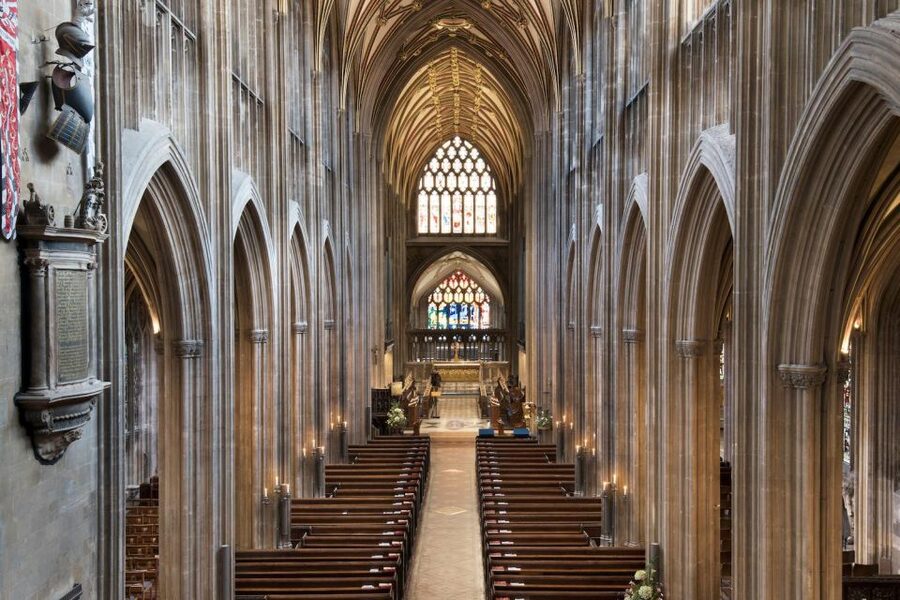
Queen Elizabeth I called it the fairest, goodliest and most famous parish church in England in 1574. You do not need to accept that royal verdict to appreciate the scale of the place. From the west end, the view through the nave toward the chancel and altar is genuinely impressive.
A self-guided visit can show you the broad outlines. A guide helps you connect the pieces. The church’s size, carved details, monuments, stained glass, and sea stories can otherwise feel like a long list. The tour gives them order and points out the details your eyes may miss.
At $8, the price is modest for a 90-minute visit with access to normally closed spaces. It is especially good value if you care about architecture, local history, church art, or unusual details rather than simply ticking off another Bristol building.
A few more things to do in Bristol worth a look
- Bristol: Blackbeard to Banksy Guided Walking Tour
★ 4.9 · 1,422 reviews - Bristol: Guided Ghost Tour
★ 4.8 · 193 reviews - Guided Walking Tour of Bristol Old City and Harbour
★ 5.0 · 166 reviews
Starting in the hexagonal North Porch
The tour begins inside the church near the main entrance and visitor’s desk, then moves to the unusual North Porch. This is not just an entrance hall. Its six-sided form dates from the 12th or 13th century, and it once served as the church’s main chapel. It also contained a shrine to the Virgin Mary.
That gives you an early lesson in how medieval churches worked. Spaces were not designed only for people to walk through. They held chapels, images, shrines, memorials, and acts of devotion. The North Porch has a more intimate scale than the vast church beyond it, so it makes a useful opening stop.
Outside, the guide draws your attention to the porch’s stone carvings. Their meaning is not always obvious, which is part of the fun. You can study the details while also getting a good view of the famous tower and spire.
This outside portion adds welcome variety to the tour. You are not standing in one place for an hour and a half. You move between close-up carving, broad exterior views, and the church interior.
John Cabot, The Matthew, and Bristol’s sea connections
Inside, the tour turns to Bristol’s maritime past. A 15th-century whalebone associated with John Cabot represents his 1497 voyage to North America aboard The Matthew. A model of the ship hangs above the main entrance.
The object is memorable because it links a large medieval church to the working world around it. Bristol’s prosperity did not come from church building alone. Merchants, ships, overseas trade, and civic power helped shape the city, and St Mary Redcliffe reflects that connection.
The whalebone is also the kind of object that benefits from a guide’s explanation. Without context, it may look like an odd relic. With the story attached, it becomes a marker of Bristol’s place in the age of exploration and of the church’s long relationship with merchants and seafarers.
You will hear about the church’s famous associations with royalty, merchants, artists, and poets throughout the tour. This is one of the strongest reasons to choose the guided option rather than simply walking in for a quick look.
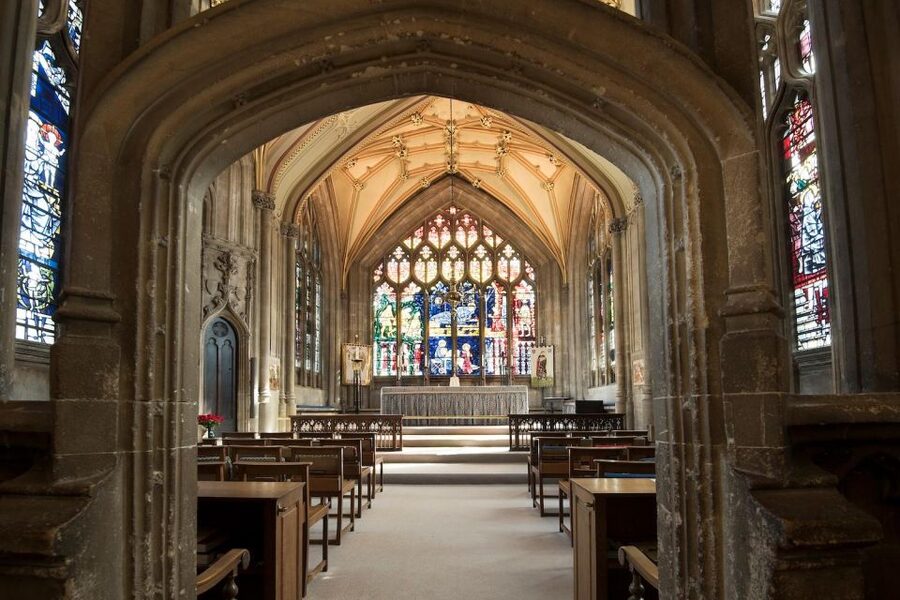
Medieval glass in St John’s Chapel
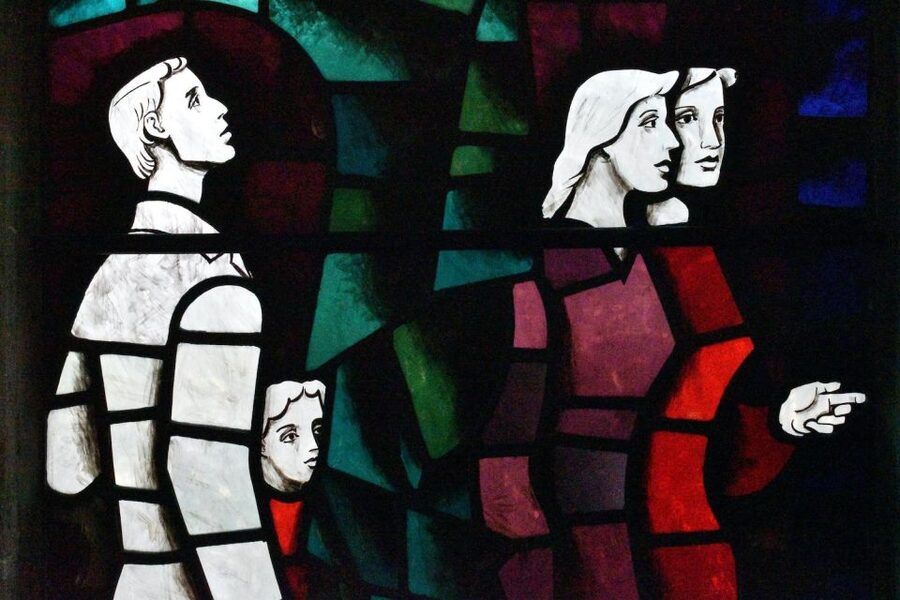
St John’s Chapel offers a quieter change of mood. Here you can see some of St Mary Redcliffe’s remaining medieval stained glass, dating from the 14th century.
The glass is valuable not only for its age but also because so much historic church decoration has been damaged, removed, or lost over time. The guide helps you place these surviving pieces within the church’s longer story.
Look closely rather than expecting one huge wall of glass. The pleasure is in the details, colors, figures, and the sense of continuity with the people who first saw these windows centuries ago. The chapel also gives the tour a chance to discuss medieval design without getting lost in technical terms.
The church contains later work as well, so you can compare periods rather than treating everything as medieval. That mix makes the visit more useful for anyone interested in how religious buildings change over time.
Same city, a very different afternoon:
- Blackbeard to Banksy – The Ultimate Walking Tour of Bristol
★ 5.0 · 1,961 reviews - Air Raid Shelter + St. Nicholas Market Walking Tour
★ 5.0 · 1,950 reviews - From Bristol: Stonehenge and Cotswold Villages Day Tour
★ 4.8 · 717 reviews - (9pm) The House Magicians Comedy & Magic Show – Smoke & Mirrors
★ 5.0 · 356 reviews
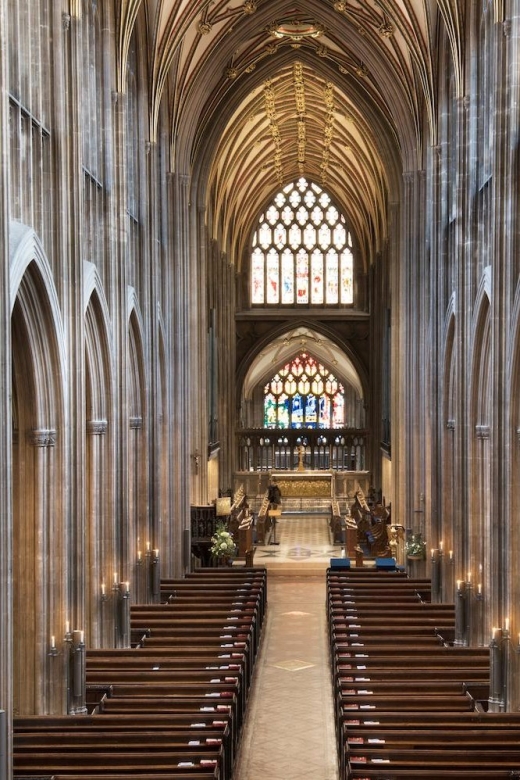
The great interior: 1,200 roof bosses and Gothic height
From the west end, stop and look down the full length of the church. The chancel and altar draw the eye forward, while the vaulted ceiling rises overhead. More than 1,200 individual roof bosses decorate the ceiling. These carved groin stones are easy to miss when you are focused on the floor-level monuments.
The pillars are another major sight. They form one of England’s finest examples of perpendicular Gothic architecture, with a strong vertical rhythm that makes the interior seem taller still.
This is where the guide’s pacing matters. You need a few quiet moments to look up, but you also need help knowing what deserves attention. Several people who took the tour found it so absorbing that they took few photographs during the visit. That is a useful tip: take quick pictures if you like, but give yourself time to listen and look.
The building’s scale can be a drawback for visitors who prefer small, intimate historic sites. There is a lot to absorb, and the ceiling details alone could occupy a separate visit. The guided format helps, but you will not see every carving in equal depth.
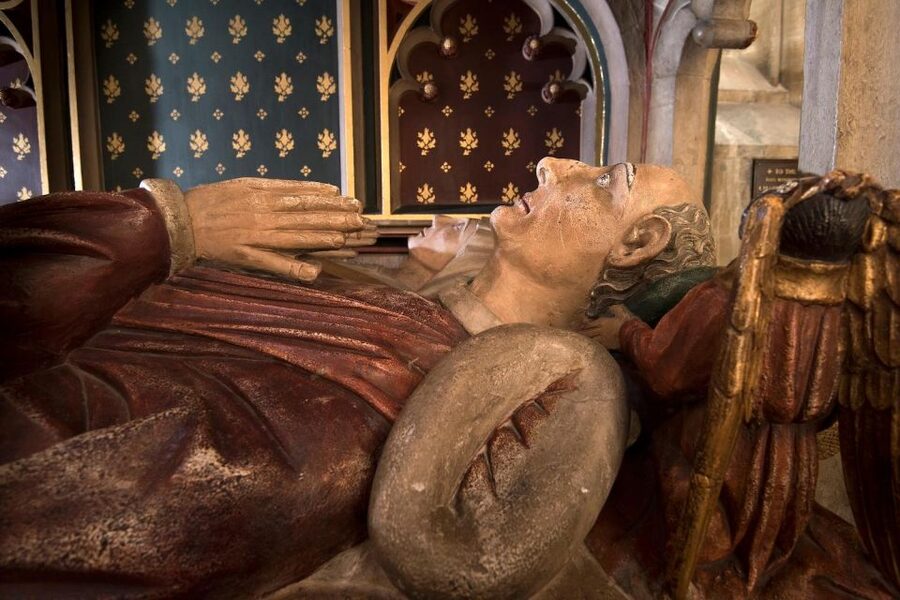
The mysterious knight in the North Transept
In the North Transept, you meet one of the church’s most intriguing objects: an effigy of an early medieval knight.
The figure has long been linked with Robert de Berkeley, who gave the church a water supply in 1190. Yet the identity is not certain. The effigy may even be older than the present church building.
That uncertainty makes the stop better, not worse. You are not being handed a tidy answer. Instead, you get a glimpse of how historians work with incomplete evidence, old traditions, and objects that have outlasted their original records.
For me, this is the sort of detail that makes a church tour memorable. The major architecture is easy to admire, but an unidentified knight invites questions. Who commissioned the monument? When was it made? Why was it preserved? The guide can point you toward those questions without pretending the evidence says more than it does.
The Lady Chapel and the Canynges tomb
The 14th-century Lady Chapel brings together a Gothic screen and stained glass designed by Harry Stammers in the early 1960s. It is a useful reminder that St Mary Redcliffe is not frozen in the Middle Ages. Later artists added their own work while responding to the building’s older forms.
The South Transept introduces Bristol’s merchant princes through the polychrome stone altar tomb of William Canynges II and his wife, Joan. Canynges was an MP and mayor of Bristol, and he is credited with rebuilding much of the church in the 15th century.
The rebuilding followed a disaster. Lightning struck the spire, which collapsed and destroyed part of the nave. That single event explains why the church is a record of both wealth and risk. Great buildings require money, labor, and civic backing, but they are also exposed to fire, weather, structural failure, and changing fortunes.
The tomb gives you a human focus for that story. Instead of hearing only about anonymous patrons, you see the memorial of a man tied to Bristol’s government, commerce, and church life.
Medieval graffiti and merchants’ marks
One of the tour’s most distinctive features is its attention to medieval graffiti. Marks and merchants’ signs have adorned the walls for about 800 years, but many are only now being noticed and recorded more closely.
This is not graffiti in the modern street-art sense. These marks can reveal ownership, trade, devotion, or simple acts of leaving a sign behind. They are small traces of ordinary people, which makes them different from grand tombs commissioned by the wealthy.
Your guide will point out examples as you move through the building. Bring your patience and look where you are directed. Some marks may be subtle rather than dramatic, and this part of the tour rewards close attention more than quick photography.
I especially like that these details widen the story beyond famous names. Kings, mayors, poets, and explorers matter, but a scratched mark can make the church feel connected to people whose names were never preserved.
Climbing to the Chatterton Room
The final special access stop is the Chatterton Room, above the North Porch. It is associated with Thomas Chatterton, the Bristol boy poet who lived from 1752 to 1770 and is widely recognized as the father of English Romantic literature.
Getting there requires a 75-step spiral staircase. This is the clearest practical limitation of the tour. If you cannot manage the stairs, you cannot visit the room, but you can still join the main tour. Most of the church is on a level route and can be accessed through the south entrance.
The upper room gives the experience a satisfying finish because it is both physical and historical. You leave the grand public spaces and reach a room with a more private connection to Bristol’s literary past.
The staircase may be uncomfortable for anyone with limited mobility, balance concerns, or a fear of confined steps. Tell the organizers in advance if you need to skip it. The rest of the tour remains worthwhile without that final room.
The guides and the human touch
The guide is a major part of the experience. Guides named Bryan, Sarah, and Paul have led tours, with each bringing a slightly different style.
Bryan Anderson has a background as a retired musical director, was chorally trained at a major cathedral, and is an organist. On some tours he has opened the large cope chest made inside the church in 1593 and demonstrated the organ. The organ has five keyboards, 71 stops, and 4,327 pipes, with some pipes reaching 34 feet. A demonstration is not listed as a guaranteed part of every tour, so treat it as a possible bonus rather than a promise.
Sarah has been praised for combining clear information with humor and energy. Paul is noted for explaining the church’s history in an easy-to-follow way. The common thread is personal attention rather than a rushed script.
This matters in a building with so many names, dates, and architectural terms. A good guide can turn the church from a grand shell into a place shaped by specific people and events.
Who should book this tour?
I would choose this tour if you want more than a quick look at a beautiful church. It suits people interested in medieval architecture, Bristol’s maritime connections, stained glass, local families, church monuments, or literary history.
It is also a good choice for repeat visitors. The church can look familiar after several visits, yet the graffiti, merchants’ marks, upper spaces, and historical connections give you fresh reasons to return. One useful approach is to revisit after the tour and spend extra time taking photographs.
Families with older children may enjoy the knight, whalebone, hidden room, and spiral staircase. Younger children may find 90 minutes of church history demanding, especially if they are not interested in architecture or stories about historical figures.
The tour is in English only. It lasts 90 minutes, so plan for a focused visit rather than a quick drop-in. The meeting point is inside near the main entrance and visitor’s desk.
Should you book St Mary Redcliffe Guided Tour?
At $8, yes, if the Chatterton staircase is manageable and you want the church to make sense as more than a grand interior. The price buys access to upper spaces, expert explanation, and a clear route through nearly eight centuries of art, building work, trade, and local memory.
Skip it if you only want a short independent visit or cannot follow an English-language tour. You can still see much of the main church on a level route, but the guided visit is the best way to find the medieval graffiti, understand the monuments, and connect the building with John Cabot, William Canynges II, and Thomas Chatterton.
FAQ
How long is the St Mary Redcliffe guided tour?
The guided walking tour lasts 90 minutes.
How much does the tour cost?
The price is $8 per person.
Where does the tour begin?
Meet inside the church near the main entrance and visitor’s desk. The guide will meet you there.
What language is the tour in?
The live tour is conducted in English.
Can I visit the Chatterton Room?
Yes, if you can climb the 75-step spiral staircase. The Chatterton Room is normally closed to the public and is part of the tour.
Is the whole tour accessible to people who cannot use stairs?
Most of the tour takes place in the main body of the church, which is accessible on a level route through the south entrance. Visitors who cannot climb the staircase can still join the main part of the tour but cannot visit the Chatterton Room.
What historical objects and features will I see?
The tour includes medieval stained glass, artwork, monuments, carvings, a mysterious knight effigy, medieval graffiti, merchants’ marks, John Cabot’s associated whalebone, and a model of The Matthew.
Can I cancel the booking?
You can cancel up to 24 hours in advance for a full refund. A reserve-now-and-pay-later option is also available.
Just added in Bristol
- West Country Games – the most popular group activity in the South West!★ 5.0 · 315 reviews
- Fun, Flexible Treasure Hunt Around Bristol with Cryptic Clues & Hidden Gems★ 5.0 · 101 reviews
- The House Magicians Comedy & Magic Show at Smoke & Mirrors Friday 8pm★ 5.0 · 202 reviews
- Guided Walking Tour Suspension Bridge Clifton Splendour & City.★ 5.0 · 100 reviews
- The Best of Bristol Bike Tour★ 5.0 · 39 reviews
- The House Magicians Comedy Magic Shows★ 5.0 · 263 reviews
- (9pm) The House Magicians Comedy & Magic Show – Smoke & Mirrors★ 5.0 · 356 reviews
- Bristol Paddleboarding Tour★ 5.0 · 92 reviews
Tours in Bristol, compared.
Blackbeard to Banksy – The Ultimate Walking Tour of Bristol
Read our review →
Air Raid Shelter + St. Nicholas Market Walking Tour
Read our review →

(9pm) The House Magicians Comedy & Magic Show – Smoke & Mirrors
Read our review →
West Country Games – the most popular group activity in the South West!
Read our review →
The House Magicians’ Comedy Magic Show at Smoke & Mirrors in Bristol (Sat 7pm)
Read our review →
Browse the lists this tour appears in